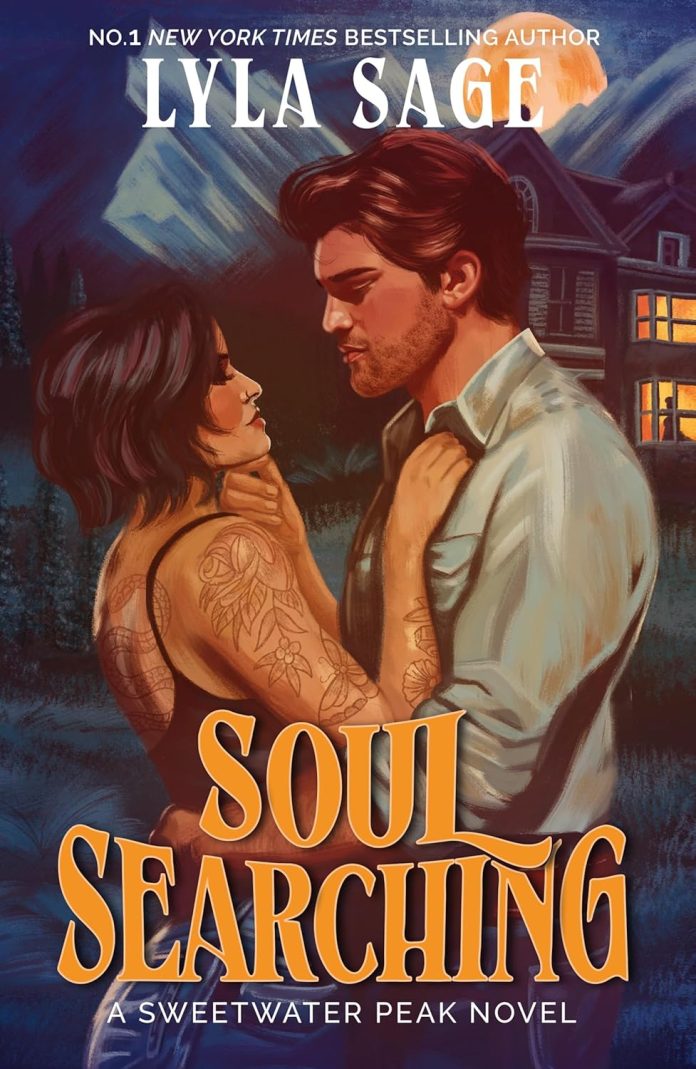
Lyla Sage ventures boldly into paranormal romance with Soul Searching, the first installment of her Sweetwater Peak series, and the result is a haunting departure from her beloved Rebel Blue Ranch books. Where Done and Dusted, Swift and Saddled, and their ranch-set companions gave us sun-soaked Wyoming cowboys, this new series plunges readers into a town where shadows linger, spirits speak, and healing happens in the most unexpected ways.
The story centers on Collins Cartwright, a photographer whose career has imploded and whose supernatural abilities have mysteriously gone silent. Returning to Sweetwater Peak, Wyoming—a town she swore she’d left behind—Collins discovers that coming home isn’t about admitting defeat. It’s about confronting the parts of yourself you’ve been running from. When she moves into a room above Brady Cooper’s upholstery shop, she encounters not just a brooding craftsman with secrets of his own, but a building full of restless spirits who refuse to be ignored.
The Architecture of Loneliness
What distinguishes Soul Searching from typical paranormal romance is how Sage uses the supernatural as a lens to examine isolation and disconnection. Collins’s ability to communicate with ghosts isn’t treated as a quirky superpower but as an intrinsic part of her identity—one she’s had to protect and hide throughout her adult life. When these abilities vanish just as her career crumbles, the loss cuts deeper than professional disappointment. She’s been severed from a fundamental piece of herself.
Brady Cooper arrives in Sweetwater Peak carrying his own ghosts, though his are entirely metaphorical. His move to this isolated mountain town wasn’t spontaneous adventure but calculated escape. Sage crafts him as a man who prizes stillness and stability, someone whose seven-year relationship ended in ways that left him questioning his own judgment. His upholstery work becomes a beautiful metaphor throughout the narrative—the patient restoration of worn things, the belief that what’s broken deserves careful attention rather than replacement.
The chemistry between Collins and Brady develops with refreshing authenticity. Their attraction builds through:
- Shared vulnerabilities revealed in careful increments
- Banter that balances humor with genuine emotional stakes
- Physical proximity that forces intimacy before either character is ready
- Moments of seeing and being seen that feel earned rather than manufactured
Sage understands that the most compelling romance springs from characters who challenge each other to grow. Collins pushes Brady to confront what he’s avoiding; Brady offers Collins the acceptance she’s never allowed herself to seek.
A Town Where Nothing Changes—Except Everything
Sweetwater Peak itself functions as more than setting. The town is a character with its own contradictions: timeless yet suffocating, safe yet isolating, beautiful yet haunted. Sage captures the particular claustrophobia of small-town life where everyone knows your history and nothing ever moves forward. The supporting cast enriches this atmosphere wonderfully. Clarke, Collins’s twin sister, carries the weight of being the daughter who stayed, the one who maintains family obligations while Collins chased freedom. Their relationship tension feels authentic—the specific hurt that only siblings can inflict and eventually heal.
The ghost characters deserve particular mention. Rather than serving as mere plot devices, spirits like Earnest and Adeline have agency and emotional complexity. The Lady in White legend, the building’s mischievous phantoms, and the various tethered souls throughout town create layers of supernatural intrigue without overwhelming the central romance. Sage treats the spirit realm with consistent internal logic, making Collins’s abilities feel grounded despite their fantastical nature.
Where the Light Struggles to Reach
Soul Searching succeeds brilliantly in its character work and atmospheric world-building, but the narrative occasionally stumbles under its own ambitions. The pacing fluctuates unevenly—early chapters establish mood with languid care, while later sections rush through revelations that deserved more development. The subplot involving the developer threatening family properties sometimes feels grafted on rather than organically integrated, though it provides necessary external conflict.
Some readers may find Collins’s internal monologue repetitive, particularly regarding her lost career and silenced abilities. While this repetition authentically captures the circular nature of depression and creative burnout, it can test patience in a narrative already thick with melancholy. The resolution of certain supernatural mysteries arrives with convenient timing that undercuts the careful tension Sage has built.
The book also wrestles with tonal balance. Sage’s signature warmth and humor appear in flashes—particularly in Brady and Collins’s domestic moments—but the overall atmosphere skews darker than her previous work. Readers expecting the sunlit charm of the Rebel Blue Ranch series may need to adjust expectations. This isn’t necessarily weakness, but it represents a significant departure that won’t appeal to all fans of Sage’s earlier books.
The Craft of Restoration
Where Soul Searching truly shines is in its exploration of what it means to rebuild yourself. Brady’s upholstery work provides the novel’s most resonant metaphor. Just as he strips furniture down to its frame, assesses the damage, and carefully rebuilds with new materials while honoring original construction, both protagonists must deconstruct their defenses and reconstruct their identities with newfound self-awareness.
Sage’s prose adapts beautifully to paranormal elements. Her descriptions of supernatural encounters balance the uncanny with the mundane—ghosts appear in casual conversation, spectral presences manifest through temperature shifts and peripheral vision, and the veil between worlds thins without melodrama. The romance scenes carry appropriate heat while maintaining emotional intimacy, and Sage earns every vulnerability her characters reveal.
For Readers Who Appreciate
This book will particularly resonate with readers who enjoy:
- Character-driven paranormal romance with emotional depth rather than action-heavy plots
- Small-town settings with gothic undertones
- Dual POV narratives that genuinely need both perspectives
- Romance that explores healing from burnout and heartbreak
- Supernatural elements treated with internal consistency and respect
If you enjoyed Soul Searching, consider exploring:
- The Invisible Life of Addie LaRue by V.E. Schwab for atmospheric supernatural storytelling
- Beach Read by Emily Henry for romance featuring creatives confronting career crises
- Midnight at the Bright Ideas Bookstore by Matthew Sullivan for mystery in a quirky small-town setting
- The Flatshare by Beth O’Leary for slow-burn roommate romance
- Mexican Gothic by Silvia Moreno-Garcia for gothic atmosphere in intimate settings
Final Thoughts
Soul Searching represents an ambitious evolution for Lyla Sage. While not without imperfections, it demonstrates her range as a storyteller and her willingness to challenge both herself and her readers. The book asks difficult questions about identity, belonging, and whether home can ever truly be left behind. It suggests that sometimes the things we run from are precisely what we need to face, and that healing requires accepting all parts of ourselves—even the shadowy ones.
For readers willing to embrace a slower, moodier romance with genuine supernatural stakes, Soul Searching offers rewards that linger long after the final page. It’s a promising beginning to a series with considerable potential, establishing a world where the paranormal and the personal intertwine with genuine heart. Sage proves she can write beyond one beloved setting, crafting a new fictional landscape where the road ends and the shadows begin—and where two lost souls might finally find each other in the dark.







