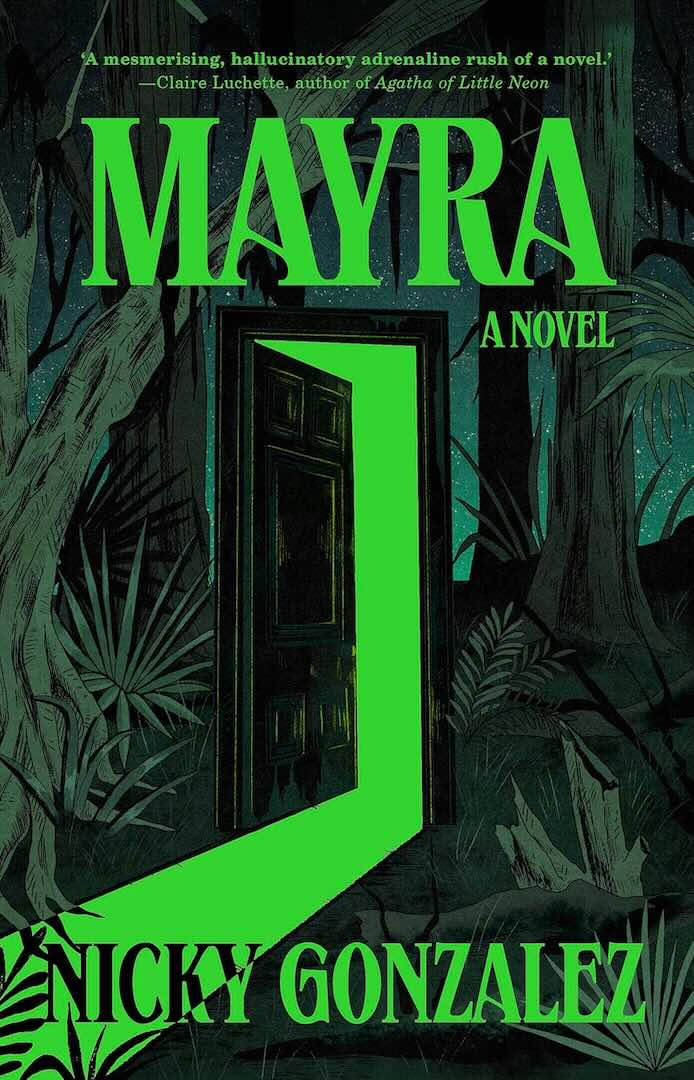
Nicky Gonzalez’s debut novel Mayra emerges like a fever dream from the sultry depths of Florida’s Everglades, crafting a psychological horror that feels both intimately familiar and utterly otherworldly. This is not your typical horror novel filled with jump scares and gore, but rather a slow-burning exploration of obsession, memory, and the terrifying ways we can lose ourselves in the name of love and belonging.
The story follows Ingrid, who receives an unexpected call from her childhood best friend Mayra after years of silence. Despite their complicated history, Ingrid accepts an invitation to spend a weekend at a mysterious house deep in the swamplands. What begins as a simple reunion quickly transforms into something far more sinister, as the house itself seems to feed on memory and identity, slowly erasing who its inhabitants once were.
The Seductive Pull of Nostalgia and Friendship
Gonzalez demonstrates remarkable skill in portraying the complex dynamics of female friendship, particularly the kind forged in adolescence that feels both electric and destructive. The relationship between Ingrid and Mayra pulses with an intensity that borders on obsession—Ingrid’s memories of their shared past are painted with the golden hue of nostalgia, yet tinged with the bitter recognition of power imbalances that defined their connection.
The author captures perfectly that universal experience of reconnecting with someone who once knew you intimately, only to discover how much you’ve both changed—or perhaps, how much you’ve forgotten about who you really were. Ingrid’s desperation to recapture their former closeness drives much of the novel’s tension, making her an unreliable narrator whose judgment becomes increasingly questionable as the story progresses.
Mayra herself is rendered with fascinating complexity—simultaneously magnetic and distant, familiar yet transformed. Gonzalez refuses to make her either purely victim or villain, instead presenting her as someone caught between worlds, unable to fully inhabit either her past or present identity.
A House That Breathes and Hungers
The true star of this novel is the house itself, which functions as both setting and antagonist. Gonzalez has created a structure that defies logic and physics—rooms that shouldn’t exist, staircases that lead nowhere, windows that open onto impossible views. The house operates like a living organism, constantly shifting and adapting to its inhabitants’ deepest needs and fears.
The author’s descriptions of the house’s labyrinthine interior create a sense of claustrophobia that gradually tightens around both characters and readers. There’s something deeply unsettling about rooms that change when you’re not looking, hallways that extend impossibly far, and furniture that seems to anticipate your needs. The house doesn’t just contain its inhabitants—it consumes them, feeding on their memories and identities until they become hollow shells of their former selves.
This supernatural element is handled with impressive restraint. Gonzalez never over-explains the house’s nature or origins, allowing its mystery to remain intact. The horror emerges not from understanding the house, but from witnessing its effects on those trapped within its walls.
The Evocative Power of Place and Memory
Gonzalez’s prose shines brightest when describing the Florida landscape, from the familiar streets of Hialeah to the alien beauty of the Everglades. The author clearly draws from personal experience, rendering the Cuban-American community of Hialeah with affection and authenticity. The contrast between the urban familiarity of their hometown and the primordial wilderness of the swamps serves to heighten the story’s sense of displacement and danger.
The flashbacks to Ingrid and Mayra’s adolescence are particularly well-crafted, capturing the intoxicating mix of rebellion, boredom, and desperate desire for connection that defines many teenage friendships. These scenes feel lived-in and genuine, grounding the supernatural elements in emotional reality.
Strengths That Elevate the Narrative
Psychological Complexity
The novel excels in its exploration of memory and identity. Gonzalez skillfully demonstrates how our sense of self can be more fragile than we imagine, particularly when confronted with versions of ourselves we’d rather forget.
Atmospheric Building
The slow accumulation of unease is masterfully handled. The author understands that true horror often lies in what’s left unsaid, in the spaces between words where dread can take root and flourish.
Cultural Authenticity
The portrayal of Cuban-American life in Miami feels genuine and unforced, adding depth and specificity to the characters’ backgrounds without falling into stereotype or exposition.
Areas Where the Novel Falters
While Mayra by Nicky Gonzalez succeeds on many levels, it’s not without its weaknesses. The pacing occasionally stumbles, particularly in the middle section where the house’s influence begins to take hold. Some readers may find the deliberate confusion of this portion frustrating rather than atmospheric, as the narrative becomes increasingly fragmented and difficult to follow.
The character of Benji, Mayra’s mysterious boyfriend, feels somewhat underdeveloped compared to the rich inner lives of the two women. While this may be intentional—he serves more as a catalyst than a fully realized character—his motivations and background remain frustratingly opaque.
Additionally, the novel’s ending, while thematically appropriate, may leave some readers wanting more concrete resolution. Gonzalez prioritizes emotional truth over plot clarity, which works for the story’s themes but may not satisfy all readers seeking clear answers.
A Promising Literary Voice
As a debut novel, Mayra announces Nicky Gonzalez as a writer to watch. The author demonstrates a sophisticated understanding of how horror can emerge from the most mundane aspects of human experience—friendship, nostalgia, the desire to belong. This isn’t Gonzalez’s first published work; her short fiction has appeared in prestigious venues like McSweeney’s Quarterly Concern and BOMB Magazine, and that experience shows in the novel’s polished prose and assured voice.
The book succeeds as both a supernatural thriller and a meditation on the ways we lose and find ourselves through our relationships with others. It’s a novel that trusts its readers to engage with ambiguity and complexity, offering rewards for those willing to surrender to its dreamlike logic.
Similar Reads for Gothic Horror Enthusiasts
Readers who appreciate Mayra’s blend of psychological complexity and supernatural atmosphere might also enjoy:
- Mexican Gothic by Silvia Moreno-Garcia – Another atmospheric novel featuring a mysterious house and questions of identity
- The Seven Husbands of Evelyn Hugo by Taylor Jenkins Reid – For complex female relationships and unreliable narration
- Beloved by Toni Morrison – A masterclass in how supernatural elements can illuminate deeper truths about trauma and memory
- The Starving Saints by Caitlin Starling – For claustrophobic settings that feel alive and threatening
- Plain Bad Heroines by Emily M. Danforth – Gothic atmosphere with strong focus on female relationships
Final Verdict
Mayra by Nicky Gonzalez is a haunting, beautifully written debut that lingers in the mind long after the final page. Gonzalez has crafted a novel that works on multiple levels—as a supernatural thriller, a meditation on friendship and memory, and a showcase for evocative, atmospheric prose. While it may not satisfy readers seeking conventional horror or tidy resolutions, those willing to embrace its dreamlike logic will find themselves rewarded with a unique and memorable reading experience.
This is literary horror at its finest, proving that the most effective scares often come not from external monsters, but from the recognition of what we might be willing to sacrifice—including ourselves—for love and acceptance.







