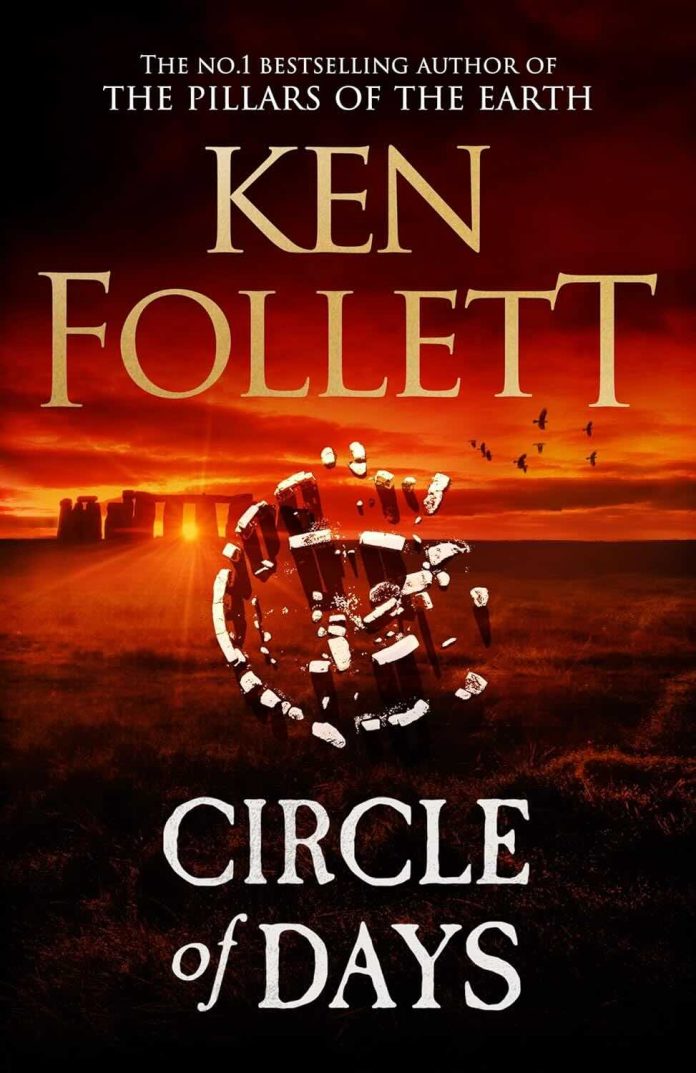
Ken Follett returns to his historical fiction roots with Circle of Days, delivering an extraordinary reimagining of humanity’s greatest prehistoric mystery: the construction of Stonehenge. This ambitious novel marks a bold departure from Follett’s medieval cathedrals and wartime dramas, transporting readers to Bronze Age Britain circa 2500 BCE, where the seeds of civilization are planted through vision, determination, and breathtaking human sacrifice.
Unlike the sweeping timelines of The Pillars of the Earth or the political machinations of A Column of Fire, Circle of Days focuses intensely on a single monumental project spanning roughly twenty-five years. The result is Follett’s most focused and emotionally resonant work in decades, proving that his storytelling mastery extends far beyond the familiar territories of medieval Europe and twentieth-century warfare.
Characters Carved in Stone
The novel’s greatest strength lies in its deeply human characters who breathe life into an era we can barely imagine. Seft, the talented flint miner fleeing his brutal family, emerges as an unexpectedly compelling protagonist. His journey from an abused young man seeking refuge to a master craftsman and devoted family man provides the emotional backbone of the narrative. Follett’s portrayal of Seft’s relationship with carpentry and engineering feels authentic—his innovative solutions to moving massive stones demonstrate both historical plausibility and individual ingenuity.
Joia, the visionary priestess whose childhood glimpse of a stone monument ignites a lifetime obsession, represents one of Follett’s most complex female characters. Her evolution from curious child to calculating leader showcases the author’s ability to balance feminine spirituality with pragmatic leadership. The romantic subplot between Joia and Dee adds contemporary relevance while remaining historically sensitive, demonstrating how human connections transcend temporal boundaries.
The supporting cast enriches the narrative considerably. Neen’s warmth and maternal instincts provide counterpoint to Joia’s driven ambition, while the various tribal leaders—from the reasonable Keff to the antagonistic Scagga—create realistic political tensions that drive conflict beyond mere engineering challenges.
Engineering Ancient Dreams
Follett’s technical descriptions of Bronze Age construction techniques represent exhaustive research translated into accessible prose. The detailed explanations of how massive sarsen stones were quarried, transported across dozens of miles using wooden rollers and human labor, then precisely erected using earthen ramps and rope systems, transform archaeological speculation into vivid reality.
The author’s background in creating The Pillars of the Earth clearly influenced his approach here. Just as that novel made cathedral construction comprehensible to modern readers, Circle of Days demystifies megalithic engineering while maintaining appropriate wonder at the achievement. The logistics of coordinating hundreds of volunteers, managing food supplies, and overcoming seasonal challenges receive equal attention to the physical construction, creating a holistic view of ancient project management.
However, some technical sequences occasionally overwhelm character development. Follett’s enthusiasm for Bronze Age engineering sometimes results in passages that read more like historical documentation than narrative fiction, potentially challenging readers seeking pure storytelling.
Tribal Politics and Timeless Conflicts
The novel’s political landscape feels remarkably contemporary despite its ancient setting. The tensions between herder, farmer, and woodland communities mirror modern resource conflicts, while Joia’s struggle to maintain political consensus for her ambitious project echoes contemporary challenges in large-scale infrastructure development.
Follett excels at portraying how individual ambitions intersect with community needs. The recurring question of whether investing years in monument construction serves practical purposes—or merely satisfies elite religious obsessions—adds philosophical depth to what could have been simple adventure narrative. The farmers’ violent opposition to the project provides genuine stakes, while the priests’ attempts to balance tradition with innovation create internal conflicts that drive character development.
The depiction of Bronze Age religious practices feels respectful and plausible. Rather than imposing modern spiritual concepts, Follett creates belief systems that emerge organically from agricultural cycles, astronomical observations, and community needs. The priestesses’ astronomical knowledge, demonstrated through their ability to predict seasonal changes and calculate calendar days, provides credible motivation for their social authority.
Love Across Millennia
The romantic elements enhance rather than dominate the narrative. Seft and Neen’s relationship develops naturally from tentative attraction to deep partnership, their love story grounded in shared values rather than dramatic passion. Their journey from young lovers to parents committed to leaving something permanent for their children provides emotional stakes that make the monument’s completion personally meaningful.
Joia’s relationship with Dee brings contemporary relevance without feeling anachronistic. Follett handles their same-sex romance with sensitivity, neither sensationalizing nor minimizing its significance within their ancient context. Their connection demonstrates how human emotions transcend historical periods while acknowledging the unique challenges they would have faced.
Narrative Structure and Pacing
Follett structures the novel around the monument’s construction phases, creating natural dramatic peaks as each massive stone is transported and erected. The twenty-five-year timeline, marked by seasonal cycles and generational changes, provides scope for character development while maintaining focus on the central goal.
The pacing occasionally suffers from Follett’s commitment to historical accuracy. Extended sequences detailing transportation logistics or tribal meetings sometimes stall narrative momentum, particularly in the middle sections where political negotiations replace physical action. However, these slower passages pay dividends during climactic construction scenes, where readers fully understand the challenges being overcome.
The novel’s conclusion, spanning multiple decades through brief passages, feels rushed compared to the detailed treatment of earlier construction phases. While this allows Follett to show the monument’s completion, it sacrifices the intimate character focus that distinguishes the earlier narrative.
Historical Authenticity and Imaginative License
Circle of Days demonstrates Follett’s meticulous research approach, evident in details ranging from Bronze Age tool-making techniques to prehistoric astronomical knowledge. The agricultural practices, social structures, and technological limitations all feel historically grounded, creating an immersive ancient world that avoids both romanticization and condescension.
The author takes necessary imaginative liberties while respecting archaeological evidence. His interpretation of Stonehenge’s builders as organized, sophisticated communities rather than primitive barbarians aligns with contemporary archaeological understanding while providing rich material for character development. The novel’s religious practices, political structures, and social customs feel plausible extrapolations from limited historical evidence.
Literary Craftsmanship
Follett’s prose adapts skillfully to the ancient setting, adopting slightly more formal rhythms that suggest antiquity without becoming archaic. His descriptions of the British landscape, from the vast Salisbury Plain to dense woodlands and rushing rivers, create vivid sense of place that grounds fantastical elements in geographic reality.
Character dialogue strikes an effective balance between accessibility and period authenticity. Follett avoids both modern colloquialisms and pseudo-archaic language, instead creating speech patterns that feel timeless while remaining comprehensible. The result is conversation that serves character development without breaking historical immersion.
Comparative Context
Among Follett’s historical fiction, Circle of Days most closely resembles The Pillars of the Earth in its focus on monumental construction and community dynamics. However, the prehistoric setting provides unique challenges and opportunities. Without written records, complex political institutions, or established architectural traditions, Follett must create believable social structures from archaeological speculation and anthropological inference.
Compared to other prehistoric fiction like Jean Auel’s Earth’s Children series or William Golding’s The Inheritors, Follett’s approach emphasizes technological achievement and social organization over survival struggles or spiritual mysticism. This choice makes Circle of Days more accessible to contemporary readers while potentially sacrificing some primal atmosphere.
Themes and Resonance
Beyond its surface adventure narrative, Circle of Days explores themes of legacy, sacrifice, and human ambition that resonate across millennia. The central question—whether constructing permanent monuments justifies years of community effort—speaks to contemporary debates about public works, cultural investment, and generational responsibility.
The novel’s portrayal of how individual vision can mobilize collective action feels particularly relevant to modern challenges requiring sustained cooperation. Joia’s ability to maintain enthusiasm for a decades-long project offers lessons about leadership, persistence, and the power of shared goals to unite diverse communities.
Minor Limitations
While Circle of Days succeeds admirably in most respects, some elements could benefit from refinement. The novel’s length occasionally works against narrative tension, with certain political negotiations and technical explanations extending beyond their dramatic usefulness. Some secondary characters, particularly among the farming communities, remain somewhat underdeveloped despite their importance to the central conflict.
The romance subplot, while sensitively handled, sometimes feels disconnected from the main construction narrative. Additionally, the novel’s conclusion rushes through the monument’s final phases, sacrificing character development for historical completion.
Recommendation and Verdict
Circle of Days represents Ken Follett at his most ambitious and successful, combining meticulous historical research with compelling character development and thrilling adventure narrative. Readers who enjoyed The Pillars of the Earth will find familiar pleasures in watching ordinary people accomplish extraordinary things through determination and cooperation.
The novel particularly rewards readers interested in prehistory, ancient engineering, or the development of human civilization. Follett’s ability to make Bronze Age Britain feel immediate and relevant demonstrates his continued mastery of historical fiction’s fundamental challenge: making the past feel alive.
For those seeking epic historical fiction that combines adventure with authenticity, emotional depth with technical fascination, Circle of Days delivers magnificently. It stands as both an entertaining adventure and a thoughtful meditation on humanity’s drive to create something lasting—a theme as relevant today as it was five thousand years ago.
Similar Reads to Explore
Readers captivated by Circle of Days should consider:
- The Pillars of the Earth by Ken Follett – The author’s masterpiece about medieval cathedral construction
- Shaman by Kim Stanley Robinson – Paleolithic fiction exploring early human consciousness
- The Inheritors by William Golding – A haunting tale of Neanderthal extinction
- Reindeer Moon by Elizabeth Marshall Thomas – Stone Age life portrayed with anthropological accuracy
- The Clan of the Cave Bear by Jean M. Auel – Prehistoric adventure focusing on survival and adaptation
Circle of Days confirms Ken Follett’s position among historical fiction’s premier practitioners while proving that even our most ancient mysteries can yield fresh, compelling narratives in skilled hands.