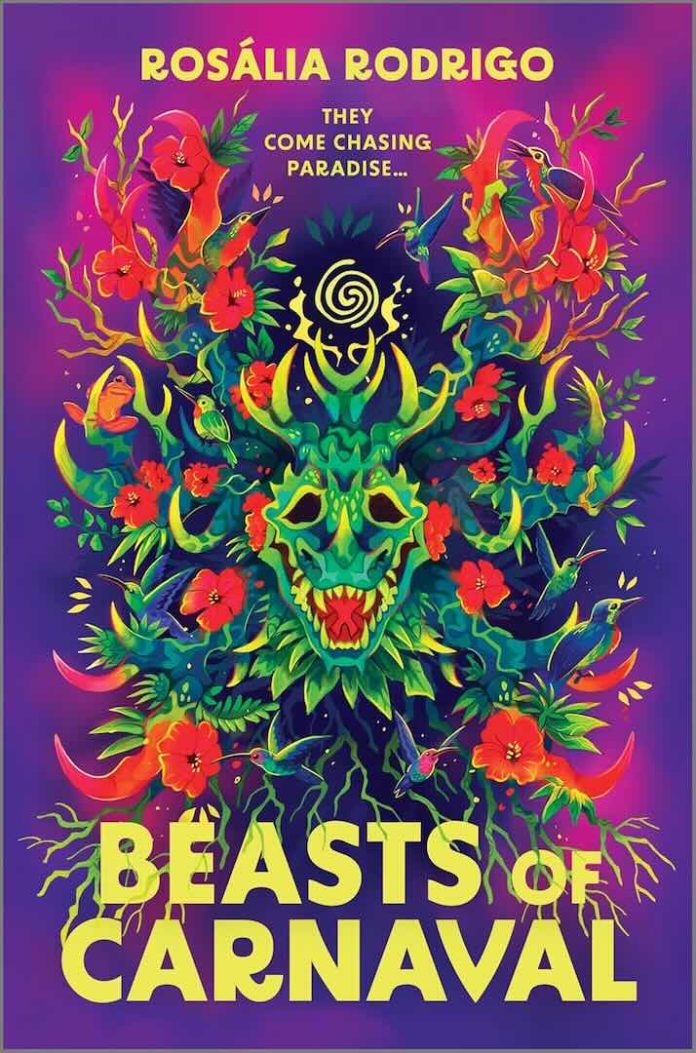
Rosália Rodrigo’s debut novel Beasts of Carnaval arrives like a hurricane—beautiful, devastating, and impossible to ignore. Set against the backdrop of a mysterious Caribbean island where colonial elites indulge in hedonistic revelry while indigenous spirits stir beneath the surface, this genre-defying work weaves together fantasy, horror, and historical reimagining with the precision of a master weaver. Yet like the island paradise it depicts, the novel’s glittering exterior conceals profound depths that reward careful examination.
The Seductive Trap of Paradise
The story follows Sofía, a recently freed mestiza woman searching for her twin brother Sol on the enigmatic Isla Bestia, home to el Carnaval de Bestias—an exclusive carnival where wealthy patrons lose themselves in endless nights of revelry. Accompanied by her privileged friend Adelina, whose father vanished alongside Sol five years prior, Sofía navigates a world where vejigantes (traditional carnival demons) serve wine that tastes too sweet and where guests find themselves reluctant to ever leave.
Rodrigo’s greatest triumph lies in her creation of Carnaval itself as both setting and antagonist. The island resort functions as a honey trap, its supernatural allure designed to keep colonial oppressors distracted while indigenous forces gather strength. The author excels at building an atmosphere of creeping dread beneath the surface glamour—every sumptuous feast and spectacular performance carries an undertone of something fundamentally wrong. When Sofía observes that she “preferred the honesty of those masks to the ones the patrons wore outside of Carnaval,” Rodrigo reveals her central conceit: that the monstrous masks worn at Carnaval are more truthful than the civilized faces colonizers present to the world.
The pacing in these early sections deserves particular praise. Rodrigo allows tension to build gradually, letting readers become as entranced by Carnaval’s offerings as her characters. The mounting sense of unease—from Adelina’s growing addiction to gambling to the mysterious vejigantes who never speak—creates a masterful slow burn that keeps pages turning.
Cultural Reclamation as Revolutionary Act
Where Beasts of Carnaval transcends mere entertainment is in its unflinching examination of cultural survival and resistance. The revelation that the island harbors Coaybay—a hidden community of the Taike’ri, descendants of the indigenous people thought extinct—transforms the narrative from supernatural thriller to powerful meditation on colonial trauma and healing.
Rodrigo demonstrates remarkable research depth in her portrayal of Taike’ri culture. The author draws from historical sources including Sebastián Robiou Lamarche’s work on Taíno mythology and José Juan Arrom’s ethnographic studies, weaving authentic details of language, spirituality, and social structure into her fictional world. The ceremony where initiates drink from the sacred ceiba tree’s sap and claim new names—abandoning those given by colonizers—pulses with genuine emotional weight.
The magic system, rooted in the goddess Atabey’s awakening consciousness, serves as both plot device and metaphor for decolonization. When Sofía experiences psychic connections with other Taike’ri through the ceiba flower’s influence, Rodrigo literalizes the concept of collective healing and shared cultural memory. These sequences, while occasionally overwhelming in their sensory density, effectively convey the disorienting experience of reconnecting with suppressed heritage.
However, the author occasionally struggles with balancing mythological exposition and narrative momentum. Dense passages explaining Taike’ri cosmology, while culturally important, sometimes slow the story’s pace. Readers seeking pure escapist fantasy may find themselves mired in worthy but lecture-heavy sections about colonial history and indigenous resistance.
Character Complexity and Relationship Dynamics
Sofía emerges as a compelling protagonist whose scholarly pragmatism masks deep emotional wounds. Her journey from cynical survivor to cultural bridge-builder feels earned, particularly in scenes where she grapples with how much of her Taike’ri identity she’s “allowed” to claim as a person of mixed ancestry. Rodrigo captures the painful reality of cultural reclamation with nuance and sensitivity.
The supporting cast proves more uneven. Adelina’s characterization suffers from inconsistency—she oscillates between brilliant inventor and gambling-addicted socialite without sufficient connective tissue. Her friendship with Sofía, supposedly the emotional core of the story, relies too heavily on implied history rather than demonstrated chemistry. Their relationship dynamic reads as more functional than deeply felt, which undermines key emotional beats.
Sol’s arc as the reluctant revolutionary proves more successful. His transformation from ashamed servant to proud Taike’ri warrior provides satisfying character growth, though his initial coldness toward Sofía strains credibility given their supposedly close twin bond.
The Cacika Kaona stands out as the novel’s most magnetic presence. Her portrayal of indigenous leadership—fierce yet calculated, vengeful yet protective—avoids both noble savage stereotypes and one-dimensional villainy. Her final sacrifice carries genuine pathos, though Rodrigo perhaps telegraphs this outcome too obviously.
The Weight of Righteous Fury
Rodrigo doesn’t shy away from the moral complexity of her premise. The Taike’ri’s plan to use Carnaval as a weapon against colonizers raises uncomfortable questions about collective punishment and the ethics of resistance. When the island-goddess Atabey awakens to reclaim her stolen children, the resulting destruction affects innocent servants alongside guilty masters.
The author handles these themes with appropriate gravity, never suggesting that violence is the only path to liberation while acknowledging the historical reality that “for a people colonized, every path to liberation demands a price.” The climactic destruction of Carnaval manages to feel both cathartic and tragic—a necessary purging that still carries tremendous cost.
Yet here the novel occasionally stumbles into heavy-handedness. Some passages read more like political treatise than narrative fiction, particularly when characters deliver speeches about colonial oppression. While the anger is justified and the history important, these moments disrupt the story’s emotional flow.
Language as Living Heritage
Rodrigo’s prose style deserves special recognition for its deliberate code-switching between English and Spanish/Taíno terms. Rather than treating non-English words as exotic decoration, she integrates them naturally into the narrative flow, reflecting how multilingual communities actually communicate. Terms like “vejigante,” “zemí,” and “batú” become part of the reader’s vocabulary through context and repetition.
The author’s background in immersive storytelling for museums and theme parks shows in her vivid sensory descriptions. Carnaval feels authentically overwhelming—the clash of music, swirl of costumes, and press of bodies create visceral atmosphere. However, this strength occasionally becomes a weakness when descriptive passages overshadow character development or plot advancement.
A Promising but Imperfect Debut
Beasts of Carnaval succeeds brilliantly as cultural reclamation project and historical intervention, moderately as horror-fantasy, and somewhat less effectively as character-driven fiction. Rodrigo demonstrates remarkable ambition in tackling themes of colonialism, indigenous resistance, and cultural survival through a supernatural lens. Her commitment to authentic representation and thorough research elevates the work above typical fantasy fare.
The novel’s flaws—uneven pacing, inconsistent characterization, occasional didactic tone—feel like growing pains of a talented author finding her voice. When Rodrigo trusts her story and characters rather than explaining everything, the narrative soars. The final image of Sofía lifting her pen to write, having inherited the role of cultural chronicler, provides a satisfying conclusion that promises future stories from this richly imagined world.
For readers seeking fantasy that grapples seriously with real-world issues, Beasts of Carnaval offers rewards worth the investment. The book demands active engagement rather than passive consumption, asking readers to confront uncomfortable truths about colonial legacy while immersing them in lush Caribbean mythology.
The Broader Literary Landscape
Beasts of Carnaval joins a growing movement of speculative fiction by authors of Caribbean and Latin American descent reclaiming their cultural narratives. The work shares DNA with Nalo Hopkinson’s Midnight Robber and The Salt Roads in its unflinching examination of colonial trauma through fantastical elements. Like Silvia Moreno-Garcia’s Mexican Gothic, it uses horror tropes to explore historical injustices, though Rodrigo’s approach feels more optimistic about possibilities for healing and resistance.
The novel also resonates with recent works exploring indigenous futurisms, such as Rebecca Roanhorse’s Black Sun series, though Rodrigo focuses more explicitly on cultural survival strategies in colonial contexts. Where it differs from these comparisons is in its specific focus on Caribbean carnival traditions as vehicles for resistance—a relatively unexplored territory in fantasy literature.
Similar Reads Worth Exploring
- The Goblin Emperor by Katherine Addison – For political intrigue with themes of cultural outsiders navigating hostile courts
- The Poppy War trilogy by R.F. Kuang – For unflinching examination of colonialism’s costs through fantasy warfare
- The Water Will Come by Jeff Goodell – While non-fiction, provides context for climate themes underlying the magical realism
- Gods of Jade and Shadow by Silvia Moreno-Garcia – For Mexican mythology woven into Jazz Age setting with similar cultural reclamation themes
- Trail of Lightning by Rebecca Roanhorse – For indigenous perspectives in speculative fiction dealing with cultural survival
Final Verdict
Beasts of Carnaval announces Rosália Rodrigo as a significant new voice in speculative fiction. While not without its stumbles, the novel’s passionate commitment to telling suppressed stories and its innovative blend of carnival tradition with supernatural horror mark it as essential reading for anyone interested in how fantasy can illuminate real-world injustices.
The book succeeds most powerfully as an act of cultural preservation disguised as entertainment. In giving voice to the Taike’ri and their struggle for recognition, Rodrigo performs the same function as her protagonist Sofía—keeping important stories alive through the act of telling them. That alone makes this ambitious debut worth celebrating, even as we eagerly await the more polished works this talented author will surely produce.