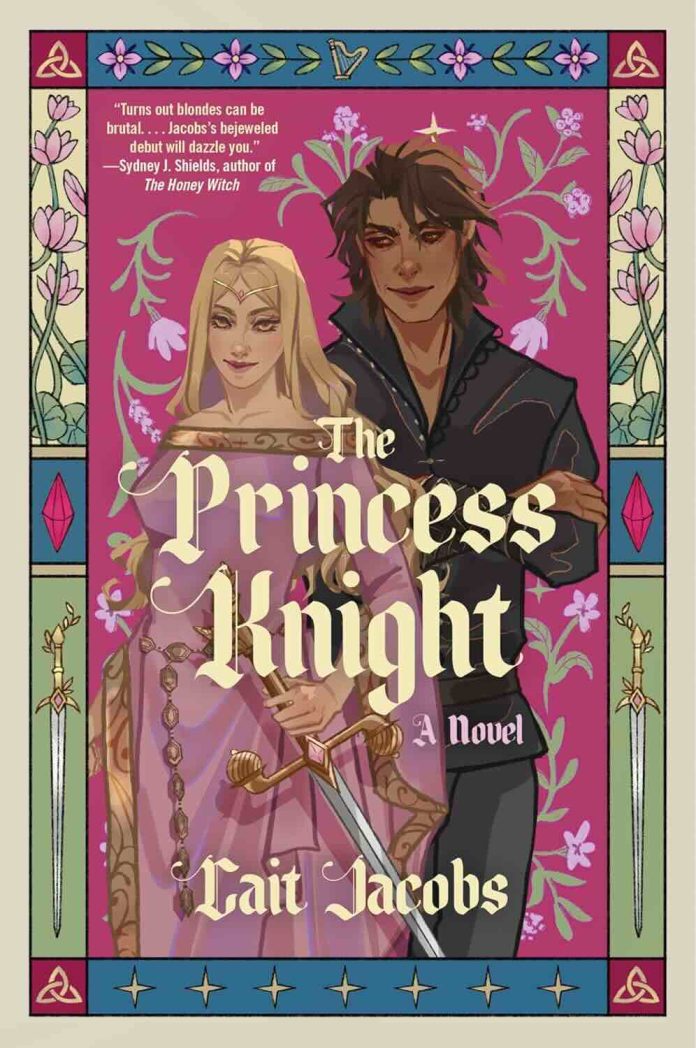
In a fantasy landscape saturated with brooding anti-heroes and grimdark narratives, Cait Jacobs’s debut novel The Princess Knight arrives like a breath of fresh air—or perhaps more aptly, like sunshine breaking through storm clouds. This delightful romantasy manages to be both effervescent and substantial, delivering a story that sparkles with wit while never shying away from the weight of duty, sacrifice, and self-discovery.
Princess Clíodhna (Clía) of Álainndore faces every young woman’s nightmare: public rejection. When Prince Domhnall of Scáilca refuses to propose despite years of expectation, Clía doesn’t retreat to her chambers to sulk. Instead, she hatches an audacious plan to follow him to Caisleán Cósta, the realm’s most brutal military academy, determined to prove she’s warrior queen material. It’s a premise that could easily veer into absurdity, but Jacobs grounds it in genuine emotional stakes and political necessity.
Character Depth Beyond the Crown
Clía: More Than Royal Window Dressing
What sets Clía apart from typical fantasy princesses is her delicious complexity. She’s neither helplessly naive nor implausibly competent—instead, she’s authentically messy in the way real people are. Jacobs crafts a protagonist who can deliver cutting one-liners with aristocratic precision while fumbling through sword forms with endearing determination. The author’s background as a BookTok creator shines through in her understanding of what makes characters genuinely compelling rather than merely likeable.
Clía’s journey from pampered princess to competent warrior feels earned rather than ordained. Her struggles with the academy’s brutal training regimen ring true, and her gradual development of actual combat skills (rather than miraculous overnight transformation) demonstrates Jacobs’s commitment to character growth over convenient plotting. The princess’s internal conflict between duty to her kingdom and her growing feelings creates genuine tension that propels the narrative forward.
Ronan: The Reluctant Mentor with Hidden Depths
Captain Ronan emerges as far more than the typical “gruff trainer with a heart of gold” archetype. His backstory as someone who fought for his place at the academy creates natural friction with Clía’s inherited privilege, yet Jacobs avoids reducing this to simple class antagonism. Instead, she explores how both characters must navigate their circumstances—Clía learning to earn respect rather than expect it, Ronan learning that privilege doesn’t negate determination.
The slow-burn romance between Clía and Ronan develops with satisfying authenticity. Their banter crackles with genuine chemistry, and their training sessions become increasingly charged as mutual respect transforms into attraction. Jacobs wisely allows their relationship to develop through shared challenges rather than manufactured romantic moments.
World-Building That Enchants Without Overwhelming
Celtic-Inspired Fantasy Done Right
Jacobs creates a richly textured world in the five kingdoms of Inismian without falling into the trap of endless exposition. The Celtic-influenced naming conventions and mythology feel organic rather than appropriative, woven naturally into the story’s fabric. The Draoi (druidic order), the Gifts of the Treibh Anam (magical artifacts of the gods), and the political tensions between kingdoms create a believable fantasy landscape with genuine stakes.
The mythology surrounding Ríoghain’s Jewel and the other divine gifts provides compelling backdrop without overwhelming the character-driven plot. The mysterious Ionróiran threats and the academy’s connection to ancient powers hint at larger conflicts while keeping the focus firmly on Clía’s personal journey.
Caisleán Cósta: A Military Academy with Bite
The military academy setting serves as more than mere backdrop—it becomes a character in its own right. General Kordislaen’s reputation for brutal training feels authentic, and the academy’s traditions and hierarchies create natural conflict and camaraderie. The various trials, from forest expeditions to combat training, provide excellent opportunities for character development and romantic tension.
Romance That Sizzles and Satisfies
The romantic elements demonstrate Jacobs’s understanding of what contemporary readers crave. The chemistry between Clía and Ronan builds naturally through shared challenges, mutual respect, and genuine emotional connection. Their stolen moments—training sessions that become too intimate, conversations that reveal vulnerability—create anticipation without resorting to contrived romantic beats.
The love triangle with Domhnall adds complexity without feeling forced. Rather than a simple choice between two suitors, it represents Clía’s choice between duty and desire, between the life planned for her and the life she’s discovering she wants. Jacobs handles this with nuance, avoiding the trap of making one option obviously superior.
Pacing and Plot: A Well-Calibrated Adventure
Strengths in Structure
Jacobs demonstrates impressive structural instincts for a debut novelist. The pacing moves briskly without feeling rushed, allowing time for character development while maintaining momentum. The academy setting provides natural episodic structure—training sessions, lessons, trials—that keeps readers engaged while building toward larger conflicts.
The integration of the broader political plot (threats from Tinelann, the search for ancient artifacts) with Clía’s personal journey creates satisfying layers without confusion. The mysterious threats and political machinations provide stakes beyond romance while never overshadowing the character development.
Minor Pacing Concerns
Occasionally, the balance tips slightly too far toward romance at the expense of world-building depth. Some readers may find themselves craving more exploration of the Draoi magic system or the specifics of the Ionróiran threat. A few training sequences feel repetitive, though this mirrors the realistic nature of skill development.
Writing Style: Accessible Excellence
Jacobs writes with a confidence that belies her debut status. Her prose strikes an excellent balance between accessible and sophisticated, never talking down to readers while remaining highly readable. The dialogue sparkles with wit and authenticity—characters speak like real people rather than fantasy archetypes spouting exposition.
The author’s ability to weave humor throughout serious moments without undermining tension demonstrates real skill. Clía’s internal monologue frequently provides comic relief without undercutting her genuine struggles, and the banter between characters feels natural rather than forced.
Cultural Representation and Modern Sensibilities
Contemporary Themes in Fantasy Dress
The Princess Knight succeeds in addressing contemporary concerns about agency, self-determination, and the pressure to conform to societal expectations without feeling anachronistic. Clía’s struggle to prove herself worthy on her own terms rather than through marriage resonates strongly with modern readers while fitting naturally within the fantasy setting.
The book’s treatment of duty versus desire, the value of earned versus inherited respect, and the complexity of navigating expectation versus authenticity feels remarkably current without sacrificing fantasy immersion.
Critical Assessment: What Works and What Could Improve
Undeniable Strengths
- Character Chemistry: The relationships feel authentic and earn their emotional beats
- Humor Integration: Comedy enhances rather than undercuts dramatic moments
- Pacing: Excellent balance of action, romance, and character development
- Accessibility: Complex themes presented without sacrificing readability
- World-building Restraint: Rich setting without overwhelming exposition
Areas for Growth
- Secondary Character Development: Some supporting characters could use more depth
- Magic System Clarity: The Draoi powers and divine artifacts merit more exploration
- Political Complexity: The broader conflicts sometimes feel simplified
- Romantic Resolution: While satisfying, the romance concludes perhaps too neatly
The Verdict: A Crown Jewel Among Debuts
The Princess Knight establishes Cait Jacobs as a significant new voice in romantasy. While not groundbreaking in premise, the execution demonstrates remarkable skill and understanding of what makes fantasy romance genuinely compelling. The book delivers on its promises—sparkling romance, engaging adventure, and a heroine worth rooting for—while avoiding the common pitfalls of debut novels.
This is comfort reading at its finest: a book that makes you smile while delivering genuine emotional stakes and character growth. Jacobs has crafted something genuinely special here—a story that honors classic fantasy tropes while breathing fresh life into them.
For readers seeking escapist fantasy with substance, romantic tension that actually builds, and a protagonist who earns her victories, The Princess Knight delivers magnificently. It’s the kind of book that reminds you why you fell in love with fantasy in the first place.
Similar Books You’ll Love
If The Princess Knight captured your heart, consider these equally enchanting reads:
- The Priory of the Orange Tree by Samantha Shannon – Epic fantasy with strong female characters and political intrigue
- The Ten Thousand Doors of January by Alix E. Harrow – Portal fantasy with beautiful prose and romantic elements
- The Bear and the Nightingale by Katherine Arden – Slavic-inspired fantasy with folklore elements
- Red Queen by Victoria Aveyard – YA fantasy with political maneuvering and romantic tension
- An Unkindness of Magicians by Kat Howard – Urban fantasy with magic competitions and romance
- The Invisible Life of Addie LaRue by V.E. Schwab – Romantic fantasy spanning centuries with beautiful prose
The Princess Knight stands as proof that debut novels can achieve remarkable sophistication while remaining utterly enjoyable. Jacobs has created something truly special—a fantasy that sparkles with joy while never forgetting that the best adventures are always, ultimately, about becoming who you’re meant to be.







