From the moment a reader picks up their next book, they’re unconsciously searching for familiar patterns that will guide them through the story. These patterns, known as book tropes, are the building blocks of compelling narratives that have captivated readers for centuries. Whether it’s the heart-pounding tension of enemies falling in love or the epic journey of an unlikely hero, book tropes serve as the secret language between authors and readers, creating instant recognition and emotional connection.
Book tropes are recurring themes, character types, plot devices, or narrative structures that appear across multiple works of literature. Far from being mere clichés, these popular narrative patterns represent the fundamental storytelling elements that resonate deeply with human psychology and experience. They’re the familiar frameworks that allow readers to quickly understand character dynamics, anticipate plot developments, and emotionally invest in stories.
Understanding book tropes isn’t just academic curiosity—it’s the key to unlocking why certain stories captivate us while others fall flat. For readers, recognizing common book tropes helps in finding new books that match their preferences. For writers, mastering these patterns provides powerful tools for crafting compelling narratives that speak to universal human experiences.
The Psychology Behind Book Tropes
The human brain is wired to recognize patterns, and book tropes tap into this fundamental cognitive process. When readers encounter familiar popular narrative patterns, their minds quickly categorize and process the information, allowing them to focus on character development, emotional depth, and unique twists within established frameworks.
Research in narrative psychology suggests that book tropes serve as cognitive shortcuts that help readers navigate complex stories. These patterns activate specific emotional responses and expectations, creating a psychological contract between author and reader. The comfort of familiarity combined with the excitement of variation creates the perfect reading experience.
Popular book tropes also function as cultural touchstones, carrying shared meanings and associations that transcend individual works. When readers encounter the “enemies to lovers” trope, they bring with them expectations and emotional memories from every other story they’ve experienced with this pattern, enriching their current reading experience.
Major Trope Categories by Genre
Romance Tropes
Romance book tropes focus on relationship dynamics and emotional development between characters. These popular narrative patterns explore different ways people can fall in love, from adversaries who discover mutual attraction to friends who realize their deeper feelings. Romance tropes provide the emotional scaffolding that supports character growth and relationship development.
Fantasy Tropes
Fantasy book tropes center on magical worlds, epic quests, and supernatural elements. These patterns often involve ordinary individuals discovering extraordinary destinies or navigating worlds where magic and reality intertwine. Fantasy tropes create familiar frameworks for exploring themes of good versus evil, personal growth, and the hero’s journey.
Mystery and Thriller Tropes
Mystery book tropes revolve around puzzles, investigations, and the gradual revelation of hidden truths. These common book tropes create suspense through misdirection, red herrings, and the systematic uncovering of clues. They engage readers’ analytical minds while building tension through uncertainty and revelation.
Science Fiction Tropes
Science fiction book tropes explore technological advancement, future societies, and the consequences of scientific progress. These patterns examine humanity’s relationship with technology, time, and space, often serving as metaphors for contemporary social and ethical issues.
Young Adult Tropes
YA book tropes focus on coming-of-age experiences, identity formation, and the transition from adolescence to adulthood. These patterns often feature young protagonists navigating complex social dynamics, discovering their place in the world, and forming meaningful relationships outside their family structures.
Top 10 Most Popular Book Tropes Across All Genres
Based on reader preferences and frequency in contemporary literature, here are the most beloved popular book tropes that consistently capture readers’ hearts:
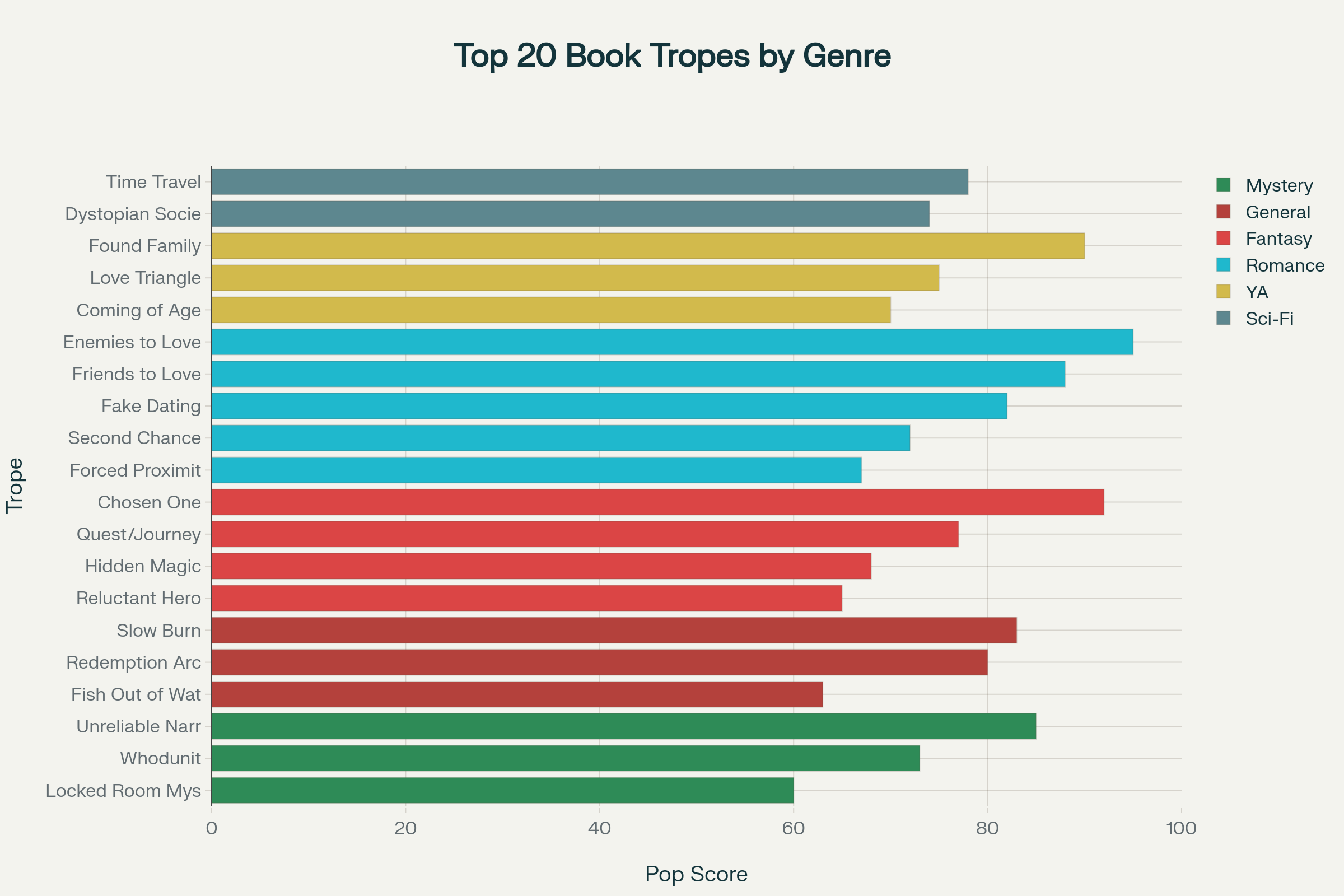
- Enemies to Lovers – The most popular of all book tropes, this pattern transforms antagonism into romance through character development and mutual understanding. Examples include “Pride and Prejudice” by Jane Austen and “The Hating Game” by Sally Thorne.
- Chosen One – This fantasy staple features an unlikely hero destined to save the world, seen in classics like “Harry Potter” and “The Lord of the Rings.”
- Found Family – Characters form deep bonds with non-biological family members, creating emotional connections that transcend blood relations.
- Friends to Lovers – Platonic relationships evolve into romance, building on established trust and compatibility.
- Unreliable Narrator – The storyteller’s credibility is questionable, adding layers of mystery and forcing readers to question everything.
- Slow Burn – Romantic or emotional development unfolds gradually, building anticipation and deeper investment.
- Fake Dating – Characters pretend to be in a relationship, leading to real feelings and authentic connections.
- Redemption Arc – Characters overcome past mistakes or character flaws through growth and change.
- Time Travel – Characters navigate different time periods, exploring themes of cause and effect, second chances, and historical what-ifs.
- Quest/Journey – Characters embark on physical or metaphorical journeys that transform them through challenges and discoveries.
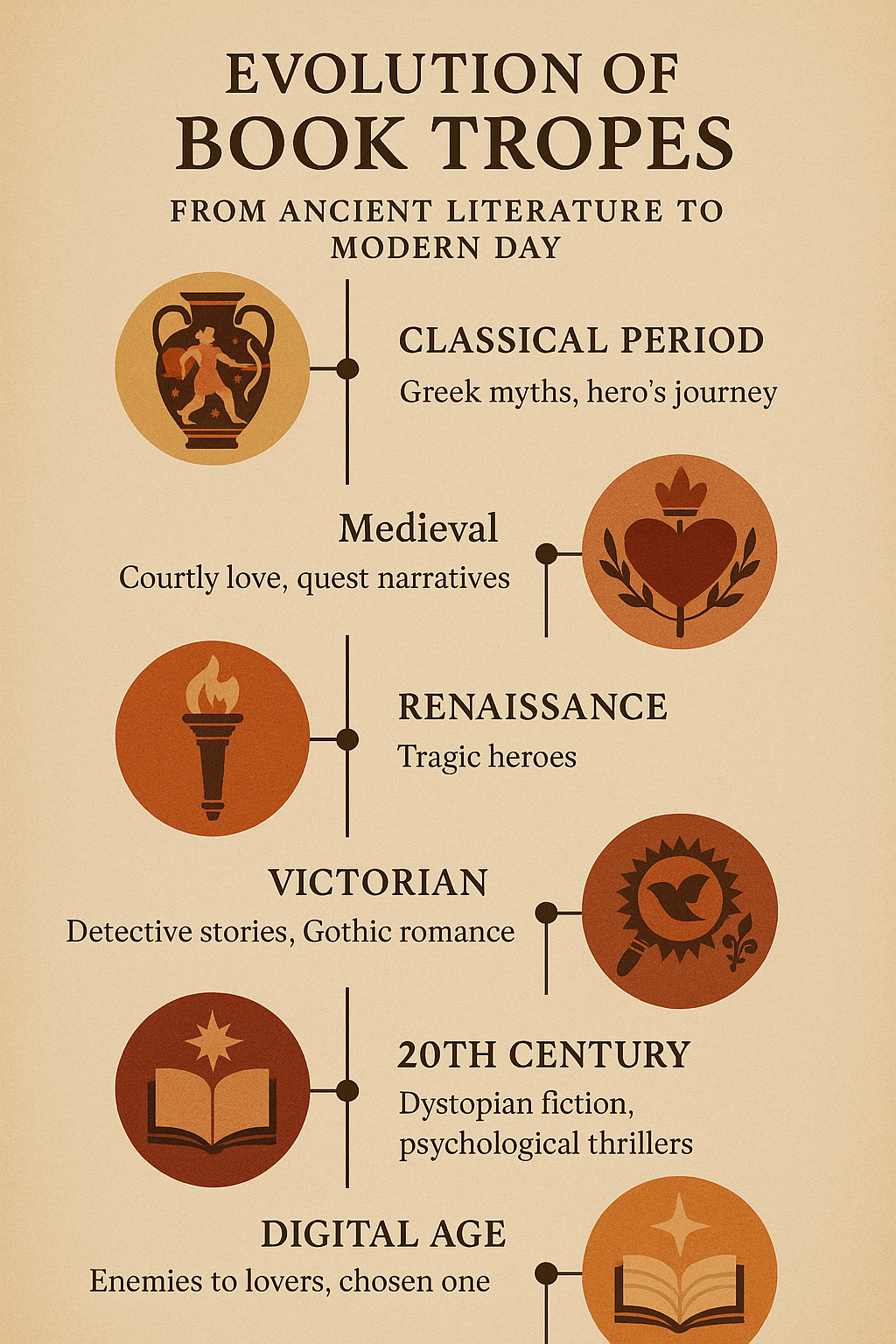
The Evolution of Book Tropes Through History
Book tropes have evolved alongside human civilization, reflecting changing social values, technological advancement, and cultural shifts. Understanding this evolution helps readers appreciate how popular narrative patterns adapt while maintaining their core appeal.
Ancient and Classical Literature
The earliest book tropes emerged from oral traditions and mythology. The hero’s journey, first codified in ancient epics like “The Odyssey,” established patterns that continue influencing modern storytelling. These foundational common book tropes explored themes of courage, sacrifice, and divine intervention.
Medieval Literature
Medieval book tropes introduced courtly love, chivalric quests, and religious allegory. The concept of romantic love as a noble pursuit emerged during this period, laying groundwork for modern romance tropes.
Renaissance and Enlightenment
This era saw the development of tragic heroes, moral complexity, and psychological depth in characters. Book tropes became more sophisticated, exploring human nature’s contradictions and moral ambiguity.
19th Century Innovations
Victorian literature introduced detective stories, Gothic romance, and social reform narratives. These popular book tropes reflected industrial society’s anxieties and the emerging middle class’s values.
20th Century Transformations
Modern literature brought psychological realism, dystopian societies, and unreliable narrators. Book tropes began questioning traditional structures and exploring subjective reality.
Digital Age Evolution
Contemporary book tropes reflect global connectivity, technological integration, and diverse perspectives. Social media has accelerated trope evolution and reader awareness of narrative patterns.
Why Readers Love Familiar Patterns
The appeal of book tropes goes beyond mere familiarity—these popular narrative patterns satisfy deep psychological needs and provide emotional comfort in an uncertain world. Understanding why readers gravitate toward common book tropes reveals the fundamental human need for storytelling.
Cognitive Processing and Pattern Recognition
Human brains are evolutionarily programmed to recognize patterns as a survival mechanism. Book tropes tap into this instinct, allowing readers to quickly process story structures and focus on character development and unique elements within familiar frameworks.
Emotional Safety and Predictability
In a chaotic world, popular book tropes provide emotional safety nets. Readers find comfort in knowing that enemies-to-lovers stories will likely end in romance, or that chosen one narratives will result in heroic triumph. This predictability doesn’t diminish enjoyment—it enhances it by allowing readers to focus on how the journey unfolds.
Wish Fulfillment and Escapism
Book tropes often represent idealized scenarios that readers wish to experience. The “found family” trope appeals to those seeking belonging, while “redemption arc” stories offer hope for personal transformation. These patterns provide safe spaces for exploring desires and fears.
Cultural Connection and Shared Experience
Common book tropes create shared cultural references that connect readers across demographics and time periods. When someone mentions “enemies to lovers,” readers immediately understand the emotional landscape and can share experiences and recommendations.
Complete Guide to 78+ Book Tropes by Category
Romance Tropes (25 patterns)
Romance book tropes explore every conceivable way two people can fall in love, from meet-cutes to second chances:
Core Relationship Dynamics:
- Enemies to Lovers – Adversaries discover attraction
- Friends to Lovers – Platonic relationships turn romantic
- Fake Dating/Marriage – Pretend relationships become real
- Marriage of Convenience – Practical unions develop into love
- Second Chance Romance – Former lovers reunite
- Forbidden Love – Social barriers complicate romance
- Secret Identity – Hidden truths threaten relationships
- Love Triangle – One person torn between two suitors
Situational Romance Tropes:
- Workplace Romance – Office relationships and professional dynamics
- Small Town Romance – Close-knit community settings
- Holiday Romance – Seasonal or vacation-based connections
- Roommates/Housemates – Forced proximity in living situations
- Best Friend’s Sibling – Complicated family connections
- Age Gap Romance – Relationships across generational lines
- Celebrity Romance – Fame and normalcy collisions
- Royal Romance – Nobility and commoner dynamics
Character-Based Romance Patterns:
- Grumpy/Sunshine – Opposite personality attractions
- Alpha/Beta/Omega – Power dynamic relationships
- Bad Boy/Good Girl – Contrasting moral compasses
- Single Parent Romance – Family considerations in love
- Hurt/Comfort – Healing through relationship
- Soulmates/Fated Mates – Destined connections
- Amnesia Romance – Memory loss affecting relationships
- Pregnancy Romance – Unexpected parenthood complications
- Virgin Romance – Inexperience and sexual discovery
Fantasy Tropes (23 patterns)
Fantasy book tropes create magical worlds and epic adventures:
Hero Archetypes:
- Chosen One – Destined savior of the world
- Reluctant Hero – Unwilling protagonist accepts destiny
- Orphan Hero – Parentless protagonist discovers heritage
- Dark Hero – Morally ambiguous protagonist
- Anti-Hero – Flawed character doing good
World-Building Elements:
- Hidden World – Magic concealed within reality
- Portal Fantasy – Travel between worlds
- Quest/Journey – Epic travel with specific goals
- Ancient Evil – Long-dormant threat awakens
- Prophecy – Foretold events driving plot
- Magic School – Educational institutions for supernatural abilities
- Dragons – Legendary creatures as allies or enemies
- Medieval Fantasy – Pseudo-historical magical settings
Power and Magic Systems:
- Coming Into Power – Characters discover magical abilities
- Magical Artifact – Powerful objects driving plot
- Magic System – Structured supernatural abilities
- Mentor Figure – Wise guide for protagonist
- Training Sequence – Skill development montages
- Good vs Evil – Clear moral dichotomy
- Dark Lord – Ultimate antagonist figure
- Elemental Magic – Powers based on natural forces
- Shapeshifting – Ability to change form
- Immortality – Eternal life complications
Mystery and Thriller Tropes (15 patterns)
Mystery book tropes build suspense through investigation and revelation:
Detective Archetypes:
- Amateur Detective – Non-professional investigator
- Hardboiled Detective – Cynical professional investigator
- Consulting Detective – Brilliant outsider solving cases
- Unreliable Narrator – Questionable storyteller credibility
- Multiple POV – Various character perspectives
Plot Structures:
- Whodunit – Classic murder mystery format
- Locked Room Mystery – Impossible crime scenarios
- Cold Case – Investigating old, unsolved crimes
- Serial Killer – Multiple murders with patterns
- Conspiracy – Large-scale hidden plots
- Red Herring – False clues misleading investigation
- Twist Ending – Surprising plot revelations
- Femme Fatale – Dangerous, seductive woman
- Missing Person – Search for disappeared individual
- Small Town Secrets – Hidden truths in close communities
Science Fiction Tropes (18 patterns)
Science fiction book tropes explore technology, future societies, and space:
Technological Themes:
- Artificial Intelligence – Sentient machines and robots
- Time Travel – Movement through temporal dimensions
- Space Opera – Grand-scale interstellar adventures
- Dystopian Society – Oppressive future governments
- Utopian Society – Perfect future civilizations
- Cyberpunk – High-tech, low-life futures
- Genetic Engineering – Biological manipulation
- Virtual Reality – Simulated world experiences
- Nanotechnology – Microscopic technological applications
Alien and Space Themes:
- First Contact – Initial alien-human encounters
- Alien Invasion – Extraterrestrial conquest attempts
- Generation Ship – Multi-generational space travel
- Terraforming – Planetary environment modification
- Post-Apocalyptic – Survival after civilization’s end
- Mad Scientist – Obsessed researcher creating problems
- Clone/Duplicate – Identical being complications
- Parallel Universe – Alternative reality versions
- Big Dumb Object – Mysterious alien artifacts
This comprehensive collection of popular book tropes demonstrates the incredible variety of narrative patterns available to both readers and writers, each offering unique opportunities for storytelling and emotional connection.
How to Use Book Tropes in Your Reading Journey
Whether you’re a voracious reader seeking your next obsession or someone struggling to find books you enjoy, understanding book tropes can transform your literary experience. These popular narrative patterns serve as reliable guides for discovering new favorites while expanding your reading horizons.
For Genre Exploration
Book tropes provide safe entry points into unfamiliar genres. If you love the “enemies to lovers” dynamic in contemporary romance, you might enjoy fantasy novels featuring the same relationship pattern. The familiar trope creates comfort while new genre elements provide excitement and discovery.
For Reading Slumps
When nothing seems appealing, returning to favorite common book tropes can reignite reading passion. Sometimes we need the comfort of familiar patterns to reconnect with why we love reading. Starting with beloved tropes can lead to discovering new variations and authors.
For Recommendation Systems
Understanding your trope preferences makes book recommendations more accurate and useful. Instead of simply saying you like romance, specifying that you prefer “slow burn enemies to lovers with found family elements” helps others suggest perfect matches.
The Future of Book Tropes
Book tropes continue evolving as society changes, new voices enter publishing, and readers demand fresh perspectives on familiar patterns. Contemporary popular book tropes increasingly emphasize diversity, mental health awareness, and complex social dynamics while maintaining their core emotional appeal.
Digital platforms and social media have accelerated trope awareness and discussion. Readers now actively seek specific common book tropes, and authors consciously incorporate popular patterns while adding unique twists. This symbiotic relationship between creators and consumers drives continued innovation within established frameworks.
The rise of self-publishing and diverse voices has introduced variations on classic book tropes that reflect different cultural perspectives and experiences. These fresh approaches ensure that popular narrative patterns remain relevant and inclusive while honoring their foundational appeal.
Conclusion
Book tropes represent far more than simple storytelling shortcuts—they’re the fundamental patterns that connect human experiences across cultures, generations, and genres. These popular narrative patterns provide the frameworks within which authors can explore complex themes, develop compelling characters, and create emotional resonance with readers.
Understanding common book tropes enhances every aspect of the reading experience, from discovering new favorites to appreciating the craft behind beloved stories. Whether you’re drawn to the tension of enemies becoming lovers, the epic scope of chosen one narratives, or the warmth of found family bonds, these patterns offer endless opportunities for literary exploration and emotional connection.
The 78+ book tropes outlined in this guide represent just the beginning of your journey into narrative patterns. Each trope offers countless variations, combinations, and interpretations, ensuring that familiar patterns never become truly predictable. By embracing these popular book tropes rather than avoiding them, readers open themselves to a richer, more satisfying literary life filled with both comfort and surprise.
As you continue your reading journey, remember that book tropes are tools for connection—between authors and readers, between stories and emotions, between the familiar and the transformative. Use this guide to discover new patterns, deepen your appreciation for favorite stories, and find your next great read among the countless variations of these timeless narrative patterns.







