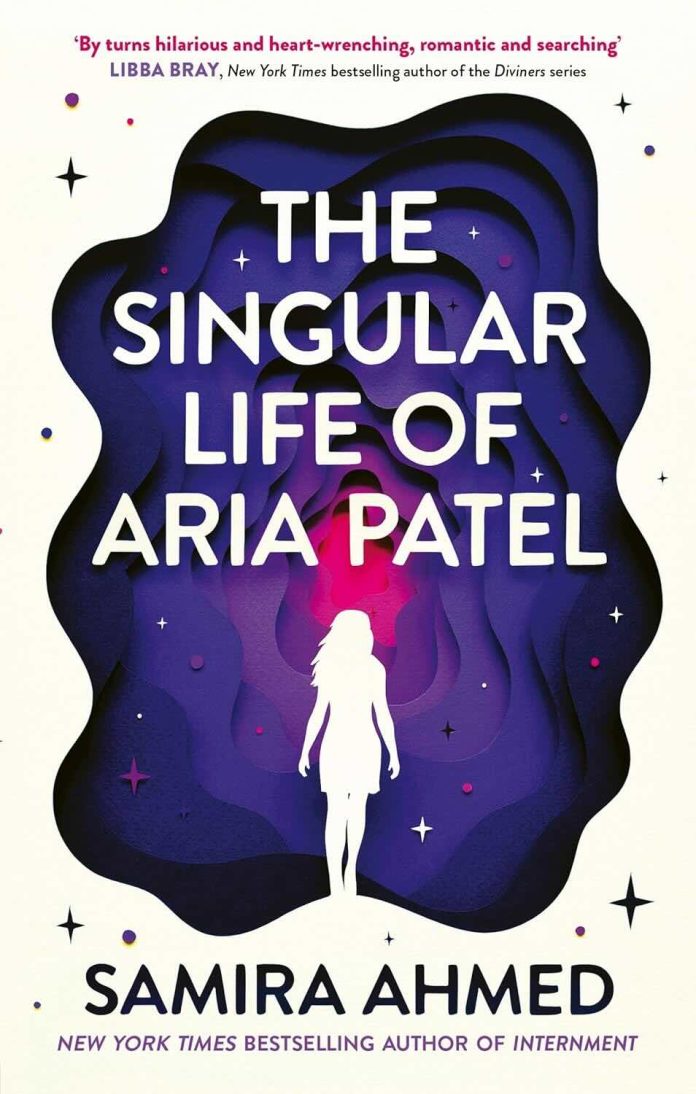
The Singular Life of Aria Patel marks Samira Ahmed’s foray into the increasingly popular multiverse subgenre of YA literature, blending science fiction with heartfelt coming-of-age themes. Ahmed, known for powerful contemporary novels like Internment and Love, Hate & Other Filters, ventures into more speculative territory with this story of a scientifically-minded teen who suddenly finds herself falling through parallel universes.
What begins as a seemingly ordinary story about a high school senior navigating relationship anxieties transforms into a profound meditation on identity, choice, and what it means to belong—not just in one world, but potentially in many. While the concept isn’t entirely novel in today’s pop culture landscape, Ahmed brings a fresh perspective through her protagonist’s unique voice and scientific approach to an impossible situation.
Plot: Falling Through Reality’s Cracks
Aria Patel is a physics-loving high school senior who values predictability and control. She’s recently broken up with her boyfriend Rohan because they’re headed to different colleges, and she’d rather end things neatly than face the messy uncertainty of a long-distance relationship. This practicality defines Aria—until her world literally fractures around her.
After witnessing what appears to be her mother’s car accident, Aria begins an involuntary journey through parallel universes, moving from one reality to another with each intense headache she experiences. In each world, she encounters variations of the people she knows—her family, her best friend Dilnaz, and sometimes even Rohan—but never exactly as they were in her home universe.
The narrative becomes increasingly urgent as Aria gets “stuck” in one particular universe where she has a little sister named Zayna and both her parents are alive (unlike her prime universe, where her father died years ago). As she adapts to this new reality, she forms a connection with this world’s version of Rohan, even as she struggles to find a way back to save her mother from the accident she witnessed.
The culmination brings a mind-bending twist involving a mysterious poem that appears in every universe and an encounter that forces Aria to make an impossible choice between worlds—and between different versions of herself.
Characters: Variations on a Theme
The novel’s primary strength lies in its characterization, particularly of Aria herself. Across universes, she remains recognizably herself—scientifically-minded, slightly anxious, and determined—while subtly changing based on each world’s circumstances. Through Aria’s eyes, Ahmed explores how environment shapes identity without completely determining it.
Some of the most poignant moments come from Aria’s interactions with characters who don’t exist in her home universe:
- Her relationship with little sister Zayna in the world where she gets “stuck” is particularly touching, evolving from awkward confusion to genuine sisterly affection
- Her encounters with her father in worlds where he’s still alive evoke complex emotions about loss and what-might-have-been
- Her growing connection with the “stuck” universe’s Rohan creates genuine emotional stakes for her eventual decision
However, some secondary characters remain somewhat underdeveloped. Dilnaz, while likable, sometimes reads more as a support system than a fully realized character with her own motivations. Similarly, Aria’s mother, despite being central to Aria’s desire to return home, lacks dimensionality beyond being the person Aria needs to save.
Themes: Science Meets Philosophy
Despite being rooted in physics and multiverse theory, The Singular Life of Aria Patel ultimately concerns itself more with philosophical questions than scientific ones:
- Identity and authenticity: If multiple versions of yourself exist, which one is “real”? Are you defined by your circumstances or something more fundamental?
- Choice and consequence: Every decision closes doors while opening others—literally, in Aria’s case. The novel poignantly illustrates how choosing one path necessarily means abandoning others.
- Connection across differences: Through her relationship with multiple versions of Rohan, Aria discovers that meaningful connections can transcend circumstantial differences.
- Control versus acceptance: Aria’s journey forces her to reconcile her desire for certainty with the fundamental unpredictability of life.
Ahmed weaves these themes together elegantly, creating a narrative that’s intellectually stimulating while remaining emotionally grounded.
Writing Style: Accessible Yet Profound
Ahmed’s prose strikes a balance between accessibility and depth. The first-person narration captures Aria’s voice—analytical yet vulnerable, with flashes of dry humor—while still conveying complex concepts about quantum physics and identity.
The poem that appears throughout the novel serves as both plot device and thematic touchstone, with its imagery of roots, wings, and doorways reinforcing the novel’s central concerns. Phrases from the poem recur throughout the narrative in different contexts, creating a sense of coherence despite the constantly shifting settings.
The author’s handling of the multiverse concept is competent, though some readers may question certain elements of the “physics” behind Aria’s experiences. The novel occasionally falls into convenient narrative shortcuts, particularly in its resolution, which relies on a somewhat convenient time-loop paradox.
Strengths and Weaknesses
What Works Well
- Emotional core: Despite its high-concept premise, the novel remains grounded in relatable emotional stakes
- Voice: Aria’s narration is distinctive and consistent, balancing scientific terminology with teenage vernacular
- Representation: Ahmed naturally incorporates South Asian American identity into the narrative without making it Aria’s defining characteristic
- Pacing: The novel maintains momentum throughout, with each universe shift adding new dimensions to Aria’s character and dilemma
Areas for Improvement
- Scientific explanation: The mechanism behind Aria’s universe-hopping sometimes feels underdeveloped, relying more on poetic imagery than coherent sci-fi logic
- Secondary character development: Some supporting characters, particularly in the brief universe visits, feel more like sketches than fully realized people
- Resolution: The ending, while emotionally satisfying, relies on a somewhat convenient time paradox that may leave scientifically-minded readers questioning its logic
- Universe variety: Despite visiting numerous parallel worlds, the differences sometimes feel incremental rather than truly exploring the multiverse’s potential for radical alternatives
Comparisons and Context
The Singular Life of Aria Patel enters a literary landscape already populated with multiverse narratives, including YA titles like Rachel Lynn Solomon’s See You Yesterday and Adam Silvera’s They Both Die at the End. What distinguishes Ahmed’s entry is her protagonist’s scientific mindset and the novel’s focus on family relationships alongside romantic ones.
The novel also bears comparison to Ahmed’s previous works, representing a departure from her more grounded contemporary fiction like Internment while maintaining her interest in South Asian American protagonists navigating complex identities. Fans of her earlier books may appreciate the familiar voice while enjoying this venture into more speculative territory.
Final Verdict: A Journey Worth Taking
Despite occasional scientific handwaving and a somewhat convenient resolution, The Singular Life of Aria Patel succeeds as both a thought-provoking exploration of identity across possibilities and a poignant coming-of-age story. Ahmed skillfully balances the novel’s high-concept premise with genuine emotional stakes, creating a protagonist whose journey across universes ultimately helps her understand herself in this one.
The novel asks big questions: What makes us who we are? How do our choices define us? What would we sacrifice for those we love? While it doesn’t provide definitive answers, it invites readers to consider these questions in relation to their own lives, which is perhaps the most one can ask of speculative fiction.
For readers seeking a blend of quantum concepts, philosophical questions, and heartfelt relationships, The Singular Life of Aria Patel offers a singular reading experience that lingers in the mind long after the final page—much like the ripple effects of choices that echo across Ahmed’s multiverse.







