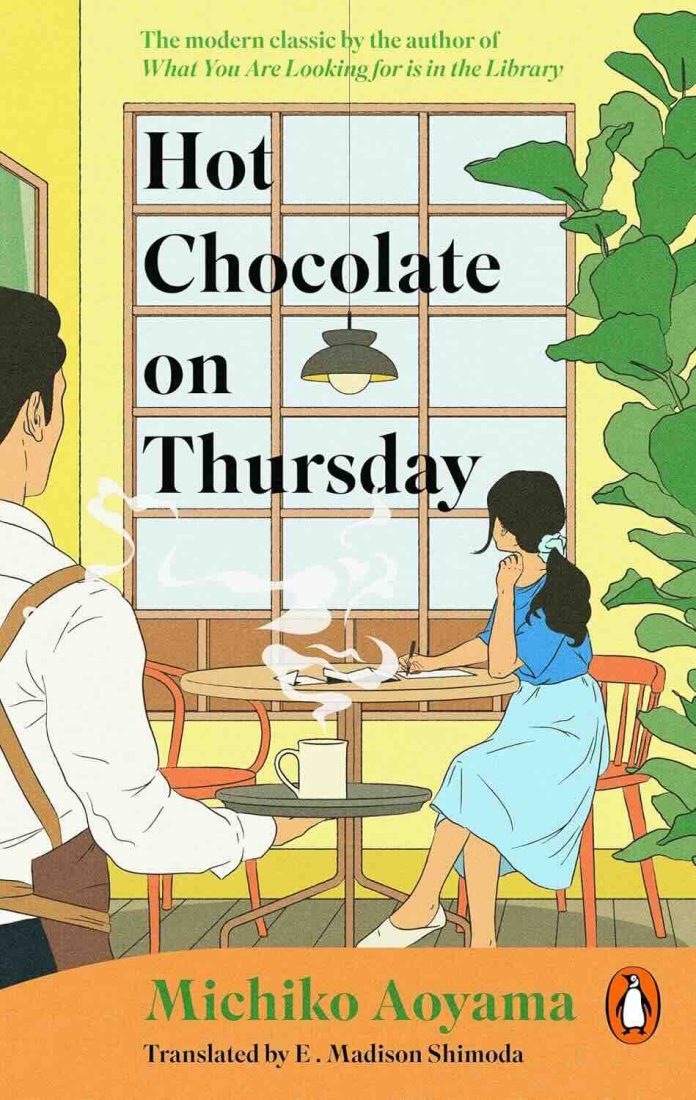
There is a particular kind of Japanese fiction that does not announce itself with drama or urgency, but arrives the way warmth does on a cold afternoon — quietly, gradually, leaving you changed before you quite notice it happening. Hot Chocolate on Thursday by Michiko Aoyama, translated into English with admirable restraint and sensitivity by E. Madison Shimoda, belongs entirely to this tradition. A review copy arrived ahead of its English-language publication, and reading it slowly proved the only sensible approach.
Tucked at the end of a riverside cherry blossom path in a quiet Tokyo neighbourhood, the Marble Cafe seats only a handful of people — three tables, a counter for five, raw wooden furniture, a single dangling lamp. What Aoyama builds inside this modest space is something far larger than its dimensions suggest: an intricate, interconnected tapestry of twelve short stories, each told through the eyes of a different character, each threaded to the others through the invisible stitching of shared moments, chance encounters, and the extraordinary weight of ordinary acts.
A Palette of Lives, One Color at a Time
Each chapter carries both a character’s name and a colour. Brown belongs to Wataru, the quietly lovelorn young barista who runs the cafe alone. Yellow follows Asami, a high-achieving mother undone by something as seemingly simple as a rolled omelette. Pink is the world of Ena, a young kindergarten teacher navigating the unspoken politics of painted nails. Blue opens into Yasuko, a rigid veteran teacher softened by a decades-old friendship. From there, the book stretches outward to Sydney, drawing in a newlywed couple, a fifty-year marriage, an artist obsessed with creating her own particular shade of green, a sandwich shop owner who painted his storefront orange for a woman he never confessed his love to, and an aromatherapist who believes, with full sincerity, that she is a witch.
What makes this structure so quietly effective is not the novelty of multiple perspectives but the cumulative resonance they produce. A gesture made in one chapter — a kind word, a table cleared in thirty seconds, a letter slightly stained with spilled hot chocolate — reappears in another story, now carrying entirely new weight. Aoyama trusts her readers to gather these details the way one gathers stones from a riverbank, only to realise much later they have been building something all along.
The Maestro: A Thread Running Through Every Life
Winding through each story is a mysterious figure — a man with a mole at the centre of his forehead, known only as the Maestro. He surfaces in cafes, galleries, and airport lobbies across Tokyo and Sydney, often saying just enough to redirect a life before slipping quietly away. He is never over-explained, and this restraint is precisely why he works. Aoyama uses him as both structural glue and philosophical argument: that some people exist primarily to nudge others toward their own possibilities, and that this, too, is a form of greatness.
The Writing: Unhurried, Precise, and Quietly Powerful
Aoyama’s prose, as Shimoda renders it, carries the register of someone who trusts her reader implicitly. Sentences are short and often declarative, yet layered beneath with emotional precision that takes time to fully register. There is no melodrama. A woman cries alone in a kitchen over a failed omelette, and it lands with more force than any theatrical confrontation might. A barista clears a table in under a minute, and this small act eventually touches a life on the other side of the world. Aoyama demonstrates — rather than argues — her central conviction: that life is not shaped by grand events but by the slow accumulation of small ones, and that we rarely know which of our moments will matter most to someone else.
Where This Novel Earns Genuine Praise
Hot Chocolate on Thursday by Michiko Aoyama excels in several areas worth naming specifically:
- The architecture of connection. The way these twelve stories fold into one another — without ever feeling contrived — is a genuine structural achievement. Discovering how a detail from chapter two resurfaces in chapter eight delivers the particular pleasure that the best ensemble fiction offers.
- Emotional honesty without sentimentality. Each character is treated with dignity. Their anxieties around motherhood, friendship, belonging, love, and mortality are rendered without condescension and without resolutions that arrive too cheaply.
- Distinct voices across chapters. Each perspective is genuinely differentiated — from Asami’s controlled corporate precision to You’s quietly wounded interior life. Aoyama does not allow her characters to blur together.
- The translation itself. Shimoda’s English reads with the naturalness of an original, preserving the rhythm and restraint of the Japanese without flattening what is distinctively Aoyama’s.
Where the Warmth Becomes a Limitation
To write honestly about Hot Chocolate on Thursday by Michiko Aoyama requires acknowledging that its very gentleness, the quality that makes it so appealing, is also its most consistent constraint.
Several character arcs arrive at resolutions of a tidiness that, while emotionally satisfying in the moment, leaves little room for genuine ambiguity. Characters who begin with real complexity occasionally find their stories resolved through a single well-timed conversation or a conveniently placed coincidence. The Ralph and Cindy chapter, which leans into magical thinking with playful confidence, sits somewhat uneasily alongside the careful naturalism governing the rest of the book. The whimsy is charming in isolation; as part of a larger whole committed to understated realism, it tilts the balance slightly.
Readers who arrive after Aoyama’s internationally bestselling What You Are Looking For Is in the Library may also find that the short-story structure, however beautifully managed, limits the depth any individual character can reach. The breadth of Hot Chocolate on Thursday by Michiko Aoyama is, inevitably, its constraint as much as its strength.
What Aoyama Readers Should Know
This is Michiko Aoyama’s debut novel in Japan, first published in 2017, and it functions as both an introduction to her sensibility and a companion piece to Matcha Coffee on Monday, which continues the world of the Marble Cafe. Her multi-million-copy bestseller What You Are Looking For Is in the Library shares the same philosophical DNA — the conviction that the right encounter at the right moment can quietly reorient a life — but operates with a slightly warmer dose of whimsy. The Healing Hippo of Hinode Park, her other work available in English, applies a similar attentiveness to community and quiet connection. Readers new to Aoyama will find this novel a natural entry point.
Five Books That Share This Novel’s Quiet Frequency
For Readers Who Want More of This World
If Hot Chocolate on Thursday by Michiko Aoyama found its way into your heart, these books share something of its quiet register:
- Before the Coffee Gets Cold by Toshikazu Kawaguchi — another Japanese cafe story built from interlocking lives and emotional restraint
- The Travelling Cat Chronicles by Hiro Arikawa — tender, episodic, and similarly devoted to the weight of small human bonds
- A Man Called Ove by Fredrik Backman — gruffer in tone, but equally attentive to how one life quietly shapes many others
- The House in the Cerulean Sea by TJ Klune — for readers drawn to found community and the particular magic of ordinary care
- The Midnight Library by Matt Haig — shares the novel’s meditation on the invisible reach of choices we do not know we are making
This is a book for readers who believe in the long reach of small kindnesses. It will not shake you. It will warm you slowly, from the inside, and leave you looking twice at the strangers beside you — wondering, as Aoyama clearly intends, what invisible thread might already run between you.







