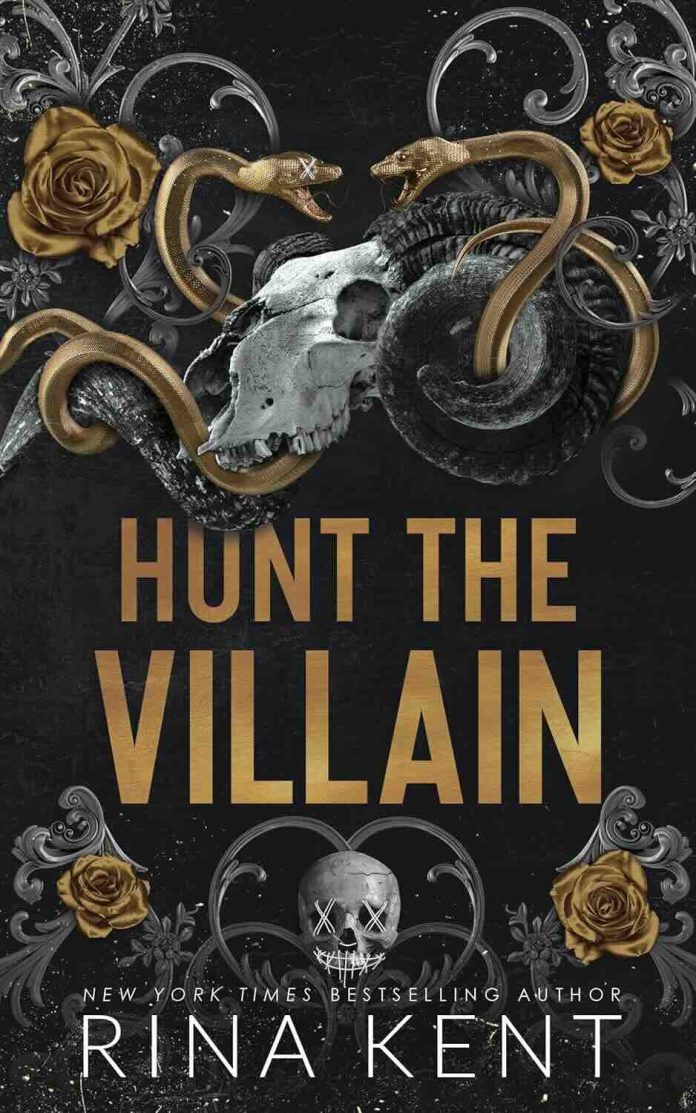
There is something almost theatrical about the opening of Hunt the Villain by Rina Kent — a summer camp deep in the Adirondack Mountains, populated not by teenagers with canoe paddles, but by the heirs of rival Russian-American mafia organizations, stripped of phones and personal guards, forced into uneasy cohabitation. The premise is dramatic almost to the point of absurdity. And then Yulian Dimitriev walks in — bloodied, grinning, having just detonated a device for the sheer entertainment of it — and the novel announces itself as something far more complicated than its setup suggests.
Hunt the Villain by Rina Kent is the second entry in Rina Kent’s Villain series. Where Kiss the Villain introduced Nikolai’s story and laid the groundwork for this world, this book narrows its focus to two characters who have been circling each other — and readers’ curiosity — since the series began. The forthcoming Crave the Villain will close out the trilogy, but for now, this is the installment that carries the heaviest emotional weight of the three. Its predecessor established the mafia world’s rules and its cruelty; this one makes you feel the cost of living inside them.
A Masterclass in Dual POV
The Man With a Playbook
The dual-POV structure is where Hunt the Villain by Rina Kent earns its most significant points. On one side is Vaughn Morozov, heir to the New York Bratva — methodical, immaculate, and emotionally sealed behind an armor of precision. Vaughn is the kind of character who, upon discovering his girlfriend of four years has been unfaithful, does not cry or break things. He drafts a calculated social demolition plan and executes it before midnight. His chapters are tight, clipped, and quietly devastating in the places where the control slips. The world he navigates — mafia-funded gallery openings, a Columbia University schedule designed to keep him close to power — is rendered with elegant specificity. Vaughn is not cold because he lacks feeling. He is cold because he was built that way, and because feeling, in his world, is a liability.
The Man With No Playbook at All
On the other side is Yulian Yaroslavich Dimitriev — one of the more genuinely memorable heroes in recent MM romance. Chaotic, physically reckless, perpetually bleeding from something, and funnier than a dark mafia novel has any business being, Yulian wears a mask of unhinged bravado over a childhood of staggering cruelty. His mismatched eyes — one pale blue, one dark brown — and his absolute refusal to take anything seriously are survival mechanisms the reader comes to understand slowly, in the way that matters most. He is equally capable of making you laugh in one paragraph and winding you with grief in the next, and it never feels manipulative. It feels honest.
What Kent executes particularly well is ensuring these two voices remain genuinely distinct. Vaughn’s internal monologue reads like a chess player cataloguing threats. Yulian’s reads like someone who lost the rulebook entirely and is delighted about it. Reading the same scene from both perspectives — and Kent gives us several — reveals new emotional layers each time. These are not two halves of the same archetype. They are two fully realized people falling into forbidden love, and the collision is entirely earned.
The Stakes Are Real, and That Matters
One of the more serious achievements in Hunt the Villain by Rina Kent is how it handles queerness inside organized crime. The homophobia Yulian has navigated since adolescence is not set decoration — it carries genuine, mortal weight. His father, Yaroslav Dimitriev, is a villain who exceeds standard mafia-patriarch tropes. The history Kent reveals about how Yaroslav responded when he first discovered his son’s sexuality is genuinely harrowing, and it reframes every piece of Yulian’s chaotic behavior as something other than entertainment. The stakes for these two men being together are not abstract. They are life-and-death.
This is also where the novel distinguishes itself from lighter college romance fare. The Legacy of Gods universe has always traded in darkness, but this entry pushes further into exploring what it means to desire freely inside a world that doesn’t just disapprove — it punishes — and that thematic weight gives the romance its gravity.
Where the Story Stumbles
Honest criticism is owed here. The novel’s pacing is its most noticeable flaw, and acknowledging it is part of respecting readers who will enter with high expectations.
- The first act, set at the summer camp during adolescence, is immersive and carefully written. The survival sequence — where an ambush forces Vaughn and Yulian into an isolated, dangerous situation together — is the kind of scene that lingers in memory for months
- The four-year time jump that follows it, though narratively necessary, is bridged more by exposition than by felt experience, creating a real but manageable distance in the early chapters of the present-day timeline
- The subplot surrounding Vaughn’s girlfriend Danika serves its catalytic purpose but feels more functional than emotionally resonant — a plot mechanism rather than a character
- Certain members of the supporting ensemble, particularly among the King’s University crowd, drift in and out without cohering fully. In a world this dense with mafia politics and shifting alliances, a sharper editorial focus on which relationships truly earn their page time would have served the story well
Cyrus, Yulian’s brilliant and fiercely protective closest companion, is a consistent bright spot — his skepticism and his layered loyalty add genuine friction. But the surrounding cast sometimes struggles to match his presence.
The Prose and the World
Kent’s style is economical and rhythmically deliberate — short sentences, blunt emotion, scenes that snap with tension before breaking for dry, surprising humor. That register suits Yulian’s POV almost perfectly; his chapters read with a gleeful momentum that makes it difficult not to race through them. Vaughn’s chapters demand a steadier pace, and Kent handles the tonal gear-shift with care. The Russian language insertions — phrases, endearments, sharp commands — feel earned rather than decorative, adding cultural texture to a world where identity and violence are deeply intertwined.
The romance itself builds slowly enough to be credible, and when it arrives, it arrives with weight. When Yulian says something has been marked onto him permanently, it means something, because Kent has spent the entire novel showing what it costs him to let anyone close enough.
Similar Reads Worth Exploring
For readers who want to stay in this emotional territory:
- Kiss the Villain by Rina Kent — the necessary first entry; Nikolai’s story and the world’s foundation
- God of Malice by Rina Kent — another Legacy of Gods title with comparable darkness and moral complexity
- Captive Prince by C.S. Pacat — the benchmark for dark, slow-burn MM enemies-to-lovers fiction
- Corrupt by Penelope Douglas — dark college romance with rivals whose hatred is undeniably something else
- Haunting Adeline by H.D. Carlton — for readers comfortable with deeply complicated romantic dynamics
- Twisted Love by Ana Huang — forbidden romance with genuine emotional stakes
Worth the Hunt
Hunt the Villain by Rina Kent is not a flawless novel. Its pacing has gaps, its secondary cast is uneven, and certain early chapters resist the momentum the story eventually builds. But in its best moments — and there are many — it is an extraordinary one. Yulian Dimitriev, chaotic and wounded and genuinely funny and heartbreakingly honest when his guard is finally down, is a character who earns genuine attachment. Vaughn’s quieter, harder arc rewards the patient reader with something that stays. And the world Rina Kent continues to build across this series — dangerous, textured, morally grey, and heavy with consequence — shows no sign of loosening its hold. Crave the Villain has a lot to live up to.







