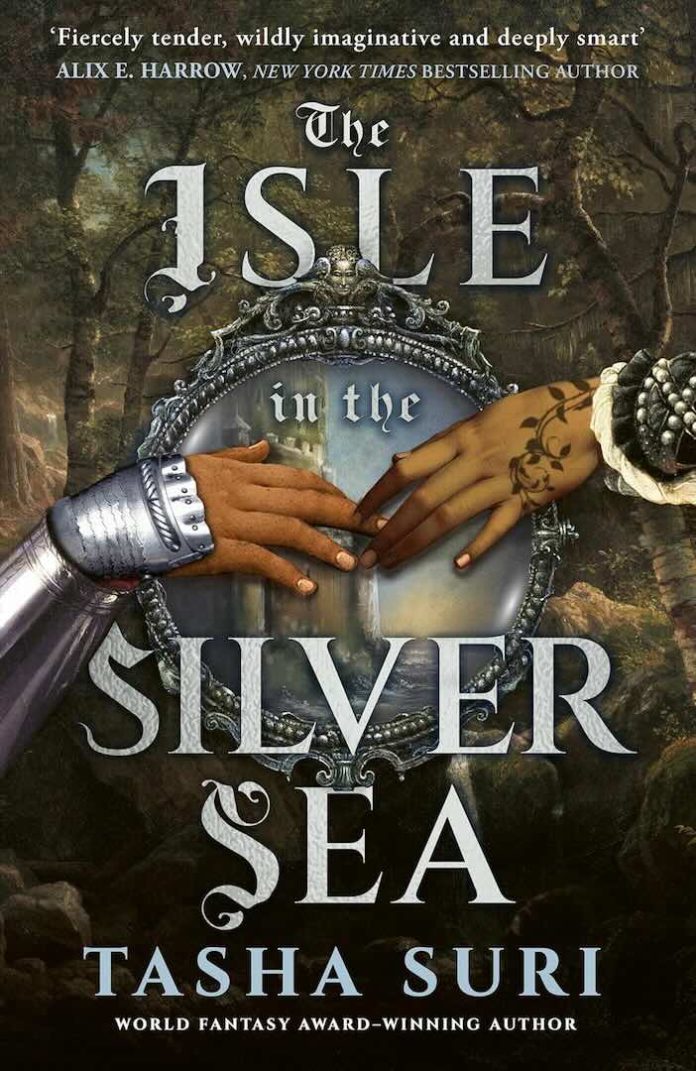
In an era when fantasy romance often treads familiar ground, Tasha Suri’s The Isle in the Silver Sea arrives like a meteor strike—devastating, beautiful, and utterly transformative. This sapphic romantasy isn’t content with simply telling a love story; it interrogates the very nature of narrative itself, asking what happens when stories become prisons and love becomes a curse that repeats across centuries.
A World Built on Stories and Subjugation
Suri constructs a Britain where tales literally shape reality, where land grows from stories told and retold. The Isle exists as a strange patchwork of narratives, where medieval knights brush shoulders with industrial-era Londoners, where fae creatures haunt misty forests and archivists wield power more absolute than any monarch. This isn’t mere window dressing; the world-building serves as both foundation and thesis for Suri’s exploration of how narratives control, constrain, and sometimes destroy those who inhabit them.
The magic system revolves around limni ink—a substance that can bind tales, reshape reality, and trap incarnates in their designated roles. These incarnates are people born to embody specific stories, living and dying and living again to feed the Isle’s insatiable hunger for narrative. It’s a brilliantly unsettling concept that Suri mines for both horror and pathos. The archivists who control this system aren’t cartoon villains but bureaucrats of fate, convinced their control preserves the Isle even as it slowly withers from their grip.
What makes this world sing is Suri’s refusal to simplify. The Isle is dying precisely because stories have been frozen in place, cultivated and controlled until they lose their vital spark. New tales from “Elsewhere”—other lands, other peoples—threaten the archivists’ power structure, leading to violence and suppression. The political dimensions here are sharp and deliberate, examining colonialism, cultural preservation, and who gets to decide which stories matter.
The Knight and the Witch: Love as Tragedy and Rebellion
At the heart of this elaborate tapestry stand Simran and Vina, incarnates of The Knight and the Witch—a tale that has condemned them to fall in love and destroy each other across hundreds of lifetimes. Simran, raised in the Tower archives and trained as a scribe, is sharp-edged and defensive, her vulnerability hidden beneath layers of anger and mistrust. Vina, a knight of the Queen’s court, wears her chivalry like armor, making herself smaller and more foolish than she is to please those around her.
Their dynamic crackles with tension from their first meeting. Suri writes their relationship with remarkable restraint, allowing desire and recognition to build slowly despite the tale that screams for them to hurtle toward doom. When Simran and Vina finally kiss—breaking the fae enchantment that has captured Vina—the moment lands with devastating emotional weight precisely because Suri has earned it through careful character development rather than narrative inevitability.
The romance here isn’t about grand gestures or flowery declarations. It’s found in Vina seeing Simran’s fear beneath her rage, in Simran recognizing Vina’s intelligence beneath her performance of foolishness, in two people choosing each other despite knowing that choice has killed them before. Suri captures something profound about queer love here—the act of choosing a relationship that the world insists should not exist, that fate itself seems determined to destroy.
Their chemistry burns brightest in quieter moments: standing atop a mountain surrounded by copper-colored landscape, Simran showing Vina her witch’s tower while their tale tightens its noose around them both; Vina tracing the contours of Simran’s face on a London rooftop, both of them aware they’re stealing borrowed time. These scenes showcase Suri’s prose at its most luminous, balancing mythic grandeur with intimate vulnerability.
The Architecture of Fate
Where Suri’s narrative truly distinguishes itself is in its meta-textual ambitions. This isn’t simply a story about breaking a curse—it’s an examination of how stories themselves can become instruments of oppression. The archivists don’t just preserve tales; they bind them with ink-forged chains to incarnate books, forcing incarnates to perform their narratives exactly as written. Any deviation is treated as heresy, potentially threatening the Isle’s existence.
The figure of Galath—the pale assassin who haunts Simran across lifetimes—embodies this tragedy most acutely. Once a child saved by the witch in a previous life, he was transformed into something immortal through her desperate magic, becoming both her protector and executioner across centuries. His character arc, slowly revealed through flashbacks and recovered memories, provides the book’s emotional gut-punch. He represents what happens when love becomes obligation, when protection curdles into mercy-killing.
The revelation that Simran herself, in a previous incarnation as the witch Elayne, created Galath’s immortality adds layers of complexity to her character. She carries the weight of choices made by her past selves, decisions that have reverberated across centuries. This raises fascinating questions about identity and continuity—is Simran responsible for what Elayne did? Can you be guilty of crimes committed by someone who wore your soul in a different body?
Prose and Pacing: A Dance Between Past and Present
Suri’s prose operates on two registers simultaneously. Her present-tense narrative moves with thriller-like urgency, propelling readers through conspiracies and chases across London. But she also weaves in fragments of past lives—glimpses of previous knights and witches, other incarnations of Simran and Vina’s doomed love. These interludes could have disrupted the narrative flow, but instead they create a haunting chorus of voices, each one adding depth to our understanding of the central relationship.
The book’s structure is ambitious, splitting into two parts with the midpoint death and resurrection of both protagonists. This bold choice reinforces the cyclical nature of their tale while allowing Suri to show us Simran and Vina transformed—carrying the full weight of their memories across lifetimes, finally able to make informed choices about their fate. The second half gains tremendous power from this decision, as both women navigate their relationship with the knowledge of how many times they’ve loved and killed each other.
However, this structural ambition occasionally works against the narrative’s momentum. The middle section, where both protagonists separately piece together their histories and the truth about Galath, occasionally treads water. Some readers may find the pacing uneven, particularly in the extended sequences at the green library and during the journey to free the Eternal Prince. These sequences are rich with world-building and thematic resonance, but they can feel like the narrative is gathering breath before its final sprint.
Secondary Characters: Flesh and Purpose
Suri populates her world with supporting characters who feel fully realized rather than functional. Hari, who is simultaneously Simran’s brother-figure and Vina’s father from her previous life, navigates this temporal paradox with quiet dignity. His transformation from scholar to witch—choosing magic that marks him as dangerous and other—reflects the book’s broader themes about embracing marginalization as a form of power.
Edmund, Vina’s fellow knight, provides crucial moral complexity. His journey from loyal servant of the crown to revolutionary demonstrates how proximity to injustice can slowly erode even the most deeply held convictions. His relationship with Matthias, another knight who cannot abandon his oath even as the world crumbles around him, offers a poignant counterpoint to Vina’s own arc of defiance.
The archivists themselves—particularly Meera, who raised Simran—occupy an uncomfortable gray area. They genuinely believe they’re preserving the Isle, protecting stories from corruption and change. Suri doesn’t let them off easily, but neither does she reduce them to caricatures. They represent institutional power’s ability to convince intelligent people to commit atrocities in service of abstract principles.
Themes of Liberation and Narrative Control
Beneath the romance and adventure, Suri explores profound questions about stories and power. Who decides which tales deserve preservation? What happens when narratives ossify into dogma? The Isle’s dying state directly results from the archivists’ insistence on freezing stories in their “canonical” forms, refusing to let them evolve or change.
This becomes explicitly political when we learn that incarnates from “Elsewhere”—representing colonial perspectives and immigrant stories—are being systematically murdered to preserve the Isle’s “purity.” The archivists fear contamination from foreign tales, failing to recognize that stories have always traveled, always mingled, always transformed through contact with new perspectives. Suri’s commentary here cuts deep, examining how nationalist narratives require constant policing and violence to maintain the fiction of cultural purity.
The book’s treatment of queerness operates on multiple levels. On the surface, Simran and Vina’s love exists outside the constraints of their heteronormative tale—their sapphic desire literally has no place in the canonical version of The Knight and the Witch. But more subtly, their entire struggle represents a queer project: the refusal of assigned narratives, the insistence on writing their own ending even when the world demands they perform scripted roles.
Where the Seams Show
Despite its considerable achievements, The Isle in the Silver Sea occasionally strains under the weight of its ambitions. The magic system, while thematically rich, can feel inconsistent in its rules and limitations. Simran’s abilities with ink evolve rapidly in the final act, granting her powers that feel convenient rather than earned. Readers seeking hard-magic clarity may find themselves frustrated by the fuzzy boundaries of what magic can and cannot accomplish.
The book’s climax, featuring the long-awaited battle between the Eternal Queen and the Eternal Prince, delivers spectacle but doesn’t quite achieve the emotional resonance of earlier, quieter moments. After spending hundreds of pages with Simran and Vina, shifting focus to these more archetypal figures can feel like the narrative is fulfilling generic obligations rather than following its heart.
Some secondary plotlines receive insufficient development. The green library and its mysterious chalice of knowledge, while fascinating, feels like a concept worthy of deeper exploration. Similarly, the various covens of witches and cunning folk that Vina recruits to assault the archives deserved more page time to establish stakes and relationships before the final confrontation.
The ending itself walks a delicate line between earned catharsis and wish fulfillment. Suri grants her protagonists the happy ending they’ve fought so desperately to achieve, but some readers may find the resolution arrives too neatly after such sustained tragedy. The book’s final image—Simran and Vina choosing to remain in London, building new lives free from narrative constraints—offers genuine hope, but the path to get there requires accepting some narrative conveniences.
The Suri Signature
Readers familiar with Suri’s previous work—the lyrical The Jasmine Throne and its sequels in the Burning Kingdoms trilogy, or the intricate political fantasy of Empire of Sand and Realm of Ash—will recognize her hallmarks here. She excels at crafting relationships between complex women, at building worlds where magic and politics intertwine inextricably, at prose that can shift from brutal to beautiful within a single paragraph.
But The Isle in the Silver Sea represents Suri working in a different mode. Where her previous books sprawled across continents and generations, this standalone novel compresses and intensifies. The tighter focus allows for deeper character work, though it occasionally feels constrained compared to the epic scope of her other work. The meta-fictional elements here are also more prominent, with Suri explicitly interrogating the mechanics of storytelling in ways her other books approached more obliquely.
Final Verdict: A Love Letter to Stories That Dare to Change
The Isle in the Silver Sea is ambitious, often brilliant, occasionally flawed fantasy romance that deserves its place among the year’s most interesting genre offerings. Suri has crafted a book that works on multiple levels—as sweeping romantasy, as political allegory, as meditation on narrative and power, as celebration of queer love’s transformative potential.
The novel’s greatest achievement lies in how it makes readers interrogate their own relationship with stories. We consume narratives that repeat familiar patterns, find comfort in knowing how tales will end, resist changes to beloved characters and worlds. Suri asks: what does that comfort cost? Who benefits when stories cannot change? What violence do we perpetuate by demanding narratives remain frozen in familiar forms?
For readers seeking a conventional romantasy with clear villains and uncomplicated happy endings, this may prove challenging. But for those willing to engage with a book that questions the very foundations of how fantasy romance typically operates, The Isle in the Silver Sea offers rich rewards. Suri has written something genuinely innovative within a genre space that often prizes comfort over challenge.
The Isle in the Silver Sea is fantasy romance that trusts its readers to grapple with complexity, that refuses to sacrifice thematic depth for emotional beats, that believes love stories can also be stories about liberation, revolution, and the power of choosing your own narrative. In an overcrowded genre market, that makes it essential reading.
For Readers Who Loved
If The Isle in the Silver Sea resonated with you, consider exploring:
- This Is How You Lose the Time War by Amal El-Mohtar and Max Gladstone – Another lyrical sapphic romance spanning lifetimes with similar meta-textual ambitions
- The Priory of the Orange Tree by Samantha Shannon – Epic fantasy featuring lesbian romance and interrogation of traditional fantasy narratives
- A Memory Called Empire by Arkady Martine – For readers drawn to the themes of cultural imperialism and narrative control
- The Goblin Emperor by Katherine Addison – Different in tone but similar in examining how institutions preserve power through tradition and ritual
- She Who Became the Sun by Shelley Parker-Chan – Historical fantasy exploring identity, destiny, and the power of choosing your own story
- The Jasmine Throne by Tasha Suri – For more of Suri’s intricate world-building and complex female relationships, set in her epic Burning Kingdoms trilogy
You might also like: Tempest by Victoria Aveyard is another island-and-empire story: a slow-burn pirate romance told out of order, with almost no magic and a heroine whose defining act is a betrayal.