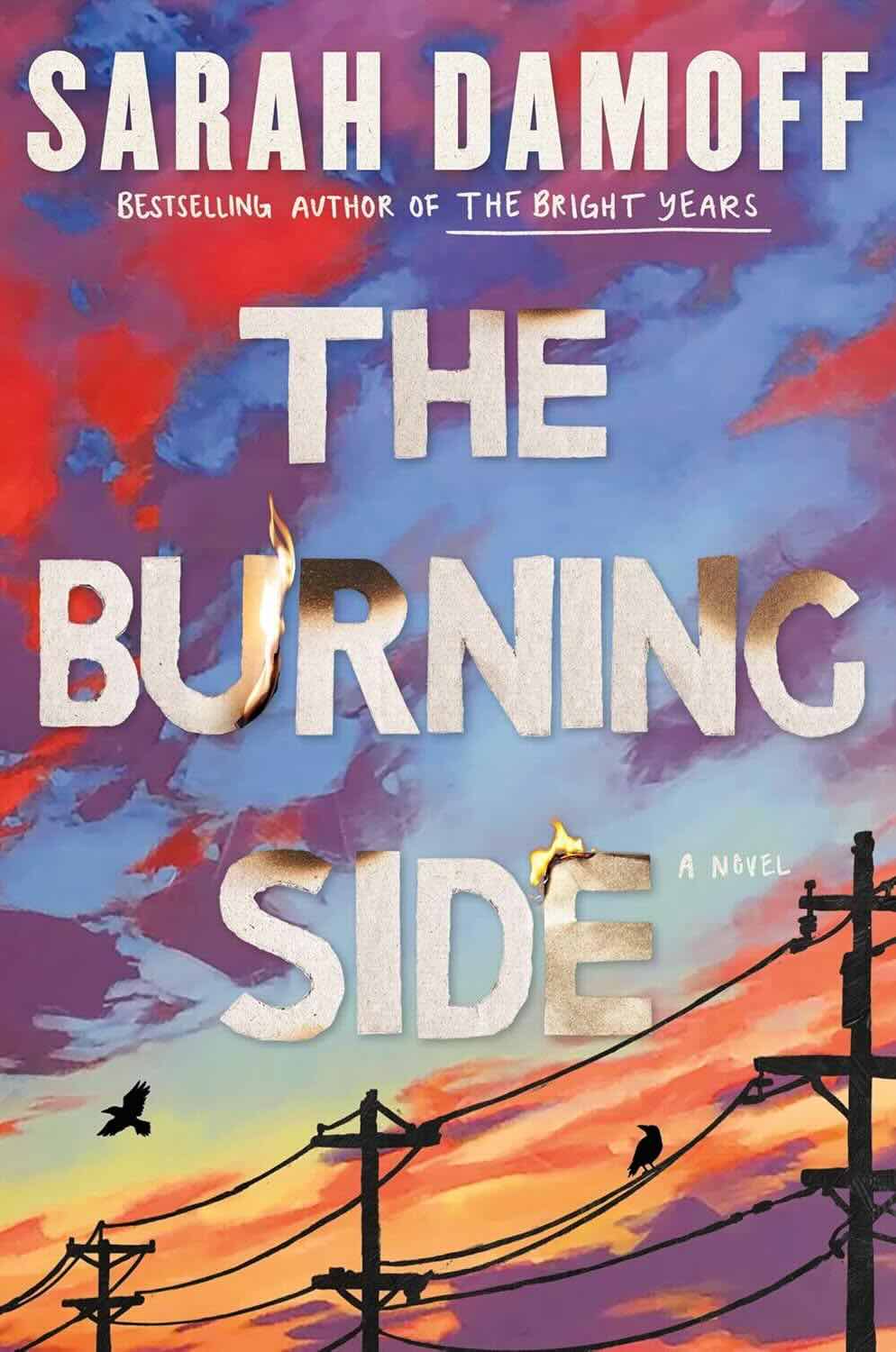
A house fire opens this novel, The Burning Side. April and Leo escape with their two small children, one paperback, and the bruising private knowledge that the marriage was already going up before the kitchen burner did. From that first scene, Sarah Damoff writes like she is standing in the wreckage with a flashlight, deciding what to salvage and what to leave to the rain.
The Premise: A House, a Marriage, a Family Holding Both Together
In the middle of a June night in 2022, April stumbles out the front door with her baby Otto and a book in her arms while her husband Leo carries their daughter Sadie through smoke. They flee to April’s parents’ home in Dallas, where her mother Deb, her gentle father Billy, and her grown siblings absorb them into the routines of family life. What follows is not really about the fire. It is about what the fire makes visible.
Told across alternating first-person chapters from April, Leo, and Deb, with flashbacks reaching back to a marching-band morning in 2011 when April and Leo first met on a Texas high school’s front steps, the novel widens out into a meditation on long love, generational inheritance, motherhood, and the slow grief of an Alzheimer’s diagnosis quietly arriving inside a household already on fire.
Why The Burning Side by Sarah Damoff Sticks With You
Damoff has a real gift for the texture of a household. The novel earns its emotional weight through accumulated specifics rather than declarations: the exact shade of paint on the shutters, dollar-menu cheeseburgers eaten in the rain, a stuffed bear named Bear Bear tossed in the dryer, a child saying her favorite color is purple because she has decided on the spot to love someone new.
A few things this novel does especially well:
- The pacing of revelation. Information arrives the way it arrives in life, sideways and at the wrong moment.
- The interior life of motherhood, written without sentimentality. April’s exhaustion, her postpartum disappearance from her own body, her small resentments, all rendered honestly.
- The character of Deb. April’s mother nearly steals the book. Her perspective on caretaking and private sacrifice forms the quiet spine.
- The Texas of it. Argyle, Dallas, Odessa, Waco. The land has a personality. Cottonwoods, sandhill cranes, monsoon season, Topo Chico bottles sweating on patio tables.
Leo’s voice in particular surprised me. A history teacher shaped by abandonment, he registers his world in small, careful nouns. He notices what the firefighters call “the burning side” of the house, the side that still stands. The metaphor never gets explained in capital letters; Damoff trusts you to feel it sitting there.
A Style You Can Almost Smell
Damoff writes in clean, sensory sentences that often turn at the last second toward an image. A thread of nature runs through everything: ash falling like seeds, fire described as a bright and beautiful terror, a marriage compared to weather, a new bud weighing down a young branch. Reading The Burning Side by Sarah Damoff feels like sitting in a kitchen at the back of a long Texas afternoon, half-listening to a story someone is telling another someone while a pie cools on the counter.
The prose adapts to each narrator without losing its overall warmth. April’s chapters are tighter, more interior, heavy with self-blame. Leo’s are quieter, frequently interrupted by Spanish phrases that gesture toward the heritage he barely got to keep. Deb’s are funny in a way that catches you off guard.
Where the Novel Strains
If the average reader has given this book four stars rather than five, here is where the half-step back lives.
- The structure works most of the time, but the time jumps occasionally land a chapter where you wanted more breath. A flashback sometimes interrupts a present-tense moment that was just beginning to gather pressure.
- The plot machinery, taken together, is a lot. House fire, marital crisis, infidelity, a parent’s diagnosis, a long-buried reunion with an estranged father, a sibling’s engagement. The novel mostly carries the load, but in the middle stretch some threads compete for room and a couple feel underweighted.
- One pivotal third party in the marriage is more catalyst than character. His scenes do their job, but I wanted him a little more dimensional, if only because his shadow falls so long across the rest of the book.
- The closing coda is gorgeous and risks being too much. Some readers will find it earned and elegiac. Others will find that it tidies what the rest of the book had honored as untidy.
These are real notes rather than disqualifying ones. The Burning Side by Sarah Damoff draws criticism precisely because it works hard enough to invite close reading.
The Bigger Questions Under the Smoke
What the book is doing, slowly, is asking what a family is supposed to do with someone after they have damaged the family. It asks what we owe parents who could not parent us, and what we owe children who did not ask for any of this. It asks whether forgiveness is a feeling or a series of small daily acts. It asks whether home is a building or a memory or a person who will lift a hand to meet yours in the dark even when their own mind is leaving.
A few quiet themes the novel keeps returning to:
- Inheritance, both the wanted and unwanted kinds
- Caretaking as a vocation and a private weight
- Memory as a kind of architecture
- The difference between staying and choosing to stay
Who Should Read The Burning Side by Sarah Damoff
Readers who loved Damoff’s debut, The Bright Years, will recognize her steady hand with family-ensemble novels and her instinct for the moment a domestic detail tips into grief. Readers new to her will find a writer who is patient with quiet pain and unwilling to flatten her characters into heroes or villains.
If you love literary family sagas that hold romance, regret, and tenderness in the same hand, this one will sit on your shelf with the books you reach for in autumn.
Comparable Reads If You Liked This One
If this book lands for you, try:
- The Bright Years by Sarah Damoff, her first novel, for more of this exact voice
- Crossroads by Jonathan Franzen for the multi-generational family weight
- Tom Lake by Ann Patchett for the gentle layering of marriage and memory
- The Most Fun We Ever Had by Claire Lombardo for sibling dynamics around an aging father
- Hello Beautiful by Ann Napolitano for love that breaks and tries to mend
- An American Marriage by Tayari Jones for the question of whether a marriage can survive what gets revealed inside it
Final Thoughts
The Burning Side by Sarah Damoff is a generous, observant, occasionally devastating second novel that earns its title from the inside out. It follows a family that almost loses everything in one night and figures out, slowly, what it is willing to do for the parts of itself that survived. Read it on a slow afternoon, with tea, and someone you might want to forgive sitting nearby.