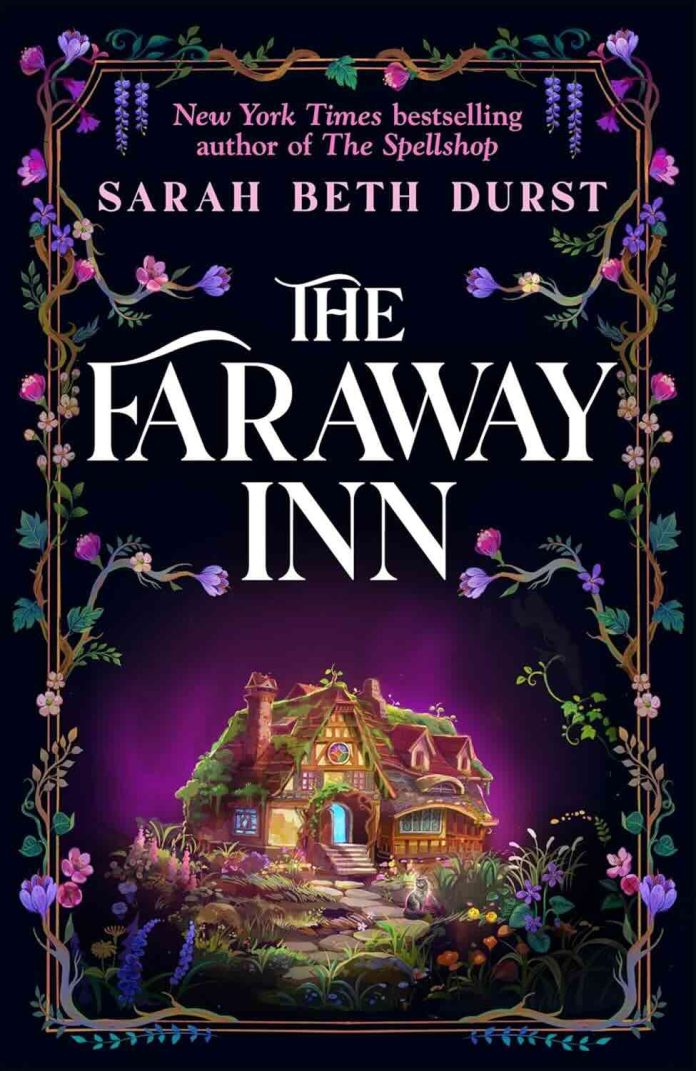
Sixteen-year-old Calisa shows up at her great-aunt’s Vermont bed-and-breakfast soggy, heartbroken, and immediately plunges chest-deep through a broken porch board. If you have read anything by Sarah Beth Durst before, that first chapter lands like a promise: things here are strange, things here are warm, and the strangeness is the point.
The Faraway Inn by Sarah Beth Durst is the third entry in her Cozy Fantasies series, following The Spellshop and The Enchanted Greenhouse. Like those books, it offers domestic, emotionally grounded magic at close range. Unlike sweeping epic fantasy, the stakes here are intimate: a crumbling inn that needs saving, a great-aunt who bristles at help, and a girl who needs to work out who she is when she’s no longer defined by the boy who cheated on her.
Where Vermont Meets the Very Uncanny
The setup does exactly what it should. Calisa, eager for distance from her heartbreak, arrives at the Faraway Inn expecting hard work and pine trees. What she finds is a three-story architectural disaster being slowly consumed by vines, a handful of guests who appear at odd hours, a groundskeeper’s son named Jack who is simultaneously warm and skittish, and a great-aunt who keeps insisting she leave.
Durst writes Calisa’s inner voice with a light, knowing touch. She’s funny without performing humor, self-aware without being paralyzed by it, and likable in the way of someone who would start a detailed conversation about cheese taxonomy while stuck in a hole in a porch. She anchors a story that gets progressively stranger, and that groundedness is part of what makes the magical reveals work. When Calisa starts noticing that the inn is hiding something beyond crumbling plasterwork and suspicious closets, you’ve already learned to trust her perception.
The inn itself is rendered with real care: dusty sitting rooms with furniture shaped like sea shells and tree stumps, a library with a rolling ladder that has opinions, a mirror that Auntie Zee describes as “an asshole” and absolutely earns that description. The Vermont setting feels lived-in rather than decorative. Durst layers sensory details throughout, the petrichor after rain, dried herbs in the kitchen rafters, a dozen maple syrup flavors arranged lovingly on a single shelf. Structurally, the prose stays tight inside Calisa’s perspective, which means the reader discovers things at exactly her pace, a fair amount of intentional confusion before the larger picture comes into view.
Auntie Zee and the Art of Refusing Help
One of the more interesting dynamics in The Faraway Inn by Sarah Beth Durst is the relationship between Calisa and her great-aunt. The innkeeper is gruff, stubborn, and deeply resistant to assistance, even when her inn is one missed repair away from being reclaimed entirely by the Vermont forest.
But Durst never lets Auntie Zee become a simple obstacle. Her refusal to accept help is rooted in something recognizable: pride in what she built, grief at what she can no longer do alone, and the fear that asking for help is the same as admitting defeat. These layers make her feel real. She’s difficult in ways that resonate beyond fiction, and Calisa’s slow, imperfect attempt to win her over is one of the book’s quieter pleasures.
A Cast Worth Knowing
Where the book really earns its pages is in the guest roster. The inhabitants of the Faraway Inn are a wonderfully odd collection: a theatrical gentleman who makes exquisitely good hot chocolate and carries antique vials in his robe; a regal, perpetually damp woman who doesn’t suffer fools; a green-haired newcomer who screams when vines are cut and communes cheerfully with beavers; and a winged lizard named Steve who appoints himself Calisa’s companion and never once apologizes for it.
Each guest arrives carrying their own wound. That’s the thematic through-line: the inn as refuge for those who need room to breathe, to think, to grow at their own pace. Durst never makes it heavy-handed. It emerges through small moments, a late-night conversation over hot chocolate, a pep talk delivered beside a rosebush, a silent exchange with a garden statue who can only answer yes-or-no by turning her head. The inn offers space; what guests do with that space is their own business.
Jack, as the love interest, is handled with care. He’s earnest and visibly burdened, anxious about the inn, about his long-absent father, about whether he’s even allowed to want more for himself. The slow burn between him and Calisa is paced well, built on shared competence and quiet trust before anything bigger unfolds.
The Magic Works, Mostly
The fantasy mechanics in The Faraway Inn by Sarah Beth Durst are inventive and pleasingly strange: portals behind closet doors, a night market that trades in bottled emotions, creatures from worlds that shouldn’t quite exist. The worldbuilding stays suggestive rather than encyclopedic, which suits the cozy atmosphere.
Where the book finds less sure footing is in pacing. The transition from quirky-inn story to portal fantasy takes time, and there’s a stretch where mysteries accumulate faster than the emotional momentum does. Some of the guest storylines feel more like charming vignettes than fully woven threads, and the final act resolves several knotted problems faster than readers might like. The magic also requires Calisa to experience a kind of epiphany as a plot mechanism, and while the intention is clear, the execution leans on slightly abstract terms.
That said, Durst handles the emotional core with skill. Calisa learning to ask for help, to accept love, to trust her own instincts rather than measure her worth by someone else’s opinion of her, is the real story here. The magical metaphors are earned, not decorative.
Should You Read It?
The Faraway Inn by Sarah Beth Durst is precisely the book it wants to be: comforting, inventive, and warm without cloying. The food descriptions alone may inspire midnight pancake cravings. Readers who loved The Spellshop will recognize the same voice applied to a setting with more interpersonal friction and a stronger romance thread. For those new to Durst’s work, this is an accessible and satisfying starting point.
If This Book Is Your Kind of Thing, Try These Next
- The House in the Cerulean Sea by TJ Klune: magical guesthouse, unusual residents, and all the warmth of found family
- Howl’s Moving Castle by Diana Wynne Jones: a magical residence, a practical heroine, and a romance built on competence and banter
- A Witch’s Guide to Escape by Alix E. Harrow: a magical library as sanctuary, emotionally grounded and beautifully written
- Practical Magic by Alice Hoffman: witchcraft, family secrets, and healing for readers who want something with a bit more bite
- The Girl Who Drank the Moon by Kelly Barnhill: a gentle YA fantasy about inherited magic, love, and the courage to let light back in







