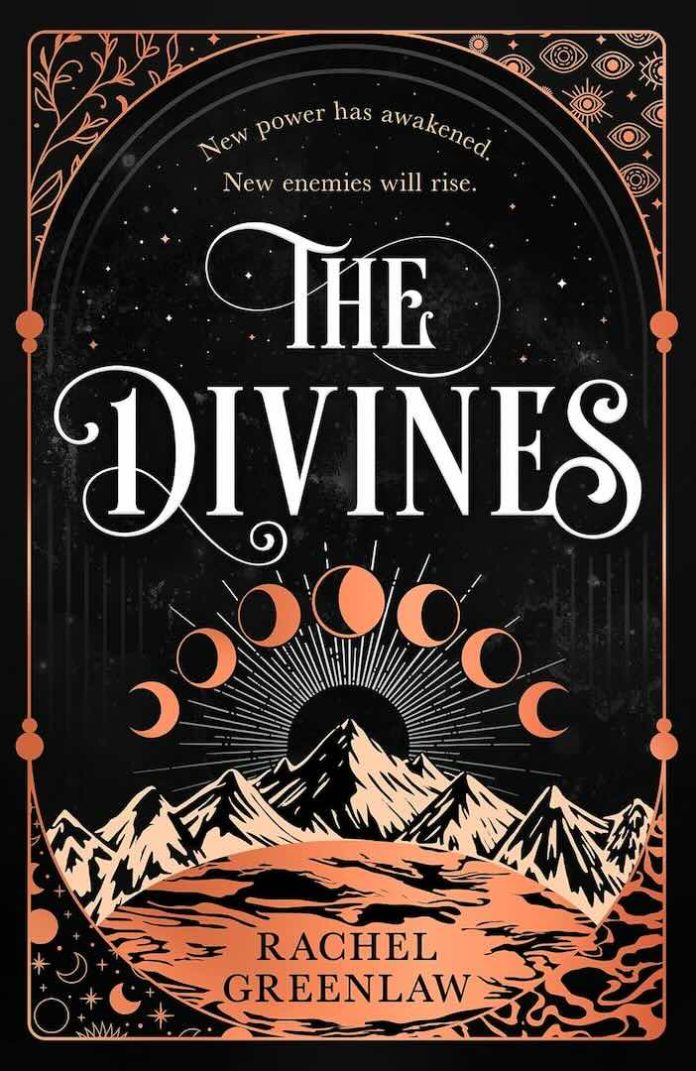
Four weeks after the attack that ended the first book, the maze outside Killmarth College is full of monsters and the newly qualified scholars are being sent in to practise on them. The war is live, the Crown’s forces are split across two fronts, and the one weapon that might end the hunts for good is an elixir missing a single ingredient. Then the people who knew which ingredient are killed at a wedding. The Divines by Rachel Greenlaw picks up the Killmarth Trials at a dead sprint and does not slow down for anybody who skipped the first volume.
Where The Divines by Rachel Greenlaw Begins
This is the second half of a duology, and it is a true conclusion rather than a middle book. The grief is already in progress when it opens. One scholar has been in an armchair facing the sea for two days and has to be bathed and dressed by a friend. A professor is a shell. A mentor is dead and her books have been left outside a door with a note.
That choice pays off, because the novel is not interested in reintroducing itself. Within forty pages there is a secret meeting, a map with crosses on it, a vial of something that glows, and the admission from the woman representing the Crown that they are losing. The Divines by Rachel Greenlaw assumes you remember the taxonomy, the houses and the traitor from last time, and gets on with the business of spending the characters it has.
What Rachel Greenlaw Does With the Rules
The magic is the best-engineered element here, because it is constrained.
Alchemists change the state of things that do not grow or breathe, and they build portals and the bridges that run between them. Botanists grow and heal. Illusionists work on the senses. Masquiers change shape, including into werewolves. Every working draws on a personal well, and when the well runs dry the nosebleeds start and then the collapse. Crossing between worlds needs three wielders, and reaching the vampires’ world needs a vampire, which is why the plot’s engine is a theft rather than a battle.
The training scenes are where that specificity earns its keep. A blindfolded exercise in a far corner of a room, with instructions to turn every lump of matter on a distant table into silver, and the slow discovery that clay explodes and stone will not budge. A duel fought through a locked door, won by a thrown picture frame. An opponent who makes the staircase disappear a step at a time, then moves the steps to himself. These are the pages where the dark academia framing stops being a label and becomes a method.
Rachel Greenlaw and the Problem of Scripture
The best idea in the novel arrives two thirds through, in a hidden castle in the territory that executes people for having magic.
The elders there keep the gods’ stories. They are not atheists; they are archivists, and they distinguish between the gods and the church that claims to speak for them. What they hand over is an account of how the vampires were made that is nothing like the official version, and the reason is simple. The scripture of this world was dictated by the gods themselves to the people who founded the church, which means it is a document written by the winners of an argument about which the losers were never consulted.
So the real history survives in the oral tale of a goddess everyone filed as minor. The Divines by Rachel Greenlaw builds its endgame on that, and it is a genuinely satisfying piece of construction: the thing that was skimmed past as a decorative little story about flowers turns out to be the key, precisely because it was written to look unimportant.
The chapter titles do similar work. They swing between funereal and flippant, from “A Garden of Graves” and “God Trap” to “Grumpy Gargoyles” and a title about what girls actually want instead of flowers. That tonal split is the whole book in miniature.
Where The Divines by Rachel Greenlaw Gives Ground
- The deadline is announced rather than felt. Nine days. Ten days. A moon turn. Characters tell each other the number at intervals, and the figure keeps shifting, which drains the urgency out of the one device meant to supply it.
- The romance takes up room the plot cannot spare. The sex is frequent, lengthy and structurally very similar from scene to scene, and it lands at implausible moments: the night before a battle, minutes after an injury, on a balcony with a crisis unresolved downstairs. One or two of these are electric. Six is a pacing problem.
- Borrowed power is too convenient. Whenever the narrator is overmatched she reaches into another wielder’s well and takes what she needs, and the rules governing that are established roughly when the plot requires them.
- The cast is overcrowded with casualties. Four or five senior scholars arrive with one trait each, and several exist to die. The novel is honest enough to have a character note that one of them went unmourned, which is accurate and also the problem.
Do You Need the Earlier Book?
Yes, and unusually for a sequel, the answer is not negotiable. The Divines by Rachel Greenlaw opens on the emotional aftermath of events you have not witnessed, with a cast already bereaved, a magic system already taught and a conspiracy already resolved. Read The Ordeals first. There is no version of starting here that works.
Content Notes
Explicit sex, repeatedly and at length, including biting and blood drawn during sex. A war waged mostly against civilians: a school massacred, a wedding party slaughtered, a ballroom of guests fed on. Graphic throat wounds, broken necks, a body missing its head, a man bleeding out on stone. On-page torture, with a blade driven through a captive’s hand and twisted for information, narrated by the woman doing it. A second instance described after the fact. Bereavement throughout: one character is catatonic with grief, another is hollowed out by it. Assisted death discussed at length, with one character asking a friend to kill him rather than let him become something else. Suicidal despair. A thrown blade in a shoulder and the surgery that follows. Religious persecution as a system, with a state hunting and executing people for an inherited trait, including a mother’s account of her daughter’s trial and death. Coercive guardianship of a child, including confinement in a vault as punishment and a blood-bound bracelet worn from the age of six.
Read These Next
Five of ours for readers finishing The Divines by Rachel Greenlaw.
- The Ordeals by Rachel Greenlaw is where the trials and the taxonomy begin.
- The Woodsmoke Women’s Book of Spells by Rachel Greenlaw is her gentler register, and a good palate cleanser.
- The Will of the Many by James Islington for a school where power is literally borrowed from other people.
- Arcana Academy by Elise Kova if the magical-college structure is the draw.
- The Aftermyth by Tracy Wolff for gods behaving badly at close range.
Readers who want the author’s other work should look up her young adult trilogy, Compass and Blade, Shadow and Tide and Starlight and Storm, which is sea-magic rather than campus-magic.
Worth Your Shelf
What stays is not the vampires and not the war. It is the guardian: a man who clamped a bracelet on a six-year-old, locked her in a vault as punishment, trained her by making himself the wall she threw herself against, and who is slowly re-read across four hundred pages until the cruelty resolves into terror. He is the best-written relationship in the novel and he is not the love interest.
The Divines by Rachel Greenlaw announces its countdown more than it dramatises it and spends too long in bed, and it still closes the duology properly. It understands that the most dangerous thing in any mythology is not the monster the goddess made. It is the official account of why she made it, and who was allowed to write it down.







