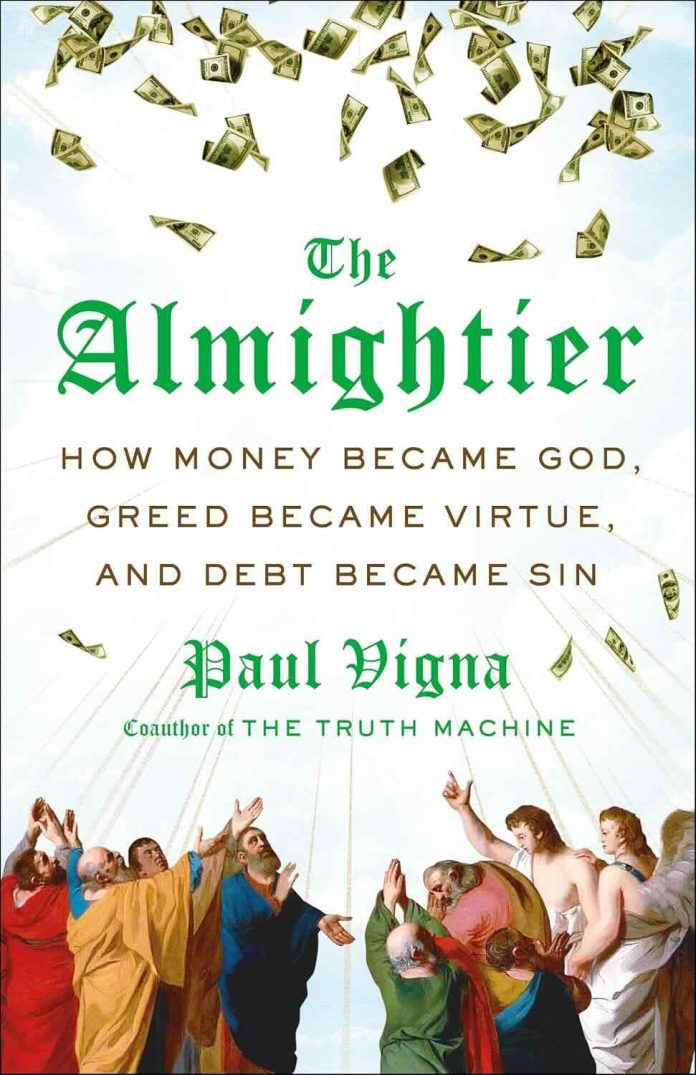
Paul Vigna’s The Almightier arrives at a moment when our relationship with money feels increasingly toxic. The veteran Wall Street Journal reporter, known for his previous works on cryptocurrency and blockchain technology, ventures into far more ambitious territory with this sweeping historical narrative that traces how money evolved from a simple accounting tool in ancient Mesopotamian temples to what he argues has become our modern secular religion.
The Central Thesis: Money as Religion
Vigna’s core argument is both provocative and meticulously researched: money has gradually replaced traditional religion as the organizing principle of Western society. Unlike other financial histories that focus on economic systems or market mechanisms, The Almightier by Paul Vigna examines money as a belief system with its own moral framework, rituals, and sacred spaces. The author traces this transformation across five millennia, from the temple scribes of ancient Uruk to the gleaming towers of Wall Street.
The book’s most compelling insight emerges from Vigna’s analysis of how religious authority and monetary power have been intertwined since civilization’s earliest days. He demonstrates how temple officials like Kushim, a Mesopotamian accountant whose clay tablets represent some of humanity’s oldest writing, established money not just as a measurement tool but as something imbued with divine authority. This connection between the sacred and the financial, Vigna argues, never truly disappeared—it simply evolved.
Structure and Narrative Arc
The Almightier by Paul Vigna unfolds in two parts that chronicle money’s theological evolution. Part I traces the historical development from ancient temple accounting systems through the Renaissance banking revolution, focusing particularly on figures like Cosimo de’ Medici and the philosophical shift that made greed socially acceptable. Part II examines how Protestant theology, particularly John Calvin’s teachings about wealth as divine favor, provided the moral foundation for modern capitalism.
Vigna’s journalistic background serves him well in crafting accessible narratives around complex historical developments. His description of how Poggio Bracciolini’s 15th-century dialogue De avaritia intellectually legitimized greed as potentially beneficial reads like a thriller, complete with political intrigue and moral conflict. The author’s ability to make medieval banking practices feel relevant to contemporary readers represents one of the book’s greatest strengths.
Strengths: Deep Research and Contemporary Relevance
The book’s research foundation is impressive. Vigna draws from sources spanning anthropology, theology, economic history, and philosophy to construct his argument. His analysis of Max Weber’s The Protestant Ethic and the Spirit of Capitalism feels particularly fresh, as he builds upon Weber’s insights about capitalism’s religious origins while extending them to examine money’s evolution into what he terms “the Almightier.”
Vigna excels at connecting historical developments to contemporary issues. His exploration of how debt jubilees functioned in ancient societies feels especially relevant given current debates about student loan forgiveness and wealth inequality. The author’s background covering financial markets adds credibility to his observations about how modern financial institutions deliberately employ religious imagery and architecture to reinforce money’s quasi-sacred status.
The writing style itself deserves recognition. Vigna adopts a conversational yet authoritative tone that makes complex historical and theological concepts accessible without oversimplification. His occasional use of contemporary analogies—comparing ancient Uruk to New York City, for instance—helps readers understand the scale and significance of historical developments.
Critical Weaknesses and Limitations
Despite its ambitions, The Almightier by Paul Vigna suffers from several significant limitations. The book’s scope, while impressive, sometimes works against its central argument. Vigna attempts to cover five thousand years of history across multiple civilizations, resulting in some superficial treatment of complex topics. His analysis of Islamic and Eastern perspectives on money and wealth feels particularly underdeveloped, limiting the book’s claims to universality.
The author’s thesis, while provocative, occasionally feels overstated. His argument that money has completely replaced traditional religion overlooks the continued influence of religious institutions and beliefs in modern society. While declining religious observance in Western societies supports part of his argument, Vigna doesn’t adequately address how traditional faiths continue to shape attitudes toward wealth and economic behavior.
The book’s treatment of potential solutions feels frustratingly brief. After spending hundreds of pages documenting how money became “the Almightier,” Vigna offers only limited suggestions for addressing the problems he identifies. His proposal for a global debt jubilee, while historically grounded, receives insufficient analysis regarding practical implementation challenges.
Weber’s Shadow and Vigna’s Innovation
Vigna’s engagement with Max Weber represents both the book’s greatest strength and a potential weakness. While his analysis of Weber’s insights about capitalism’s religious origins is sophisticated and well-argued, some readers may feel that Vigna’s central thesis simply extends Weber’s century-old observations rather than offering fundamentally new insights.
However, Vigna’s contribution lies in his detailed historical documentation of how this process unfolded. His exploration of figures like Cosimo de’ Medici and the intellectual evolution that made greed socially acceptable provides concrete historical mechanisms for abstract sociological theories. The author’s analysis of how Protestant theology provided moral justification for wealth accumulation offers valuable historical context for understanding contemporary attitudes toward inequality.
Contemporary Relevance and Practical Implications
The Almightier gains particular relevance in light of recent economic crises and growing wealth inequality. Vigna’s analysis of how financial institutions deliberately employ religious symbolism and architecture to reinforce their authority feels especially pertinent given ongoing debates about corporate power and economic justice.
The author’s exploration of debt jubilees offers historical perspective on contemporary policy debates. His documentation of how ancient societies periodically canceled debts to prevent economic collapse provides relevant context for discussions about student loan forgiveness and systemic debt relief.
Comparison to Similar Works
Vigna’s work joins a growing literature examining money’s cultural and psychological dimensions, including books like:
- David Graeber’s Debt: The First 5,000 Years – Offers complementary analysis of debt’s role in human societies
- Niall Ferguson’s The Ascent of Money – Provides more traditional economic history perspective
- Michael Lewis’s financial journalism – Shares Vigna’s accessible approach to complex financial topics
- Thomas Piketty’s Capital in the Twenty-First Century – Examines wealth inequality from economic perspective
Unlike these works, Vigna uniquely focuses on money’s quasi-religious functions and moral dimensions rather than purely economic or political analysis.
Final Assessment: Ambitious but Incomplete
The Almightier succeeds as an ambitious intellectual history that challenges readers to reconsider their assumptions about money’s role in society. Vigna’s central thesis—that money has evolved into a secular religion—provides a compelling framework for understanding contemporary economic behavior and cultural attitudes toward wealth.
The book’s greatest achievement lies in its historical documentation of how religious and monetary authority became intertwined throughout Western civilization. Vigna’s analysis of figures like Cosimo de’ Medici and theological developments around wealth provides valuable insights into capitalism’s moral foundations.
However, the work’s scope sometimes exceeds its analytical depth. Vigna’s attempt to cover five millennia of history across multiple civilizations results in some superficial treatment of complex topics. The book would benefit from either narrower focus or expanded length to adequately support its sweeping claims.
Despite these limitations, The Almightier by Paul Vigna offers valuable perspectives on one of humanity’s most important inventions. Vigna’s background as a financial journalist brings practical credibility to abstract theoretical discussions, while his accessible writing style makes complex historical and theological concepts understandable to general readers.
The book succeeds in its primary goal of encouraging readers to think critically about money’s role in modern society. Whether or not one accepts Vigna’s thesis that money has become our primary religion, his historical analysis provides valuable context for understanding contemporary economic challenges and cultural attitudes toward wealth.
Recommended Similar Reading
For readers interested in exploring these themes further:
- David Graeber – Debt: The First 5,000 Years – Anthropological perspective on debt and credit
- Max Weber – The Protestant Ethic and the Spirit of Capitalism – Foundational analysis of capitalism’s religious origins
- Niall Ferguson – The Ascent of Money – Traditional economic history approach
- Michael Lewis – The Big Short – Contemporary financial journalism
- Thomas Piketty – Capital in the Twenty-First Century – Economic analysis of wealth inequality
- Georg Simmel – The Philosophy of Money – Sociological examination of money’s cultural role
The Almightier deserves attention from anyone interested in understanding how historical developments continue to shape contemporary economic behavior and cultural attitudes toward wealth and success.







