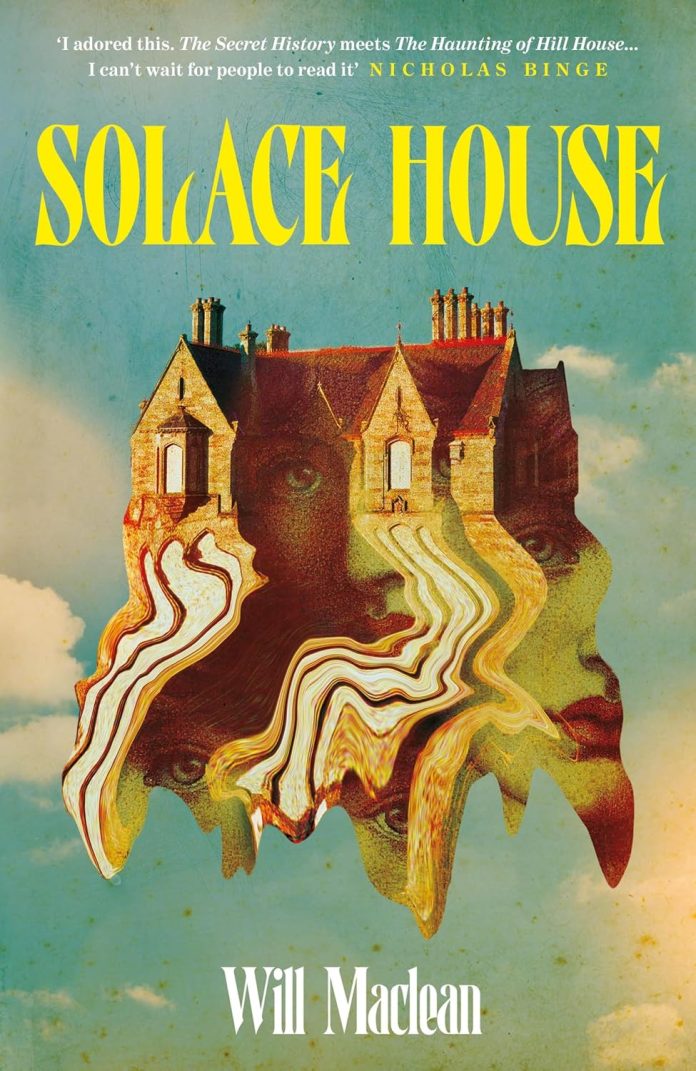
Alex Lane is nineteen, has made no plan for the summer, and cannot go home, because there is no home and no one left in it. Everyone else at his hall of residence is collected by embarrassed parents in small cars. He watches from a third-floor window as the building empties, then counts the lights still burning at night and finds there is only one other. Solace House by Will Maclean begins with a very ordinary horror: being the last person in a building designed for hundreds.
What rescues him is a summer job. A university wants to buy a former sanatorium and the enormous private house beside it, and neither can be surveyed until they are emptied. Eight students, three hundred pounds a week, board included.
How Solace House Works
The sanatorium is straightforward. The house is not.
Edwin Flayne died at a hundred and one, having lived alone there for roughly sixty years, and in that time he filled the place. Not untidily. Systematically. Fifty rooms, floor to ceiling, newspapers and boxes and objects packed so densely that only two channels remained: one from the front door to the foot of the stairs, one from there to the three squalid rooms he actually inhabited. The crew have to work upwards, clearing the staircase first, because nobody knows whether the rubbish is load-bearing.
They find things as they climb. Photograph albums in which Flayne’s face has been scratched out of every single image and repainted, always with the same horned, snouted, mouthless creature. An attic hung with several hundred of his own oil paintings, each swarming with detail. Three padlocked doors. A library burned book by book, the ash swept up and returned to the shelves in neat piles. And a room whose every surface, floor and ceiling included, is mirror.
The mechanism at the centre of Solace House by Will Maclean is a book of verse: one hundred and twenty-three quatrains, hand-illuminated, apparently the ramblings of a lonely madman. It is not. Take the first letter of every word and a second, shorter poem falls out. Do it again and a third appears. Keep going and the poems compress, four times over, until what is left is a single word, and that word is a confession about a murder committed decades before anyone in this book was born.
What the Solace House Puzzle Is Doing
That trick could be a gimmick, and in a lesser novel it would be. In Solace House by Will Maclean it earns its place, because the shape of the puzzle is the shape of everything else.
Flayne’s obsession has a name, given in the text: horror vacui, the abhorrence of empty space. The reference point is Richard Dadd’s The Fairy Feller’s Master-Stroke, a small canvas crammed with impossible detail, worked on for years by a painter confined to an asylum after killing his father. Dadd’s painting recurs throughout, and by the last page it has stopped being a comparison and become the book’s final image.
So the house is a maze; the garden behind it is a yew maze gone feral; there is a cave under the hill carved with Neolithic spirals, which are themselves mazes; and the poem is a maze of poems. Mazes inside mazes, and at the centre of each one, something the builder could not look at directly. It is a very tidy design, and it does not announce itself.
What Works
- The two readings. Every supernatural event in Solace House by Will Maclean has an exact psychiatric twin, and the novel declines to choose. This is not fence-sitting; it is the point, and the last hundred pages hold both possibilities open without going slack.
- Clive. A permanently stoned maths postgrad, casually cruel, extremely funny, and the first to notice that history is being edited when a song he has known since childhood turns out to be by the wrong band.
- 1993 without the costume-box treatment. Jazz-funk compilations bought to impress a girl, a radio whose batteries keep dying, a speech about how the coming decade will be characterised by kindness. Read now, that speech is quietly brutal.
- The set pieces are genuinely frightening. The mirrored room, in particular, where a group of people cannot find the door.
- The hoard is written with real attention. Not as spectacle but as pathology, with a specific loss underneath it.
Where Solace House Gives Ground
- Solace House by Will Maclean is five hundred pages and behaves like it. The sanatorium section runs well over a hundred pages before anyone sets foot in the house, and the fetch-and-carry rhythm is enacted on the reader rather than described.
- The narrator withholds for the plot’s convenience. Alex deflects every question about his parents with a joke naming a different fictional orphan. Charming twice; visible machinery by the twentieth time, and it keeps his backstory offstage for four hundred pages.
- Helen is a punchbag for too long. The devout, literal, exhausting member of the group is mocked by the others and by the narration itself, and only granted an interior life once she is in a state to be pitied.
- Ella is more function than person. Sharp and funny and built almost entirely out of her effect on the narrator, then removed at the two-thirds mark.
- The antagonist belongs to a different book. The obsession works. What he eventually does feels imported from a slasher.
Read It If
- You want horror that is structural rather than atmospheric, and you enjoy being handed a puzzle you can actually solve.
- A five-hundred-page slow burn with a hallucinatory final act sounds like a good weekend.
- You like an ending that refuses to tell you which of two explanations is correct, and means it.
Skip It If
- You need a clear answer about what was real.
- Detailed self-harm, suicide and a description of self-trepanation are not something you can read right now.
- You want a brisk haunted-house novel. Solace House by Will Maclean is not in a hurry at any point.
Content Notes
Solace House by Will Maclean earns a long list. Suicide and self-harm shown on the page. A fatal car crash in which a passenger dies slowly in front of the driver. Multiple murders. Drink-spiking with hallucinogens and a long non-consensual trip. Self-trepanation, described plainly. Homelessness and addiction. Domestic violence and the stalking of a woman and child across years. Extensive drug use throughout.
Read These Next
- Starling House by Alix E. Harrow, for another house that is an argument rather than a setting.
- The September House by Carissa Orlando, if a narrator whose account of a haunting cannot quite be trusted is the appeal.
- The House That Eats the Dead by Max Doty, for a building with an appetite and a long memory.
- Gothictown by Emily Carpenter, for the same interest in property, inheritance and what a place will demand from newcomers.
- The Apparition Phase by Will Maclean, his first novel, which shares this one’s fondness for English suburban dread and a period setting rendered without nostalgia.
Worth Your Shelf
The detail that lingers is the burned library. A man methodically destroying his own books one at a time, sweeping each one up, and returning its ashes to the exact centre of the shelf where it had stood. He could not bear an empty space, so he filled it with the remains of what used to be there.
Solace House by Will Maclean is too long, its central group is unevenly drawn, and its villain is broader than the book around him. It is also the most ambitious English horror novel published this year, and the only one that has bothered to hide a working cipher inside itself and then trust readers to find it. Five years in the writing, apparently, and the labour shows in the right places. Read it slowly. The poem is not decoration.