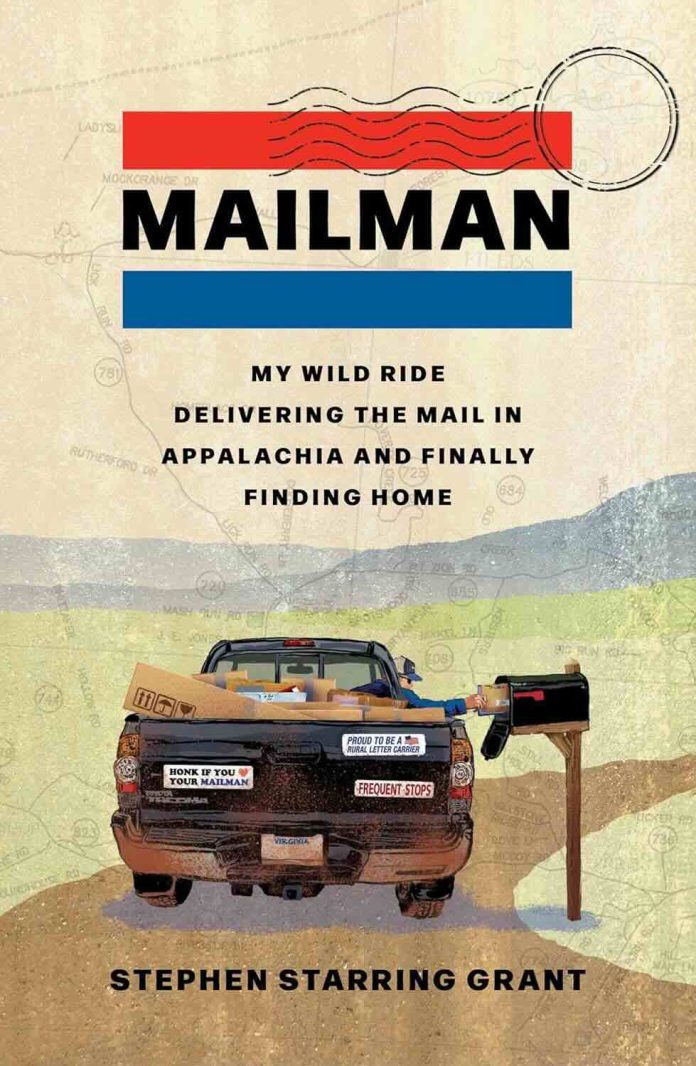
Stephen Starring Grant’s Mailman: My Wild Ride Delivering the Mail in Appalachia and Finally Finding Home arrives at a moment when Americans are wrestling with questions about purpose, community, and what it means to serve something larger than oneself. This memoir chronicles Grant’s transformation from a laid-off marketing consultant to a rural mail carrier in his hometown of Blacksburg, Virginia, during the pandemic’s early months—a journey that becomes both deeply personal and surprisingly universal.
The Story Behind the Story
The narrative begins with stark vulnerability. Grant, at fifty and recently diagnosed with cancer, finds himself unemployed when the pandemic shutters his boutique marketing consultancy. Needing health insurance desperately, he takes what seems like a temporary position as a Rural Carrier Associate with the United States Postal Service. What unfolds is a year-long odyssey that reconnects him with his Appalachian roots, his family, and his sense of civic duty.
Grant’s prose carries the conversational ease of someone who has spent decades in corporate boardrooms but retains the earthy wisdom of his mountain upbringing. His voice shifts seamlessly between self-deprecating humor and moments of genuine philosophical insight, creating a narrative texture that feels both accessible and intellectually substantial.
Strengths That Deliver
Authentic Character Development
Grant excels at portraying the colorful cast of postal workers who become his teachers and companions. Characters like Kat, his guardian angel trainer with a West Virginia accent “strong enough to remind me of my mamaw,” and Cash, whose quiet competence masks deep wells of integrity, emerge as fully realized individuals rather than workplace archetypes. These relationships provide the memoir’s emotional backbone, demonstrating how shared purpose can forge unlikely bonds.
Rich Sense of Place
The author’s descriptions of the Blue Ridge Mountains and rural Virginia landscapes are particularly compelling. Grant writes with the precision of someone who understands that geography shapes character. His route descriptions—from the Corporate Research Center’s maze of identical buildings to the muddy driveways of mountain hollows—create a vivid sense of the territory he covers, both literally and metaphorically.
Political Nuance in Polarized Times
One of the memoir’s most impressive achievements is its handling of political division. Rather than retreating into partisan talking points, Grant navigates the cultural tensions of contemporary America with remarkable dexterity. His encounters with customers across the political spectrum—from Trump supporters to university professors—are rendered with empathy and genuine curiosity about what drives people’s beliefs.
The Pandemic as Backdrop
Grant captures the surreal quality of 2020 without allowing it to overwhelm his personal story. The pandemic becomes a character in its own right, creating the conditions that lead to his career change while highlighting the essential nature of postal work during a time of national crisis.
Areas Where the Route Gets Bumpy
Structural Inconsistencies
While Grant’s episodic approach generally works well, some chapters feel more like collected anecdotes than integral parts of a cohesive narrative. The memoir occasionally loses momentum when it veers into extended tangents about postal history or technical details of mail sorting that, while interesting, don’t always serve the larger story.
Family Dynamics Underdeveloped
Although Grant writes movingly about his relationship with his daughters and his father’s death, some family relationships remain frustratingly opaque. His wife Alicia, who provides crucial support throughout his career transition, never fully emerges as a three-dimensional character. The memoir would benefit from deeper exploration of how his career change affected family dynamics beyond surface-level interactions.
Economic Realities Glossed Over
Grant acknowledges the financial hardship of transitioning from a well-paid consultant to a part-time postal worker, but he doesn’t fully reckon with the privilege that made this transition possible. His ability to take a massive pay cut while maintaining his family’s lifestyle suggests resources that many Americans facing similar job losses simply don’t have.
The Art of Blue-Collar Memoir
Grant joins a tradition of writers who find profound meaning in seemingly ordinary work. His prose style borrows from this lineage while maintaining its own distinctive voice. Like Matthew Crawford in Shop Class as Soulcraft or Tim Kreider in We Learn Nothing, Grant understands that physical labor can provide insights unavailable to purely cerebral pursuits.
The memoir’s greatest achievement lies in its portrayal of work as a form of service. Grant transforms the mundane act of mail delivery into something approaching sacred duty, writing: “The whole world is coming with all its inevitability—promises made and broken, cookbooks, novels, instruction manuals, histories of the distant and recent past… We carry it for you.”
Technical Mastery and Literary Merit
Grant’s background in marketing and his MFA from the Iowa Writers’ Workshop serve him well. His sentences carry the efficiency of business writing combined with the precision of literary prose. He has a particular gift for dialogue that captures regional speech patterns without caricature, and his descriptive passages achieve genuine lyrical beauty without becoming overwrought.
The memoir’s structure follows a traditional arc of crisis, transformation, and resolution, but Grant avoids the trap of neat conclusions. His year as a mailman doesn’t solve all his problems or provide easy answers about American division. Instead, it offers something more valuable: a model for how honest work and genuine human connection can provide meaning in uncertain times.
Critical Assessment
At approximately 300 pages, the memoir maintains good pacing throughout most of its length, though some middle chapters lag when Grant becomes too focused on postal procedures rather than personal development. His treatment of class issues, while generally thoughtful, occasionally reveals blind spots about his own privilege.
The book’s emotional honesty represents its greatest strength. Grant doesn’t present himself as a hero or his postal colleagues as saints. Instead, he offers a clear-eyed view of both the satisfactions and frustrations of service work, the dignity found in completing necessary tasks well, and the complex reality of contemporary American life.
Contemporary Relevance
Mailman by Stephen Starring Grant arrives during ongoing debates about remote work, the value of physical labor, and the role of government services in American life. Grant’s portrait of the Postal Service as a functioning institution worthy of respect provides a counternarrative to prevailing cynicism about government competence. His year-long immersion in mail delivery becomes a case study in how essential workers maintained society’s basic functions during unprecedented disruption.
Similar Reads for Further Exploration
Readers who appreciate Grant’s approach to blue-collar memoir and midlife transformation might also enjoy:
- Educated by Tara Westover – Another Appalachian memoir exploring education and family
- Shop Class as Soulcraft by Matthew Crawford – Philosophical examination of manual labor’s value
- The Tender Bar by J.R. Moehringer – Working-class memoir with similar humor and heart
- Hillbilly Elegy by J.D. Vance – Though more controversial, offers another perspective on Appalachian experience
- Nickel and Dimed by Barbara Ehrenreich – Classic exploration of low-wage work in America
- The Working Poor by David K. Shipler – Non-fiction examination of economic struggle
- Factory Man by Beth Macy – Virginia-based story of manufacturing and economic change
Final Verdict
Mailman: My Wild Ride Delivering the Mail in Appalachia and Finally Finding Home by Stephen Starring Grant succeeds as both personal memoir and social commentary. Grant’s year as a postal worker becomes a lens through which to examine larger questions about work, community, and purpose in contemporary America. While not without flaws, the memoir offers genuine insights about finding meaning through service and the value of essential work often taken for granted.
Grant has crafted a book that manages to be simultaneously specific to his experience and universal in its themes. His journey from corporate consultant to mail carrier illuminates possibilities for authentic work and genuine human connection that feel increasingly rare in our digital age. Most importantly, he demonstrates that meaning often emerges not from grand gestures but from showing up consistently, doing necessary work well, and serving others with dignity and respect.
For readers seeking inspiration about midlife career changes, insights into rural American life, or simply a well-told story about finding purpose through service, Mailman by Stephen Starring Grant delivers exactly what it promises: an honest, humorous, and ultimately hopeful account of one man’s unexpected path home.







