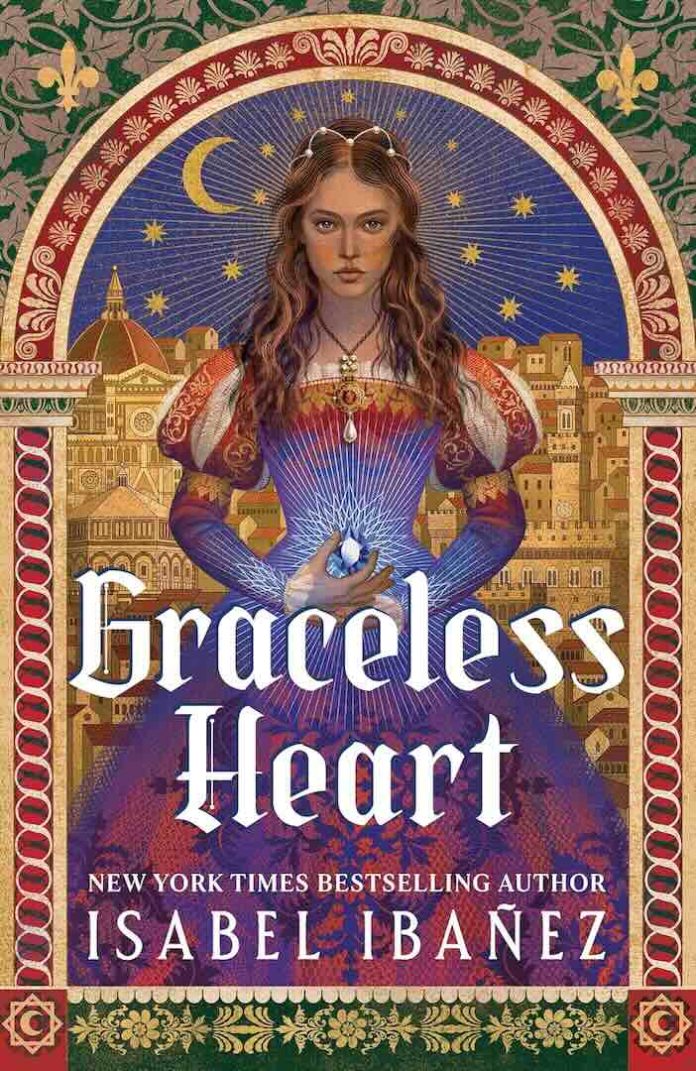
Isabel Ibañez returns to adult fantasy with Graceless Heart by Isabel Ibañez, a sumptuous Renaissance-set romance that asks what price we’re willing to pay for love, freedom, and survival. Set against the glittering backdrop of 1478 Florence during one of history’s bloodiest conspiracies, this standalone novel weaves together political intrigue, forbidden magic, and a slow-burn romance that’s as dangerous as it is irresistible.
A Sculptress Caught Between Stone and Salvation
Ravenna Maffei carries two burdens: a rare magical talent she’s spent her life concealing and the desperate need to save her brother Antonio from execution. When the immortal Luni family hosts a sculpting competition promising an “invaluable boon” to the winner, Ravenna sees her chance—only to find herself kidnapped and imprisoned in the Palazzo dei Luni, forced to complete an impossible task. But the Luni family isn’t her only problem. The Pope himself has recruited Ravenna as an unwilling spy, threatening her entire hometown with excommunication if she refuses.
Ibañez, author of the beloved What the River Knows duology and the critically acclaimed Woven in Moonlight, demonstrates her mastery of atmospheric world-building here. Florence comes alive through meticulous historical detail—from the shadow candles left as offerings to witches, to the flag-throwers practicing for Easter parades, to the very real threat of the Pazzi conspiracy brewing beneath the city’s artistic veneer. The author’s research shines through without overwhelming the narrative, creating an immersive experience that feels both authentic and enchanted.
The Architecture of Character
The heart of Graceless Heart by Isabel Ibañez beats strongest in its character work. Ravenna is a protagonist who earns our investment—practical, determined, and deeply conflicted about her magical heritage. Her magic isn’t a gift that empowers her; it’s a deadly secret that could cost her everything. This internal conflict grounds the story in genuine stakes, making her journey toward self-acceptance as compelling as any external plot.
Saturnino dei Luni initially presents as the archetypal cold immortal—calculating, merciless, with a past full of shadows. Yet Ibañez slowly peels back his layers to reveal a man who has been profoundly hurt by immortality’s burden. His vulnerability, when it emerges, feels earned rather than convenient. The evolution of his relationship with Ravenna unfolds with delicious tension:
- Their early encounters crackle with antagonism and mistrust
- Shared moments reveal unexpected depths in both characters
- Physical chemistry builds naturally alongside emotional connection
- Their romance becomes intertwined with questions of faith, grace, and acceptance
However, some supporting characters don’t receive the same depth. The Luni family members beyond Saturnino can feel somewhat interchangeable, their motivations occasionally murky. Imelda’s arc, while interesting, sometimes gets lost amid the larger political machinations.
Where Magic Meets Mortality
The magic system in Graceless Heart by Isabel Ibañez centers on the pietra magiche—seven mystical gemstones with distinct powers. The Nightflame, which grants life and controls fire, becomes central to the plot’s stakes. Ibañez uses these gemstones as more than mere MacGuffins; they represent the intersection of art, faith, and power that defined Renaissance Italy.
What makes this magic compelling is its cost. Ravenna’s ability to work with the Nightflame isn’t presented as wish fulfillment—it’s dangerous, isolating, and feared. The theological implications of magic in a deeply Catholic society add fascinating moral complexity. When the Pope wages war against magic while secretly protected by it himself, the hypocrisy becomes a potent commentary on power and persecution.
Pacing Through Marble and Blood
The novel’s structure mirrors a sculpture taking shape—slow, deliberate work interrupted by sudden, violent changes. The first third establishes the world and stakes with careful detail, perhaps too carefully for readers seeking immediate action. Once the pieces are in place, however, the tension escalates beautifully. The Pazzi conspiracy’s integration into the plot is handled with impressive historical sensitivity, using real events to heighten fictional stakes.
Key strengths in plotting:
- The dual threats from the Luni family and the Pope create constant tension
- Historical events (the Pazzi conspiracy, the jousting culture) enhance authenticity
- Multiple POVs reveal different facets of the central conflict
- The final act delivers satisfying emotional and plot resolutions
Areas that could be stronger:
- The middle section occasionally stalls as Ravenna works on sculptures
- Some political machinations require careful attention to follow
- Resolution of certain plot threads feels rushed against the climax
Love, Faith, and Freedom
At its core, Graceless Heart by Isabel Ibañez explores what it means to be “graceless”—rejected by church, family, and society for who you are. Both Ravenna and Saturnino exist outside traditional salvation: she because of her magic, he because of his immortality. Their romance becomes an act of mutual acceptance, two people offering each other the grace their world denies them.
The religious themes are handled with surprising nuance. Ibañez doesn’t paint faith itself as the villain, but rather the corruption of religious authority for political gain. Ravenna’s spiritual journey—wrestling with shame over her magic while recognizing her own inherent worth—resonates deeply. The question of whether she needs the Pope’s absolution or can find her own path to grace provides genuine theological weight.
The sensuality builds naturally, with Ibañez balancing yearning glances and charged dialogue with appropriately steamy scenes that serve character development. The power dynamic between captive and captor is acknowledged and addressed, preventing the romance from feeling exploitative.
The Renaissance Rendered
Ibañez’s prose captures Renaissance Florence in all its contradictory glory—breathtaking beauty built on ruthless ambition, art flourishing alongside assassination, magic dancing with faith. Her descriptions of sculpture and artistic process demonstrate real understanding of the craft. When Ravenna works stone, feeling its resistance and possibility, the writing comes alive with tactile precision.
The author’s use of Italian chapter titles (Capitolo Uno, Capitolo Due) and period-appropriate terms creates immersion without becoming pretentious. Historical figures like Lorenzo de’ Medici appear as fully realized characters rather than name-drops, their complexity preserved.
For Readers Who Crave
Graceless Heart by Isabel Ibañez will particularly appeal to readers who loved:
- A Dowry of Blood by S.T. Gibson for its Gothic immortal romance
- The Priory of the Orange Tree by Samantha Shannon for epic fantasy with political intrigue
- Serpent & Dove by Shelby Mahurin for forbidden magic in historical settings
- Divine Rivals by Rebecca Ross for romantic tension during conflict
- The Invisible Life of Addie LaRue by V.E. Schwab for immortality’s costs
Fans of Ibañez’s previous works, especially Together We Burn and the Secrets of the Nile duology, will recognize her signature blend of romance, history, and magic, though this feels more mature in theme and execution.
The Final Verdict
Graceless Heart by Isabel Ibañez succeeds as a lush, romantic historical fantasy that prioritizes character depth and thematic resonance over breakneck plotting. It’s not perfect—the pacing occasionally drags, some secondary characters could use more development, and readers seeking constant action may find the contemplative middle section slow. Yet these flaws fade against the novel’s considerable strengths: a vividly realized Renaissance Florence, a romance that earns its emotional beats, and a protagonist whose journey toward self-acceptance will resonate long after the final page.
Ibañez has crafted a story about finding grace in graceless places, about love as an act of defiance against systems that demand conformity. In Ravenna and Saturnino, she’s created two people who refuse to accept the judgment of church or society, instead writing their own definitions of salvation. For readers willing to luxuriate in atmospheric prose, political intrigue, and a slow-burning romance that ignites into flame, this book offers rich rewards.







