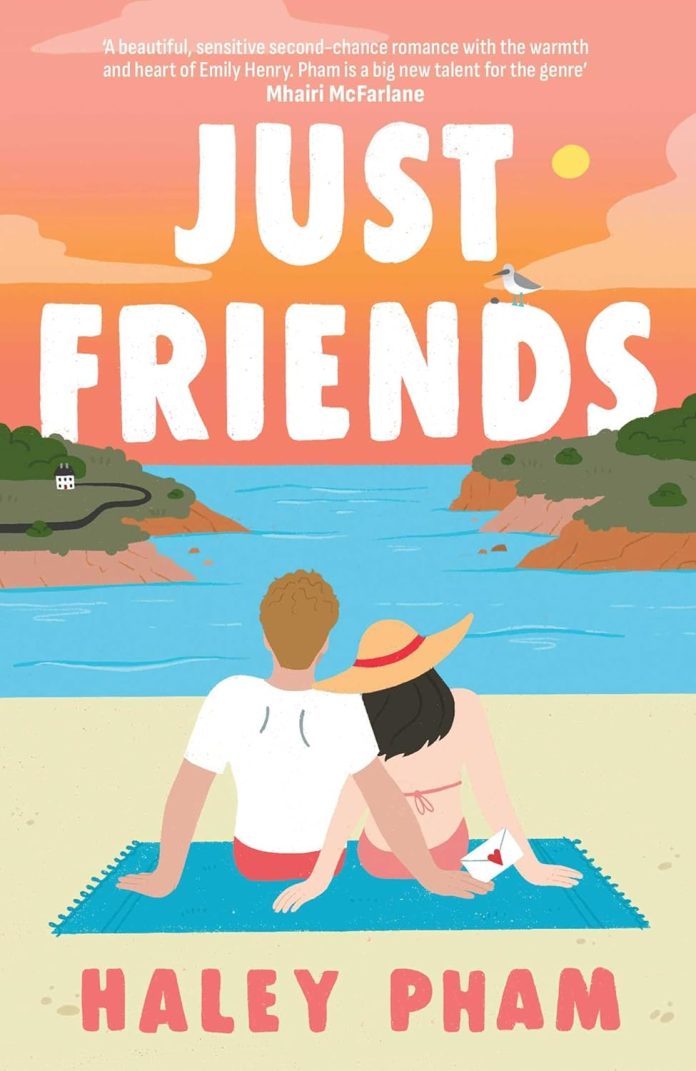
There is a particular ache that lives in the hollow between friendship and love, a space where words go unsaid and years slip through the cracks like sand between fingers. Just Friends by Haley Pham lives inside that ache, setting up camp there and refusing to leave until every last unspoken feeling has been dragged into the light.
Pham’s debut novel, published by Simon & Schuster, follows Blair and Declan, two childhood best friends from the fictional coastal town of Seabrook, California, who were inseparable for over a decade before a fight, a devastating accident, and four years of silence tore them apart. When Blair returns home to care for her dying great-aunt Lottie and support her overworked mother, the last thing she expects is to walk into a job interview at the local coffee shop and find Declan on the other side of the counter. What unfolds is a tender, achingly familiar story about what happens when the person who feels like home becomes the person you are most afraid to face.
The Dual Timeline That Holds You Hostage
One of the strongest structural choices in Just Friends by Haley Pham is the use of dual timelines. The narrative alternates between the present day, where Blair is navigating grief, career uncertainty, and the quiet devastation of seeing Declan again, and their shared past, beginning in high school when their friendship started to shimmer with something neither was brave enough to name.
The past timeline is where Pham’s writing truly shines. There is an almost unbearable tenderness to the scenes on the football field, during late-night study sessions, and on their first date at a hidden beach. Pham captures the exact texture of adolescent yearning, the way every accidental touch becomes a seismic event, the way two people can orbit each other for years without ever closing the gap. Blair’s internal monologue during these sections is devastatingly relatable, particularly her habit of lying to herself about the depth of her feelings and her reflexive use of humour to dodge vulnerability.
The present timeline carries the heavier load. Blair is dealing with Lottie’s stage-four lung cancer, the inherited cottage, her mother’s exhaustion from running seven convenience stores alone, and the deferred consulting job in New York that represented her entire plan for financial independence. There is a lot happening in Blair’s present, and Pham manages these threads with genuine care, even if the juggling act occasionally stretches thin.
Blair: Brilliant, Frustrating, and Painfully Real
Blair is one of those protagonists who will split readers right down the middle. She is sharp, self-deprecating, fiercely loyal, and deeply afraid of being left behind. Her fear is not arbitrary; it is rooted in her father’s abandonment when she was five, her mother’s quiet mantra that all men eventually leave, and the subsequent silence from Declan that seemed to confirm everything she dreaded.
What makes Blair compelling is also what makes her maddening. She runs. Physically, emotionally, conversationally. She deflects with humour so instinctively that she sometimes cannot tell when she is being genuine. When the emotional stakes get too high, when Declan says something too real, when vulnerability threatens to crack her carefully maintained composure, Blair bolts. It is a pattern Pham commits to with admirable consistency, and it gives the romance its central tension, but it also means that certain emotional beats in the back half of the book feel repetitive. Blair pushes Declan away, regrets it, circles back, and then does it again. The cycle is psychologically truthful, but it tests your patience by the third rotation.
Declan: The Quiet Anchor
Declan is the steadier presence. A former star quarterback whose career-ending accident reshaped his entire identity, he has rebuilt himself quietly, managing the coffee shop, building birdhouses, and carrying a wallet photo of Blair that he never got rid of. Pham writes him with a gentle, grounded masculinity that avoids the brooding-hero cliche. He is patient without being passive, honest without being confrontational, and wounded in ways he does not always know how to articulate.
His retelling of the accident is one of the most powerful scenes in the novel, delivered with the kind of rehearsed steadiness that only comes from having told a painful story too many times. It is in these quieter, more vulnerable moments that Just Friends by Haley Pham elevates itself beyond standard romance fare.
What Works Beautifully
Pham’s prose has a distinctive warmth to it, rich with similes and sensory detail that immerse you in Seabrook’s cypress-lined streets and salt-tinged air. There is a lyrical quality to her writing that occasionally borders on excessive but more often than not lands with genuine emotional impact. Her dialogue, particularly between Blair and Declan, crackles with the kind of easy, teasing rhythm that only exists between people who have known each other since before they had fully formed personalities.
- The grief storyline is handled with uncommon sensitivity, especially the portrayal of Blair’s relationship with Lottie and the generational weight of Lottie’s journey from wartime Vietnam to a quiet life in coastal California
- The supporting cast, particularly Harper at the coffee shop and Blair’s college friends Roshi and Faye, add texture and grounding without ever stealing focus
- The thematic layering around identity, abandoned dreams, and the difference between knowing something and believing it gives the romance genuine intellectual substance
- The setting of Seabrook itself operates almost as a character, its fairy-tale beauty contrasting with the very real pain its residents carry beneath the cobblestone surface
Where It Stumbles
As a debut, Just Friends by Haley Pham carries some of the growing pains you might expect. The simile density is notably high, and while many of them are clever and evocative, the sheer volume occasionally pulls you out of the narrative rhythm. When every emotion is compared to something, the comparisons start competing with each other for attention.
The high school dialogue, while charming, sometimes reads as too articulate and self-aware for seventeen-year-olds. Declan in particular speaks with a philosophical precision that feels slightly borrowed from the adult timeline rather than authentically teenaged. It is a minor quibble, but it occasionally disrupts the otherwise careful work Pham does in differentiating the two eras.
- The pacing in the middle section sags slightly under the weight of Blair’s indecision about the cottage, New York, and Declan, all circling the same emotional drain
- Gwen, Declan’s mother, functions as a late-stage conflict device whose intervention, while effective, feels somewhat underdeveloped compared to the rest of the novel’s emotional architecture
- The resolution wraps up several major life decisions with a speed that contrasts with the careful, slow build of everything that preceded it
A Debut That Announces Real Talent
This is Just Friends by Haley Pham at its core: a story about two people who were afraid that wanting each other would ruin the one thing they could not afford to lose. It is a debut that wears its heart not just on its sleeve but stitched across the entire garment, and while it is not without its rough edges, the emotional truth at its centre is undeniable.
Pham, who built her audience over a decade as a YouTube and BookTok creator, has transitioned to fiction with the kind of sincerity and emotional intelligence that cannot be faked. Just Friends by Haley Pham is not a celebrity vanity project. It is the work of someone who has clearly spent years absorbing what makes romance novels resonate and has poured that understanding into a story that feels distinctly her own.
For readers who love the emotional complexity of Emily Henry’s Happy Place, the coastal warmth of Sarah Adams’s writing, or the tender vulnerability of Lynn Painter’s Better Than the Movies, this one belongs on your shelf.
If You Loved This, Read These Next
- Happy Place by Emily Henry, for dual-timeline romance and the messy work of reconnection
- Better Than the Movies by Lynn Painter, for the same friends-to-lovers sweetness with a younger sensibility
- Just Last Night by Mhairi McFarlane, for grief intertwined with long-simmering romantic tension
- The Summer of Broken Rules by K.L. Walther, for a coastal setting and coming-of-age emotional stakes
- People We Meet on Vacation by Emily Henry, for best friends who cannot quite stay in the friend zone
- In a Holidaze by Christina Lauren, for second chances wrapped in a tight-knit family setting







