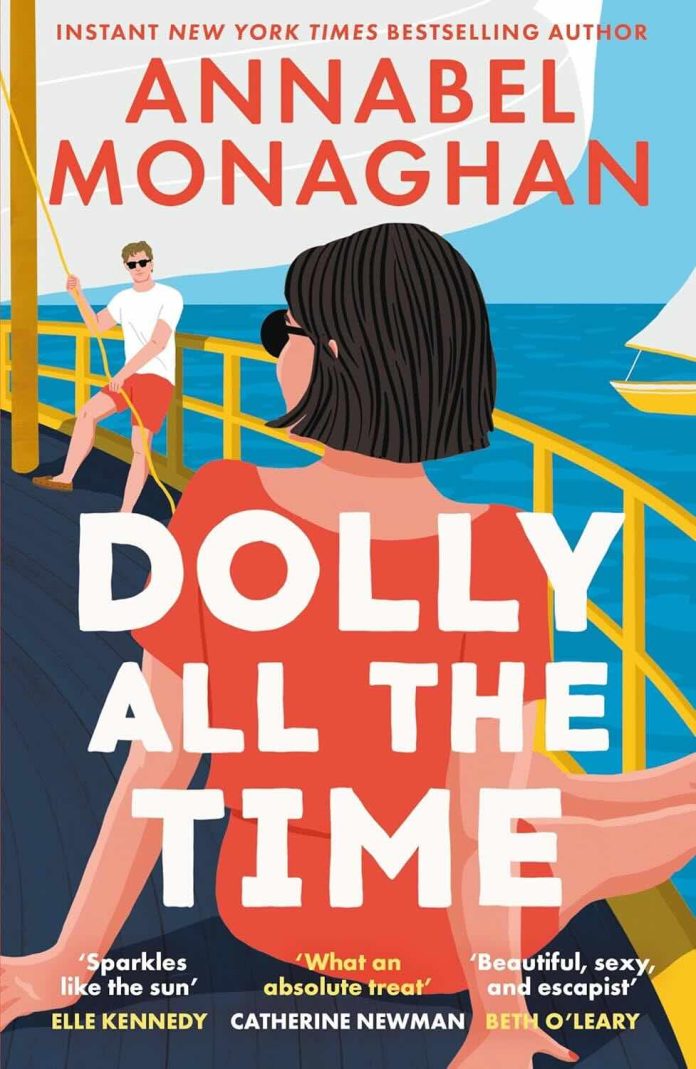
There’s a certain kind of romance novel that talks down to its reader, the kind that mistakes whimsy for character and a coastline for a plot. Dolly All the Time by Annabel Monaghan is not one of those. It’s a summer book with a brain, a single-mom heroine carrying too many side hustles, a fake-dating premise lifted straight from Pretty Woman, and a sneaky emotional core that catches you somewhere around chapter twenty.
Monaghan, whose previous novels include Nora Goes Off Script, Same Time Next Summer, Summer Romance, and It’s a Love Story, has built a small empire writing about women in their late thirties who still deserve a love story. This time she pushes her usual formula a little further, with mostly winning results.
The Setup
Dolly Brick is thirty-nine, raising her thirteen-year-old son Gus in Boston, teaching kindergarten by day, driving Uber when she can, and answering a recorded line for a sketchy sporting goods company in the moments between. When a small house fire forces her back to coastal Whitfield, Rhode Island for the summer, she’s planning to fix a sleeping porch, manage her brother Christopher’s medication, and keep her dad’s failing fish house from going under.
Then she meets Stewart Whitfield on the side of the road with a flat tire and no idea how to change it. He’s the heir to the largest local fortune, recently and publicly jilted by his fiancée, and in need of a girlfriend, fast. The deal he proposes is sixty thousand dollars for a summer of staged photo ops and gala appearances. She has a roof that needs replacing. You can guess where this is going. The fun is in how it gets there.
Dolly Herself, or Why This Heroine Lands
Most romance leads in this lane fall into one of two camps. Either the perpetually exhausted single mom whose problems get magic-wanded away by money, or the spunky working-class girl who sasses the billionaire into loving her. Dolly is neither. She’s funny in a tired way, the way real overworked people are funny, with a habit of cataloging her tasks the way other people doom-scroll. She has opinions about lint traps. She picks her contractor partly because the contractor can’t start for six weeks, which buys her time. That’s the kind of detail that tells you Monaghan has actually been broke.
Her interior voice is the engine of the whole book. Dolly’s narration runs in clipped, observant first-person present that reads almost like field notes from her own life. When she calls her father’s stubbornness anti-progress, when she nicknames her chaotic household the Cook House after circus performers, when she clocks the casual way rich people leave gold acorns out for the birds to ruin, you get a person, not a type.
The grief running under all of this gives the book its ballast. The phrase “Dolly all the time” pulls a quiet double-shift in the title. It is her son’s request that she be present for him. It is also her own slow bargain with herself to stop performing the eldest-daughter role for everyone she loves.
Stewart, the Other Half
Stewart could have been a problem. The handsome heir who can’t scramble an egg is a tired premise, and the early chapters lean into it a little too hard. There’s a stretch where his uselessness with practical tasks reads more like a sitcom bit than a character note. To Monaghan’s credit, she doesn’t keep him there. He has a sister who survived childhood cancer, a quiet anxiety around boats, a habit of going still under pressure, and a real sense of inadequacy underneath the Range Rover and the manicures.
Readers of Dolly All the Time by Annabel Monaghan will probably notice that the chemistry between these two takes its time. Their first real kiss happens deep into the book, and the slow burn pays off precisely because Monaghan refuses to rush it.
The Prose
Monaghan’s writing style is one of her trademarks, and it does most of the heavy lifting here. Short sentences. Small specific details. A self-deprecating wit that never tips into snark. She’ll describe a yacht club’s bread service in three sentences and somehow tell you what kind of woman has only ever seen it from the kitchen side. The texting exchanges between Dolly and her best friend Naomi feel like actual texts between actual women in their late thirties, complete with all-caps moments and inside jokes that have been running for thirty years.
Where the Book Sings
A short list of what Dolly All the Time by Annabel Monaghan gets exactly right:
- The eldest-daughter caretaker dynamic, especially a late-book conversation between Dolly and her sister Patsy that’s one of the most honest sibling scenes in recent commercial fiction.
- Christopher, whose disability is treated with affection and specificity rather than as a sentimental prop.
- The fish house. The mop bucket. Grandmother Maud’s iron Singer sewing machine on the sleeping porch. Setting treated as a working object, not décor.
- Gus, who reads as an actual thirteen-year-old boy, not a sitcom kid or a wise-beyond-his-years prop for his mother’s growth.
- Naomi, who sidesteps the snappy-sidekick trap. Her loyalty has texture and history.
Where It Falters
A balanced look at Dolly All the Time by Annabel Monaghan has to acknowledge a few places where the seams show:
- The fake-dating-for-cash setup leans on a contract premise the book wisely doesn’t take too seriously, but readers who want their tropes structurally airtight may find some logistical hand-waving.
- The third-act conflict resolves a touch quickly, with one significant emotional rift sewn up in fewer pages than it took to open.
- Stewart’s helpless-rich-guy bit, particularly around domestic tasks, dips into caricature in the early chapters before the book finds the real him.
- Some plot beats land exactly where genre veterans will expect them to land. This is not a story interested in subverting the rhythm of a fake-dating romance.
If You Liked This, Try
For readers coming to Dolly All the Time by Annabel Monaghan and looking for something in the same register:
- Every Summer After and This Summer Will Be Different by Carley Fortune, for similar small-coast-town summer-romance energy.
- Beach Read and Happy Place by Emily Henry, for the witty grown-woman first-person voice.
- Lovelight Farms and Good Spirits by B.K. Borison, for small-town fake-dating sweetness.
- The Flatshare by Beth O’Leary, for an unconventional setup that turns into something real.
- Sandwich by Catherine Newman, for the eldest-daughter-of-it-all energy.
Working backward through Monaghan’s own catalog is its own reward. Nora Goes Off Script remains her breakout for a reason, and Same Time Next Summer sets up some of the family-of-origin material she pushes further here.
The Verdict
Dolly All the Time by Annabel Monaghan is not the most original beach read on the shelf this summer, and it is not trying to be. What it is, is a beautifully observed, occasionally laugh-out-loud, surprisingly emotional story about a woman learning that being needed is not the same as being known. The fake-dating bones are familiar. The marrow is something a little rarer. By the time the season ends and the acorns fall and Dolly figures out what she wants for herself, you will be glad you spent the summer in Whitfield.







