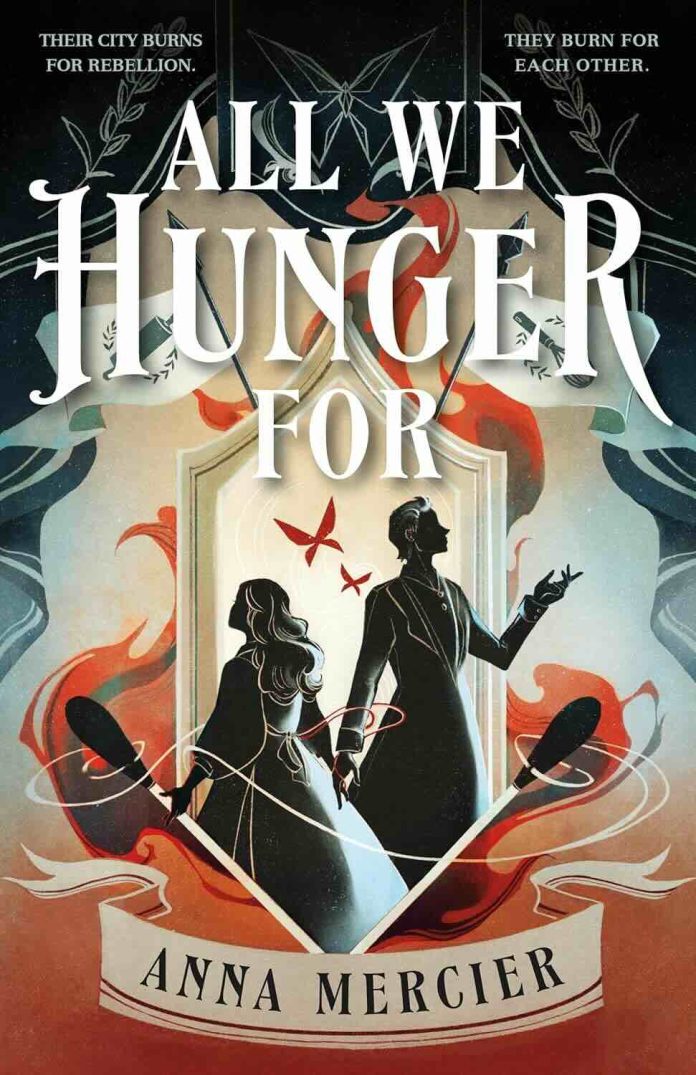
Some fantasy novels open with a map and a prophecy. This one opens with a poster of a dead woman who will not stop smiling, a contest nobody from the slums is meant to win, and a girl who has trained herself out of hoping. That gap, between the sweetness a city dangles in front of its poor and the rot it actually feeds them, runs through every page of All We Hunger For by Anna Mercier, a debut that wears a baking competition like a velvet glove pulled over a fist.
The premise, without spoiling the filling
Elara Rousseau gets by south of the Joyaux River, in the Restes, the quarter where “talentless” is just a polite word for the work the rich refuse to dirty their hands with. When the ruling Souverain of culinary arts dies, the city stages its grand Objet d’Art contest to crown a successor, and twenty lucky chefs receive enchanted coats and a shot at the council that runs everything. Elara is not supposed to be one of them. Then a brooding figure from her past sneaks her into the contest, and she finds herself baking for her future in front of the very people who would have her killed if they learned her real name.
It is a clean, sharp hook: a contestant hiding who she is, a sponsor hiding what he wants, and a city where art decides who eats and who starves. Mercier keeps the stakes personal even as the politics widen.
What you are actually getting
A few things the book pulls off straight out of the oven:
- Magic you can taste. Food magic runs on a simple, memorable rule here. Powerful intention plus powerful emotion makes powerful magie, which turns every bake into a small confession.
- Cruelty with a system behind it. The villainy is structural, dressed in white coats and gracious rules, and that lands harder than a single bad man ever could.
- A found family that earns its warmth. Elara’s odd little household quietly delivers some of the story’s best, softest beats.
A city built on appetite
Anespérer is split by a river and ruled by seven Sociétés, each governing a branch of art, each sorted into four ranks from lowly Aspirant up to untouchable Souverain. Mercier does not drown you in lore. She lets the world arrive through the senses: stale flour in a near-empty pantry, a stained-glass bird flitting up from a smashed wine bottle, officers outnumbering customers in a market that used to hum. The class politics are not subtle, and they are not trying to be. The point of All We Hunger For by Anna Mercier is that hunger gets engineered, that hope itself can be a leash, and the food writing makes you feel both the want and the brief relief of a good meal.
How the magic works
The system rewards feeling over technique, which suits a story about people taught their whole lives to swallow what they feel. An Aspirant can only follow recipes, while a Professionnelle can create, and the gap between the two becomes one of the book’s quiet heartbreaks. It is a tidy bit of worldbuilding that doubles as theme.
Two narrators on a knife’s edge
The book alternates first-person chapters between Elara and Nikolas Dupont, and the split works because the two voices actually differ.
Elara, all flint and bravado
Elara is quick with a jab, allergic to optimism, and secretly tender about a mother she lost and a café that exists only as a doodle in a recipe book. Her cynicism reads as armor rather than pose, and watching her lower it inch by inch is the spine of the whole story.
Nik, the boy who collects secrets
Nik is colder on the surface and far more fragile underneath, a young man who hoards other people’s secrets because affection was never once offered to him for free. He spends much of the book trying to shape Elara into a pawn for a father whose approval he cannot stop chasing. Seeing each narrator misread the other is half the fun.
The romance: enemies, embers, and a shared fork
The romance is a slow burn, and it earns the slowness. There is a quiet scene over a single slice of cake and two forks that does more for these two than a dozen grand declarations could. The chemistry comes from need rather than fate, two people who learned to survive alone and are unsettled to find they would rather not. Readers who like their love stories laced with guilt, suspicion, and the constant risk of betrayal will be well fed.
Where the recipe wobbles
For all its charm, this is a four-star book and not a flawless one, and the places where All We Hunger For by Anna Mercier stumbles are worth naming.
- The middle sags. The competition trials lean on a repeating rhythm of scheme, lie, and reveal, and a few stretches feel like the same beat replayed with fresh frosting.
- A couple of turns arrive on cue. Genre-seasoned readers will likely guess a central secret well before the characters do, which softens its punch.
- The setting’s French dressing is mostly surface. The names and titles are lovely, but the culture beneath them stays thin, more flavor than substance.
- The chief antagonist tips toward one note. He is genuinely chilling, yet his cruelty rarely complicates into anything harder to read.
None of this sinks the book. It keeps a very good debut from being a great one.
The author’s voice
Mercier writes in short, percussive bursts, dropping a one-word line to land a gut punch after a long sweep of description. It is a young adult fantasy voice with real confidence, wry where Elara is wry, raw where Nik is raw. All We Hunger For is Mercier’s first novel, so there is no backlist to send you toward yet, but on this evidence her next one is worth watching for. The food scenes alone suggest a writer who has spent real time with flour on her hands.
If you devoured this, try these next
Fans of magical competitions, class revolt, and slow-burn romance will find a kindred spirit in All We Hunger For by Anna Mercier. Six read-alikes to line up next:
- A Magic Steeped in Poison by Judy I. Lin, for the magical contest with a throne on the line.
- A Tempest of Tea by Hafsah Faizal, for heist energy, class friction, and a brewing rebellion.
- The Gilded Wolves by Roshani Chokshi, for a decadent city, found family, and art as power.
- An Ember in the Ashes by Sabaa Tahir, for dual narrators trapped inside a brutal empire.
- Caraval by Stephanie Garber, for a lush, dangerous competition with romance in its bones.
- The Crown’s Game by Evelyn Skye, for two rivals, real stakes, and a forbidden spark.
Good to know before you bite in
This one sits comfortably in upper-YA territory. Expect violence, grief, political brutality, and a romance that simmers rather than scorches, with content closer to longing than to anything explicit. Readers who want a cozy bake-off should know the oven runs hot.
The final taste
All We Hunger For by Anna Mercier earns its place on the shelf beside the books that inspired it. It is sweet without being soft, political without lecturing, and romantic without losing its teeth. The seams of a debut show here and there, in a baggy middle and a twist you may see coming, but the voice, the food, and the ache underneath it all carry the day. Come for the magical bake-off. Stay for the girl who refuses to stop wanting more, and the boy slowly learning he is allowed to want at all.







