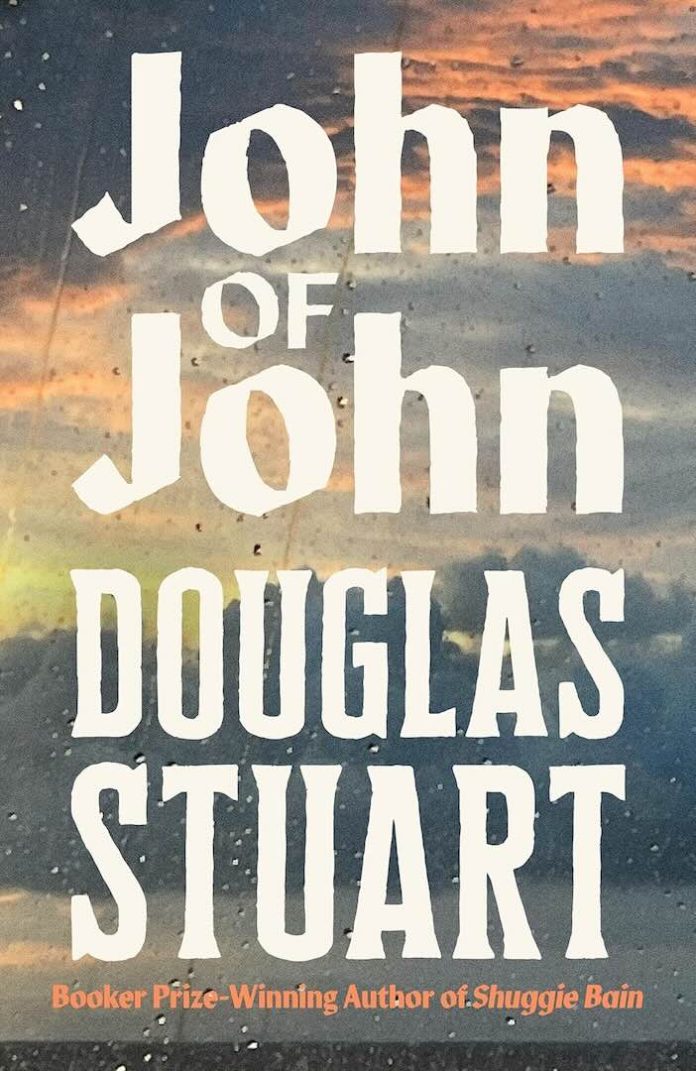
There is a moment early in John of John by Douglas Stuart when a young man hangs up a public phone after listening to his father read scripture from three hundred miles away. He has just been told that his grandmother’s feet are the colour of calves’ liver. He cannot mention where he is sleeping, who he has slept with, or what he has eaten to stay alive that week. His father cannot say very much at all. Between them sit sea, rock, and Gaelic psalm, and in that careful distance an entire novel is already breathing.
Update, August 2026: John of John made the Booker Prize 2026 longlist on 28 July. Douglas Stuart won the prize in 2020 for Shuggie Bain, and only four writers have taken it twice in its history. All thirteen longlisted titles are covered in our Booker Prize 2026 longlist guide.
This is Douglas Stuart’s third book, after the Booker-winning Shuggie Bain and the wrenching Young Mungo. For this one he leaves Glasgow behind and steers the small ferry north and west, towards the Isle of Harris, where the rain comes sideways, the sheep outnumber the souls, and the Free Presbyterian Church still keeps quiet account of who has missed a Sunday and who has been seen too often with whom.
The Setup of John of John by Douglas Stuart, Spoiler-Free
John-Calum Macleod, called Cal, comes home broke from Edinburgh art school. His father John is a tweed weaver, a sheep farmer, and a precentor at the church. His grandmother Ella is a Glaswegian who married onto the island long ago and never quite stopped being a tourist on it. Ella swears with the cheerful invention of a woman who has earned the right; John reads scripture with the patience of a man who has nothing else to set against the wind.
Cal does not want to be home. He wants to be in love, and to be seen, and to live in a city where neither of those wants is dangerous. Stuart understands that returning is its own slow weather pattern. The first chapters unfold at exactly the pace of a young person discovering that the croft has not changed, only their refusal of it has hardened.
The blurb promises a book about duty, patience, and the transformative power of the truth, and the publishers are telling the truth about that. The actual experience of the novel is quieter than the summary suggests, and also stranger, funnier, and a great deal less merciful.
A Sentence-Level Pleasure
Stuart writes about colour the way other novelists write about character. A ram’s hide, a grandmother’s swollen feet, the duck-egg blue under flaking paint, the lilac-tinged ash of an eyeshadow compact, the milky tea drowned to the shade of magnolia emulsion. Reading him is like watching a weaver hold the weft up to the window. Nothing in the book is simply brown. The Macleod men, the reader is told, communicate best when discussing colour, and the prose takes that proposition seriously on every page.
The voice carries the cadence of psalmody, the Harris gasp (“aidh-“), the elastic rhythm of an islander pretending not to gossip while gossiping at length. None of it feels imported for atmosphere. Stuart writes this place from the inside.
There is also, throughout, an extraordinary feeling for objects. A bedroom of CB radios. A sunbed hidden in the pantry. A bellwether ewe called Ishbel. A Silver Cross pram that has carried three generations of the same family. Stuart loads small things with so much meaning that by the end of the book even a sheep nosing through an open back door reads like a verdict.
What John of John by Douglas Stuart Is Actually About
It would be a discourtesy to pin the plot down too tightly, so a soft outline must do. The novel is a study of the shapes silence takes when whole communities agree, by long habit, not to look directly at what they already know. It is interested in the difference between secrecy and discretion, between a sin and a fact, between the version of a man a community will tolerate and the version it would crucify. It moves between Cal’s longings, John’s denials, and Ella’s clear-eyed Glaswegian impatience with both. Three voices, three angles, one stretch of windburnt coast.
Queerness sits at the centre of the book without being the only thing at the centre. So does faith. So does duty. And so does the harder, more political question of which family member is permitted to leave a place like this and which is asked, by quiet contract, to stay behind and absorb the rest. Stuart understands that the people who carry the heaviest weight on a croft are not always the ones with the strongest backs.
Where John of John by Douglas Stuart Tests You
To say John of John by Douglas Stuart is a slow novel is not a complaint, but it is a warning. Readers who came to Stuart through the raw momentum of Shuggie Bain will find a different temperature here. The lambing, the shearing, the weaving, the chitty marked with neighbours’ missed Sabbaths, the long bus rides and the longer kettles, all of these get their proper time. Some of it will reward you. Some of it will ask for patience the book does not always repay in the same currency.
The central revelations are powerful, but they arrive late, and the reader has to take a fair amount on trust before the design becomes legible. Cal’s interior voice can tilt into self-pity in a way that is honest to his age but occasionally feels circular. The third-person closeness to John, the father, is so disciplined that certain passages can feel withheld rather than restrained. The line between those two qualities is thin. Stuart usually lands on the right side of it, but not always.
A four-star average sits about right. This is not the runaway lightning of his debut. It is a slower, more deliberate piece of work, and the price of its grace is the patience it asks of the reader.
What to Read Alongside It
If John of John by Douglas Stuart lands for you, these are the books that share its weather.
- Shuggie Bain and Young Mungo by Douglas Stuart, for the obvious reasons: tenement Glasgow, queer working-class boys, mothers who cannot quite save themselves.
- The Blackwater Lightship by Colm Tóibín, for a son returning to a small Irish coastal community and the things three generations of women cannot quite say to one another.
- Mayflies by Andrew O’Hagan, for Scottish working-class friendship and the long shadow of unspoken love.
- His Bloody Project by Graeme Macrae Burnet, for crofting life in the Hebrides rendered with the same care for dialect and class.
- Gilead by Marilynne Robinson, for fathers, sons, faith, and prose that listens.
- This Is Happiness by Niall Williams, for the comic-elegiac rhythm of a small parish at the end of an era.
Our review of Acts of Forgiveness by Maura Cheeks covers another historical fiction in the same vein.
Final Thoughts on John of John by Douglas Stuart
John of John by Douglas Stuart is not the easiest of his books to fall in love with, and that is partly the point. It asks the reader to sit on a wet bench for a slow boat and to watch a father set a psalm and a son tear newsprint into pleats, and it gambles that if you stay, the small things will accumulate into a weight you cannot put down. By the time the last sheep wanders into the empty kitchen, the title is no longer just a name on a cover. It is a lineage, a chain, a question. Whose John. Whose son. And whose grief, and whose turn to set it down.
A note on the Booker Prize 2026. This review predates the longlist announcement by roughly ten weeks, so the prize goes unmentioned above. The judges described the novel as an excavation of family, violence and shame, woven through with imagistic detail and, to their evident surprise, shades of hope. Six of the thirteen go through on 22 September, with the winner announced on 9 November. We are reading and reviewing the whole list at our Booker Prize 2026 longlist guide.







