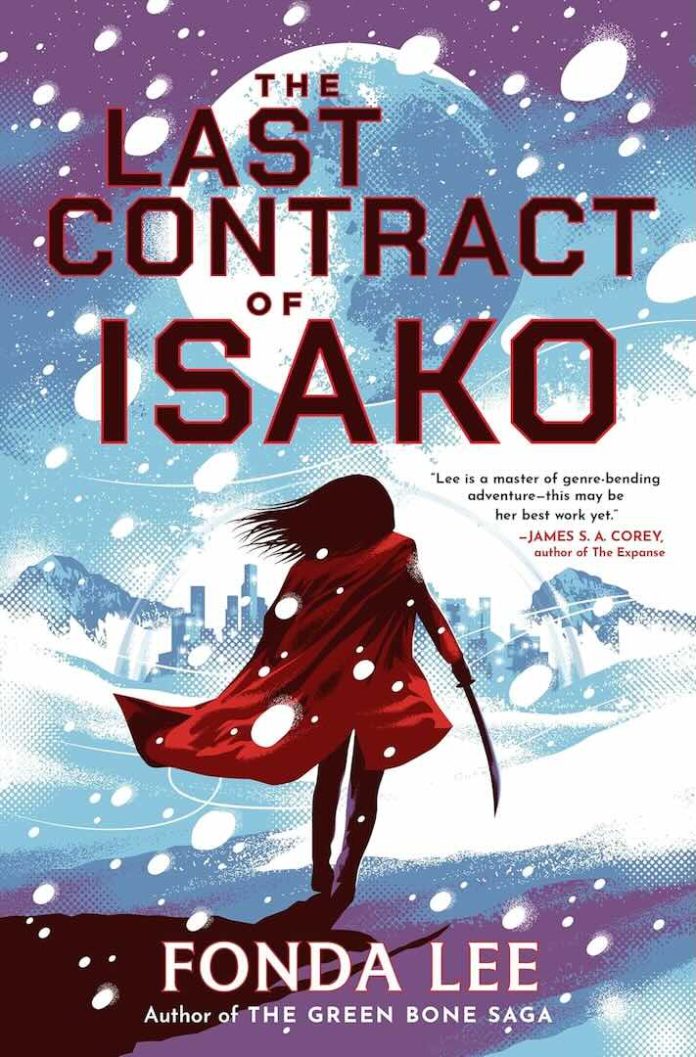
There’s a particular kind of story that sneaks up on you. It starts as one thing, then keeps shedding skins until you realize it was always something else underneath. The Last Contract of Isako by Fonda Lee is that kind of book. Pitched as “corporate samurai in space,” it earns the comparison without ever settling into it. What you actually get is a moody, methodical meditation on aging, duty, and the small mercies that hold a person together when the institutions around them refuse to.
This is also Lee’s first adult science fiction novel, a debut on this side of the genre from the writer behind the Green Bone Saga. Readers arriving from Jade City will recognize her interest in clan loyalty, codified violence, and the cost of belonging to something bigger than yourself. They will not, however, find another Kekon. Aquilo is its own beast: a frigid, half-terraformed colony five centuries removed from Earth, governed by a corporate hierarchy so total that even dying is something the Company schedules.
A protagonist worth following past her prime
Isthmus Isako is fifty years old, and the book never lets you forget it. Her knees ache. Her reflexes have slipped a half-second. The apprentices she once trained are now her competitors. The elite contractor rates she commands have begun to look less like prestige and more like a liability. As an “atier,” she serves as a kind of corporate samurai: bodyguard, fixer, strategist, and executioner, all packed into one professional. The novel opens with her delivering pink slips at a dive bar, which is to say, telling old colleagues that they are now required to walk out into a frozen wasteland and die for the good of the Company.
A fifty-year-old swordswoman as the protagonist of a space opera is a quiet act of defiance against genre habit, and Lee mines it for everything it’s worth. There’s a tiredness in Isako that feels earned, not performative. She is not the broken-killer archetype with one last job. She is a competent professional who is starting to suspect her competence might be the only thing holding her identity together.
Worldbuilding that asks for your patience
The first hundred pages are dense. Lee drops you into a fully formed corporate-feudal society and trusts you to keep up. Some readers will find this thrilling; others will reach for a glossary the book does not provide.
What you do get, if you stay with it, is a setting that feels lived in down to the bone. A few elements worth flagging:
- The Aquilo calendar (twenty-six-hour days, six-day weeks, year 500 AF) shows up in the text without ever being explained pedantically.
- The schism between “reunionists” (who want to chase the lost sister colonies and reconnect with Earth) and “terraformists” (who want to focus on warming the planet into habitability) does real political work, not just flavor.
- The “second stagers,” wealthy elites who transfer their consciousness into synthetic bodies at the end of their natural lives, sit at the center of the book’s quiet horror about who gets to live longer and why.
- The Code of Client Service, with its echoes of bushido, gives every contract relationship the weight of a marriage vow: to serve is to live, to live is to die.
The worldbuilding is precise, but it is not always frictionless. There are stretches in the middle third where divisional politics get dense enough that you may have to flip back to remember which director sat with which faction. Readers expecting nonstop blade-work should know in advance: this novel is more boardroom than dojo, and the violence is sharp but rare.
A prose style that earns its silences
Lee writes with the restraint of someone who trusts her readers. Sentences are clean and declarative. When the longknife comes out, the action is short, brutal, and physically specific: a slashed forearm, a blade reversed under the rib cage, a single second of stillness before everything changes. When Isako is sitting with a grieving colleague, the prose slows to match her breath. There is almost no exposition delivered through dialogue, which is part of why the opening feels steep. The writing assumes you are an adult and gets on with it.
The book also has a quiet sense of humor that flickers through Isako’s interior voice. She calls a synthbodied director a “brain in an expensive jar.” She thinks of her own resignation as the relief of “taking a long piss after you’ve been holding it in.” That voice, more than the plot, is the engine of the novel.
Where the book trips
Not every choice lands. The Last Contract of Isako by Fonda Lee divides itself structurally into three labeled parts: The Mentor, The Apprentice, and The Contract. The middle section steps away from Isako to flash back through the career of her former apprentice Martim, and while the information it provides becomes critical, the chronological jolt drains some momentum from a story that was just beginning to find its grip. Readers expecting a single-POV experience may find the detour frustrating, even if it eventually pays off.
The central twist, which I will not spoil, leans on a body-swap conceit that recent science fiction readers may already have encountered, most famously in Richard Morgan’s Altered Carbon. Lee’s version is quieter and more emotionally interesting than Morgan’s, but the mechanics will feel familiar to anyone who has spent time in transhumanist SF. The ending is also more bittersweet than satisfying, with several threads left deliberately unresolved. It fits the book’s themes. It just doesn’t always deliver the catharsis a tighter thriller would.
Who should pick it up
This is a recommendation with caveats. If you want your space opera fast, militarized, and full of starship dogfights, look elsewhere. If you want something closer to a John le Carré novel in a parka, with a middle-aged swordswoman walking the line between professional duty and personal grief, you will find a lot to admire in The Last Contract of Isako by Fonda Lee.
Similar reads worth your time
Readers who connected with the following will likely find common ground here:
- Jade City and the rest of the Green Bone Saga by Fonda Lee, for the codified honor and clan politics
- Untethered Sky by Fonda Lee, for the same quiet, contemplative voice in shorter form
- A Memory Called Empire by Arkady Martine, for the courtly intrigue and questions of identity
- Altered Carbon by Richard Morgan, for the synthbody and consciousness-transfer themes
- Ninefox Gambit by Yoon Ha Lee, for the calendrical empire feel and ritualized violence
- Leviathan Wakes by James S.A. Corey, for the lived-in corporate politics
- Old Man’s War by John Scalzi, for the aging-warrior premise played differently
Final word
The Last Contract of Isako by Fonda Lee is not a perfect book. It asks for patience. It occasionally buries its emotional core under Companyspeak. Its structural detour through Martim’s apprenticeship costs it some forward drive. Yet it does something space opera rarely attempts with this much seriousness: it treats endings, both personal and civilizational, as the actual subject. Isako is allowed to be old, tired, competent, and unsentimental, and the book never punishes her for it.
For readers willing to settle into its rhythm, The Last Contract of Isako by Fonda Lee offers the kind of science fiction that lingers after the last page, less for its plot beats than for the quiet weight of a woman walking, eyes open, toward the edge of her airshield.







