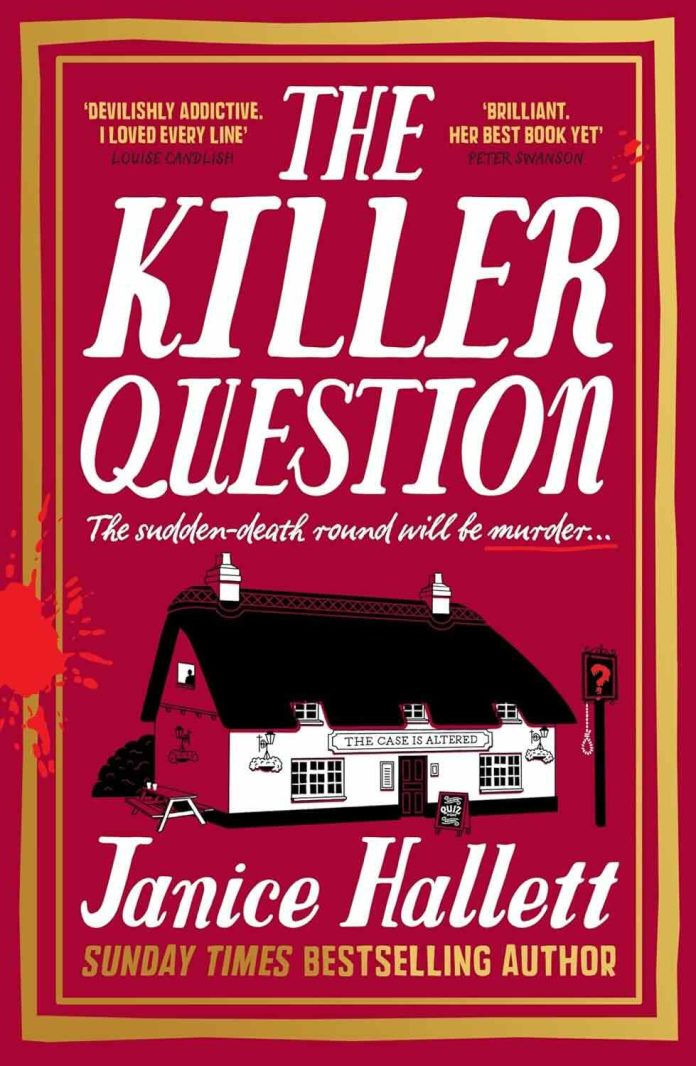
Janice Hallett has carved out a distinctive niche in contemporary crime fiction, and with The Killer Question, she demonstrates once again why readers and critics alike have embraced her unconventional approach to murder mysteries. This latest offering transforms the seemingly innocuous setting of a rural pub quiz night into a labyrinthine tale of deception, identity theft, and murder that unfolds through emails, text messages, police transcripts, and quiz scoresheets.
The premise is deceptively simple: Sue and Mal Eastwood take over The Case is Altered, an isolated pub struggling to survive, and launch a weekly quiz night that breathes new life into the establishment. Everything seems perfect until a body surfaces in the nearby river, and shortly afterward, a mysterious team called The Shadow Knights arrives, scoring impossibly high marks week after week. But as the documentary-making nephew Dominic Eastwood discovers five years later, nothing at The Case is Altered was quite what it seemed.
A Narrative Structure That Doubles as a Puzzle
Hallett’s signature epistolary format reaches new heights of sophistication here. The story unfolds through Dominic’s correspondence with a television production company, interspersed with WhatsApp exchanges between quiz teams, police briefings, witness statements, and actual quiz papers complete with scores. This isn’t merely a stylistic flourish; the format itself becomes integral to the mystery. Readers must piece together the truth from fragmented perspectives, much like solving one of Mal’s fiendishly difficult quiz questions.
The novel’s structure mirrors the experience of participating in a pub quiz—information arrives in discrete rounds, some answers seem obvious while others require lateral thinking, and the final revelation only clicks into place when you’ve accumulated enough knowledge to see the complete picture. Hallett uses this format to brilliant effect, allowing readers to feel like active participants rather than passive observers. We’re not just reading about a mystery; we’re solving it alongside the characters, sorting through genuine clues and deliberate misdirection.
What makes this approach particularly effective is how Hallett uses the various voices to control information flow. A text message from one character might contradict an email from another, forcing readers to question whose perspective they can trust. The quiz scoresheets themselves become evidence, revealing patterns that suggest something sinister beneath the surface of friendly competition.
Characters Who Exist Between the Lines
One of the novel’s most impressive achievements is how Hallett creates fully realized characters using only their digital communications. Through their messages, we come to know:
- Chris and Lorraine Thorogood, whose intense need to win The Sturdy Challengers’ table masks a deeper grief—the loss of their only child years earlier has left them channeling their pain into quiz night victories
- The Shadow Knights, a team so unnaturally skilled they seem almost supernatural, until their true nature is revealed in one of the book’s most satisfying twists
- Young teams like Ami’s Manic Carrots, who discover that putting away their phones for three hours each Monday creates a rare space for genuine human connection in an age of constant digital distraction
- Sue and Mal themselves, whose homely, bumbling exterior conceals layers of deception that run far deeper than anyone suspects
The characterization demonstrates remarkable economy. Harrison from Ami’s Manic Carrots emerges as theatrical and observant through his overly descriptive text messages. Chris “Thor’s Hammer” Thorogood’s competitive intensity bleeds through his clipped, strategic communications. Even minor characters like Wind and her spirit guide Lizzie, or Cloud with his mysterious past, feel distinct and memorable despite appearing only in brief text exchanges.
The Dark Heart Beneath Cozy Surfaces
While The Killer Question might initially present itself as cozy crime—complete with a quirky pub setting and amateur sleuths—Hallett subverts the genre’s comforting conventions. Beneath the surface of quiz night camaraderie lurks genuine darkness: murder, identity theft, police corruption, and the moral compromises people make when backed into corners.
The novel explores how ordinary spaces can harbor extraordinary secrets. The Case is Altered becomes a stage where multiple deceptions play out simultaneously. Sue and Mal aren’t who they claim to be. The Shadow Knights have a hidden agenda. Even seemingly straightforward quiz night regulars carry secrets that complicate the central mystery.
Hallett examines the theme of performance and assumed identities with particular nuance. Her background research into method acting becomes crucial to understanding how the central deception was maintained for so long. The Frosts don’t just steal the Eastwoods’ names—they inhabit their roles so completely that they blur the line between performance and reality, between who they were and who they’re pretending to be.
The novel also interrogates questions of justice and revenge. When official channels fail, when corruption goes unpunished, what recourse do victims have? The answer The Killer Question provides is morally complex, refusing easy judgments even as it depicts the devastating consequences of taking justice into one’s own hands.
The Power of Two: Partnerships and Crime
A recurring motif throughout the novel is the strength—and danger—of pairs. Hallett dedicates the book to exploring “the power of two,” and this theme resonates through multiple relationships. Sue and Mal (or rather, the people pretending to be them) operate as a unit, each compensating for the other’s weaknesses. The Shadow Knights work in coordinated pairs during their operation. Even quiz teams demonstrate how two people together can achieve what neither could alone.
This examination of partnerships extends to the darker corners of criminal psychology. Hallett notes how history is littered with couples who committed terrible acts, empowered by their bond to cross lines neither would have approached individually. The book suggests that the same synergy that makes couples effective in legitimate pursuits can make them devastatingly effective when turned toward crime.
A Few Stumbles in an Otherwise Smooth Execution
Despite its many strengths, The Killer Question occasionally struggles with pacing. The middle section, where various quiz teams exchange messages about their performances and personal dramas, can feel slightly repetitive. While these exchanges establish character and build atmosphere, some readers may find themselves impatient to return to the central mystery.
Additionally, the sheer number of characters and communication threads can become overwhelming. Keeping track of which team member belongs to which group, who’s texting whom, and what each person knows at any given moment requires active attention. This complexity is largely intentional—mirroring how confusing the situation would be for participants—but it may occasionally test readers’ patience.
The resolution, while clever, relies heavily on information withheld until late in the narrative. Some readers might feel the final revelations come too suddenly, without enough prior hints to make them feel entirely earned. The book plays fair with clues, but the epistolary format makes it easier for Hallett to control what information reaches readers and when, occasionally creating a sense that we’re not solving the mystery so much as waiting for it to be explained.
The Verdict: Another Triumph for Hallett
These minor quibbles aside, The Killer Question represents another impressive entry in Hallett’s growing bibliography. For readers who enjoyed her previous works—The Appeal, The Twyford Code, A Box Full Of Murders, The Mysterious Case of the Alperton Angels—this offers the same inventive structure and sharp character work in a fresh context. The quiz night setting provides rich opportunities for both humor and tension, and Hallett exploits these fully.
The novel works as both an engaging mystery and a commentary on contemporary life. The quiz participants’ relief at putting away their phones, their joy in testing their knowledge without Google’s assistance, speaks to a widespread hunger for experiences that demand our full presence. Hallett suggests that maybe what we lose in our hyper-connected age isn’t just facts we used to memorize, but the communal experience of gathering to test ourselves together.
The Killer Question confirms Hallett’s position as one of the most innovative voices in contemporary crime fiction. Her willingness to experiment with form while delivering satisfying mysteries sets her apart in a crowded genre. This is a book that challenges readers to be active participants, rewarding careful attention with a complex, surprising resolution that recontextualizes everything that came before.
For Fans of Clever, Unconventional Mysteries
Readers who appreciate The Killer Question might also enjoy:
- The 7½ Deaths of Evelyn Hardcastle by Stuart Turton—for those who enjoy time-loop mysteries
- The Thursday Murder Club series by Richard Osman—if you’re drawn to the cozy crime elements and ensemble cast of characters
- The Appeal by Janice Hallett—Hallett’s debut, which first demonstrated her mastery of the epistolary mystery format
- Before the Coffee Gets Cold by Toshikazu Kawaguchi—for the theme of time, regret, and second chances, though in a very different genre
Janice Hallett has proven herself the queen of the epistolary mystery, and The Killer Question adds another crown jewel to her collection. It’s a book that respects its readers’ intelligence, rewards careful attention, and delivers genuine surprises right through to its final pages. For anyone who’s ever loved a good pub quiz—or a good puzzle of any kind—this novel offers the best of both worlds.