In shadows deep where ancient powers dwell,
A powerless soul seeks truths no tongue can tell,
Between the living and the dead she stands,
With borrowed magic burning through her hands.
The Threshold Between Worlds
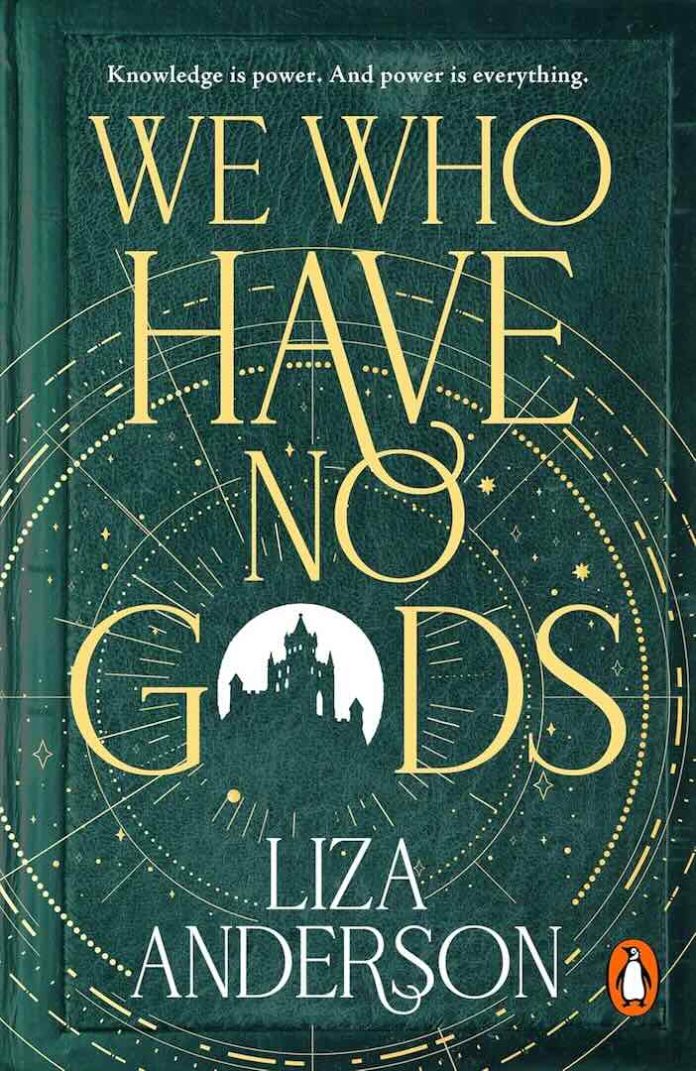
Liza Anderson’s debut novel delivers a compelling entry into the dark academia fantasy genre, weaving together gothic atmosphere, complex family dynamics, and the age-old question of what defines belonging in a world that seemingly has no place for you. We Who Have No Gods by Liza Anderson introduces readers to Victoria Wood, a woman who has spent her life managing restaurants, raising her younger brother Henry, and carefully avoiding thoughts of her mysteriously absent mother. When representatives from the Acheron Order arrive to claim Henry for magical training, Vic’s carefully constructed reality shatters—revealing a hidden world where witches maintain the boundary between the living and the dead, hunting monsters that slip through the cracks of existence.
The novel’s premise immediately distinguishes it within the crowded fantasy landscape. Rather than following the typical chosen one narrative, Anderson crafts a protagonist who is fundamentally ordinary in an extraordinary world. Vic possesses no innate magical abilities, no hidden powers waiting to manifest. She is, by all accounts, human in a realm where humanity is a liability. This choice creates an immediately compelling tension that drives the narrative forward.
Architecture of Darkness
Anderson’s worldbuilding deserves particular recognition. Avalon Castle, the headquarters of the Acheron Order, functions as more than mere setting—it becomes a character unto itself. The author describes it as a cathedral rather than a traditional castle, with gothic architecture that seems to shift and breathe according to its own inscrutable logic. Doors slam without warning, rooms appear and disappear, and the building itself seems to possess an awareness of those who walk its corridors. The castle’s oppressive atmosphere mirrors Vic’s emotional state throughout her journey, creating a symbiotic relationship between protagonist and place.
The magic system in We Who Have No Gods by Liza Anderson operates on principles both ancient and unsettling. Witches speak the Universal Language, an instinctive tongue that appears as incomprehensible symbols on paper but flows naturally from those with innate abilities. The Order’s primary function—maintaining the Veil between the world of the living and the realm of the dead—provides high stakes that feel genuinely apocalyptic. When the boundary weakens, Orcans cross over: creatures ranging from the mundane (if monstrous can be mundane) to the truly horrifying, each requiring different tactics to eliminate.
Characters Carved from Shadow and Light
Vic Wood emerges as a protagonist defined by resilience forged through hardship. Anderson reveals her character through action rather than exposition: her protective instincts toward Henry, her competence in crisis situations, her ability to assess threats and calculate odds even when facing impossible circumstances. The novel explores her complicated relationship with her late mother Meredith through discovered artifacts and reluctant revelations, painting a portrait of a woman Vic never truly knew and the legacy she left behind.
The supporting cast enriches the narrative considerably. Xan, the Chief Sentinel, initially presents as an imposing, almost antagonistic figure—towering, dark, covered in blood from monster hunting, with piercing blue eyes that seem to glow in darkness. His relationship with Vic develops through charged confrontations and reluctant respect, building toward romantic tension that Anderson handles with admirable restraint. Rather than rushing toward inevitable connection, she allows their relationship to develop organically through shared danger and gradual understanding.
Sarah and May, fellow Sentinels who befriend Vic despite her powerlessness, provide necessary warmth in an otherwise cold and hostile environment. Their acceptance of Vic’s presence, their willingness to teach her what they can despite her limitations, offers glimpses of genuine community within an institution that often feels designed to exclude.
Max Shepherd, one of the Order’s Elders, serves as a complex figure straddling lines between mentor, ally, and manipulator. His connection to Vic’s mother and his knowledge of the Order’s hidden conflicts position him as a source of crucial information, yet Anderson ensures readers question his motivations and methods throughout.
The Brotherhood’s Shadow
The novel’s central conflict extends beyond simple monster hunting. Aren Mann, a former Elder turned extremist leader, established the Brotherhood after defecting from the Order. His organization advocates for the complete elimination of “Mades”—witches who acquired their powers through dangerous rituals rather than birth—despite Mann himself being Made. This hypocrisy, this prejudice wrapped in revolutionary rhetoric, provides chilling commentary on how movements can corrupt their own stated principles.
Anderson’s handling of the Brotherhood storyline demonstrates sophisticated understanding of ideological conflict. Mann is not presented as cartoonishly evil but as charismatic, persuasive, and genuinely convinced of his righteousness. His connection to Vic’s mother Meredith adds personal stakes to the larger political struggle, transforming abstract conflict into intimate betrayal.
The Price of Power
We Who Have No Gods by Liza Anderson grapples with questions of identity, belonging, and the cost of power with impressive nuance. Vic’s journey isn’t about discovering hidden abilities or proving herself worthy through inherited talent. Instead, she must navigate a world fundamentally hostile to her existence, finding value in competencies the Order dismisses: her fighting skills, her strategic thinking, her unwavering determination to protect those she loves.
We Who Have No Gods doesn’t shy away from darkness. Anderson depicts violence with visceral immediacy—bodies torn apart, blood on stone floors, the horrifying intimacy of monster attacks. Yet these moments never feel gratuitous. They serve the story’s atmosphere and emphasize the genuine danger Vic faces every moment she remains in this world.
The author’s prose style balances gothic atmosphere with contemporary accessibility. She crafts sentences that evoke classic dark fantasy—rich with shadow and foreboding—while maintaining narrative momentum that keeps pages turning. Her descriptions of the castle, of magical workings, of combat against impossible creatures, all demonstrate careful attention to sensory detail without overwhelming readers with excessive ornamentation.
Shadows and Shortcomings
While We Who Have No Gods by Liza Anderson succeeds on multiple fronts, certain elements occasionally falter. The pacing in the middle section sometimes stalls as Vic observes rather than participates in Order activities. Training sequences, while necessary for worldbuilding, can feel repetitive when the protagonist makes minimal progress. Some secondary characters remain underdeveloped, serving functional roles without achieving full dimensionality.
We Who Have No Gods also struggles with the inherent limitations of its premise. Vic’s powerlessness, while thematically rich, sometimes reduces her to reactive rather than active protagonist. Though Anderson finds creative solutions to this challenge, readers may occasionally feel frustrated by Vic’s inability to significantly impact events unfolding around her.
The complex political machinations between the Order and Brotherhood could benefit from clearer exposition. While Anderson trusts her readers to piece together connections, some crucial context arrives late enough to create confusion rather than satisfying revelation.
A Foundation for What’s to Come
As the first installment in The Acheron Order series, We Who Have No Gods succeeds in establishing a rich, dark world with compelling conflicts extending beyond a single book’s resolution. Anderson plants seeds for future developments while delivering a satisfying arc for this particular volume. The ending leaves readers eager for continuation without resorting to cheap cliffhangers or unearned melodrama.
The novel joins a conversation with other dark academia fantasies—works like Ninth House by Leigh Bardugo or The Atlas Six by Olivie Blake—while carving its own distinct identity through its focus on powerlessness in magical spaces. Readers who appreciated A Deadly Education by Naomi Novik or The Scholomance series will find familiar pleasures here: institutional magic, complex relationships forged in adversity, and protagonists who must survive in environments designed for their failure.
We Who Have No Gods by Liza Anderson announces the arrival of a promising new voice in dark fantasy. While not without flaws, the novel demonstrates Anderson’s command of atmosphere, character development, and thematic complexity. Her willingness to center a powerless protagonist in a world obsessed with power creates unique tensions that distinguish this work from conventional chosen-one narratives. For readers seeking gothic atmosphere, morally complex conflicts, and protagonists defined by resilience rather than destiny, this debut offers a compelling entry point into what promises to be an engaging series.
Similar Books You Might Enjoy
- The Poppy War by R.F. Kuang – Dark fantasy with institutional magic and morally complex conflicts
- Ninth House by Leigh Bardugo – Dark academia with secret societies and occult elements
- A Deadly Education by Naomi Novik – Protagonist surviving in hostile magical institution
- The Atlas Six by Olivie Blake – Dark academia with complex character dynamics and moral ambiguity
- Gideon the Ninth by Tamsyn Muir – Gothic atmosphere with necromancy and complex relationships







