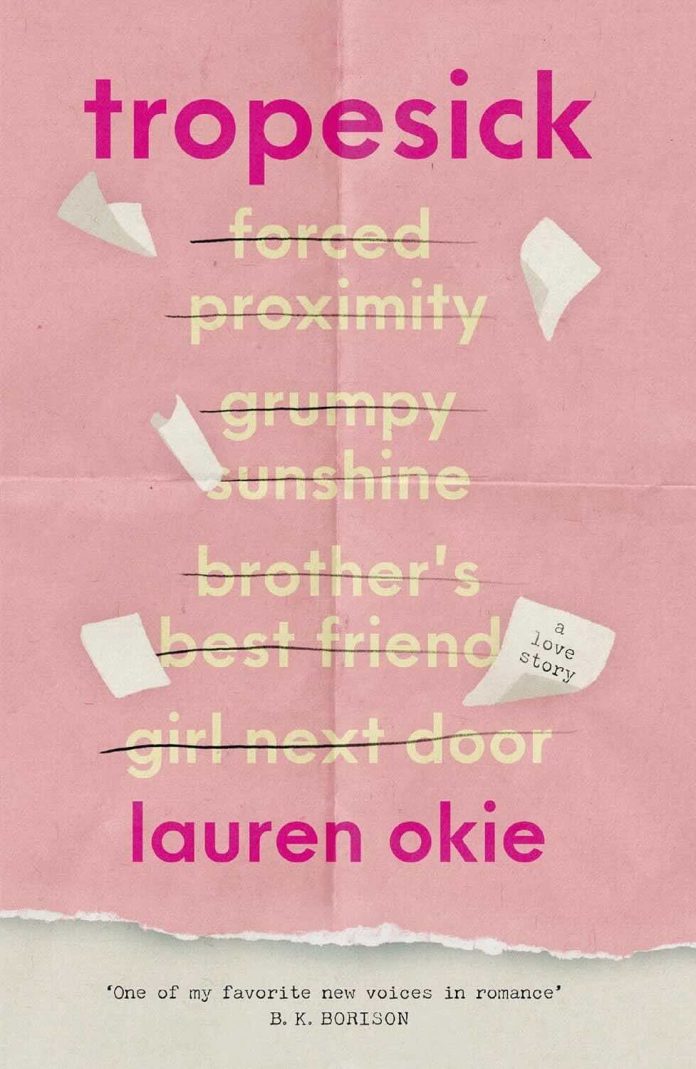
There is a moment, somewhere around the middle of Lauren Okie’s second novel, Tropesick, where her ghostwriter heroine, Katie Caruso, pulls a folder from her bag and slaps a sheet of paper down on a pizza-shop table. Tropes. Fifty of them, highlighted. The “backbone of the genre single-handedly keeping publishing companies alive,” she tells her grumpy new writing partner. It is one of those scenes that puts a book’s whole project on display. Okie is writing a romance about ghostwriting a romance, and somehow, that does not collapse under its own cleverness.
Let me explain why Tropesick by Lauren Okie works almost as well as the early hype suggests, and why a small handful of choices keep it just shy of perfect.
A Premise That Pretends to Be Simple
Twenty-five-year-old Katie Caruso looks, on the outside, like a girl whose closet runs on a glitter budget. She wears bedazzled headbands, dates lawyers named Danny, and writes books under another woman’s name. For three years she has secretly authored novels for Meredith Bradford, the reclusive bestselling romance writer of her generation. The arrangement keeps Katie’s rent paid and her real grief tucked away inside a rose-gold laptop.
Then her new writing partner walks into her café. Tyler McNally. Sleeve tattoos. Ivy League degree. Nine years sober. He used to be the boy next door, the best friend of Katie’s older brother. He used to be a lot of things she has spent the past eight years trying to scrub out of her memory.
Their assignment lands them at Meredith’s secluded Southampton estate for the summer, drafting a love story about two characters in a half-finished bed-and-breakfast. The tropes Meredith’s cat (yes, the cat) draws from a salad bowl begin showing up in the manuscript. Then they begin showing up in real life.
If you have read the blurb, you have read about that much. What the blurb does not capture is how heavy a book this is willing to be.
What Okie Pulls Off Beautifully
The promise of a meta-romance is easy to set up and almost impossible to land. Tropesick by Lauren Okie lands it because Okie refuses to let cleverness do the heavy lifting. The grief sits at the center of the book, undisguised. Katie’s brother Mikey was a major-league pitching prospect who slid into opioid addiction after an accident. The chapters dipping back into “Eleven Years Ago, Long Island” are not nostalgic interludes. They are evidence. They show, with awful specificity, how a household can lose its center while everyone is still alive.
A few elements I want to call out:
- The dual-perspective structure between Katie and Tyler genuinely earns its keep. Each voice is distinct on the page. Katie’s chapters glitter and joke and hide. Tyler’s chapters strip down to clipped sentences and unsent texts.
- The walkie-talkie scenes are an inspired choice. With no Wi-Fi on Meredith’s property, the two characters communicate at night through a child’s plastic radio, which sounds twee until you see how Okie uses it. It becomes a way to be honest without facing each other.
- The cameos of real romance titles are placed with care, not name-dropped for cred. When Tyler reads Tessa Bailey or Emily Henry, his reactions read like someone genuinely encountering the genre for the first time.
Okie’s prose deserves its own paragraph. Her sentences move in short, drumbeat fragments. The sky, blue. The air, thick. That cadence runs through the whole novel and gives even quiet scenes a pulse. Her dialogue is sharp without straining for it, and her banter never devolves into snark for snark’s sake. There is a sequence near the end where Tyler runs across the Queensboro Bridge in a wet tuxedo, and Okie writes it like she means every word, even while winking at the rom-com convention.
Where Tropesick Stalls
Praise aside, this is not a flawless novel, and treating it that way would do it a disservice.
- The middle stretch leans too hard on the Hamptons-summer aesthetic. Several chapters pile up arugula sandwiches, bike rides into town, and tan lines, with diminishing returns. The pages do not exactly drag, but they do glide where they should pull.
- Meredith Bradford’s character is the book’s biggest creative gamble. Without spoiling anything, the speculative element around her is the choice most likely to split readers. Some will find it perfect. Others will feel the romance plot did not need that scaffolding.
- The explicit sex scenes are not for every romance reader. They are graphic, lengthy, and arrive late enough that the swing in register may feel abrupt if you were reading for the slower yearning of the first half.
- A subplot involving Katie’s mother and the foundation gala wraps up in a way that some readers will find rushed against the weight of what came before.
These are real critiques, but they are critiques of an ambitious book, not a careless one. Tropesick by Lauren Okie swings hard, and most of the swings connect.
Reading Lauren Okie in Order
If you arrived here without having read Okie before, the picture is straightforward. Tropesick is her sophomore novel, following her debut, The Best Worst Thing. The debut earned her the early readership that has now turned out for this second book, and Okie acknowledges in her own author’s note that Tropesick was the harder of the two to write. You can start with either, since the books stand alone, but reading The Best Worst Thing first gives you a sense of Okie’s voice before she fully leans into the meta game.
If You Loved Tropesick, Read These Next
For readers who finished the last page and want something adjacent in tone, premise, or thematic territory, a few suggestions:
- Beach Read by Emily Henry, for a literary novelist and a romance novelist trapped in neighboring beach houses, swapping genres
- Happy Place by Emily Henry, for the second-chance ache in a vacation house with no Wi-Fi
- Funny Story by Emily Henry, for the banter and the quietly wounded hero
- The Seven Year Slip by Ashley Poston, for a love story that uses a touch of magic to do real emotional work
- By Any Other Name by Jodi Picoult, for the meta-literary ghostwriting layer
- The Wedding People by Alison Espach, for grief, friendship, and the strange softness of recovering hope
The Last Page
It is rare for a romance to ask for as much of a reader’s heart as Tropesick by Lauren Okie does and still send them off smiling. The book is funny and crude and surprisingly tender about addiction, parental absence, and the specific loneliness of being the surviving sibling. It also delivers on the genre conventions it has been gently teasing for four hundred pages. The kiss in the rain. The grand gesture. The earned happily ever after.
You will not love every single choice Okie makes here. You will, however, finish it understanding why so many readers are already calling Tropesick by Lauren Okie one of 2026’s signature romances. It is the kind of book that knows exactly which tropes it is playing and trusts that you, the reader, know them too.







