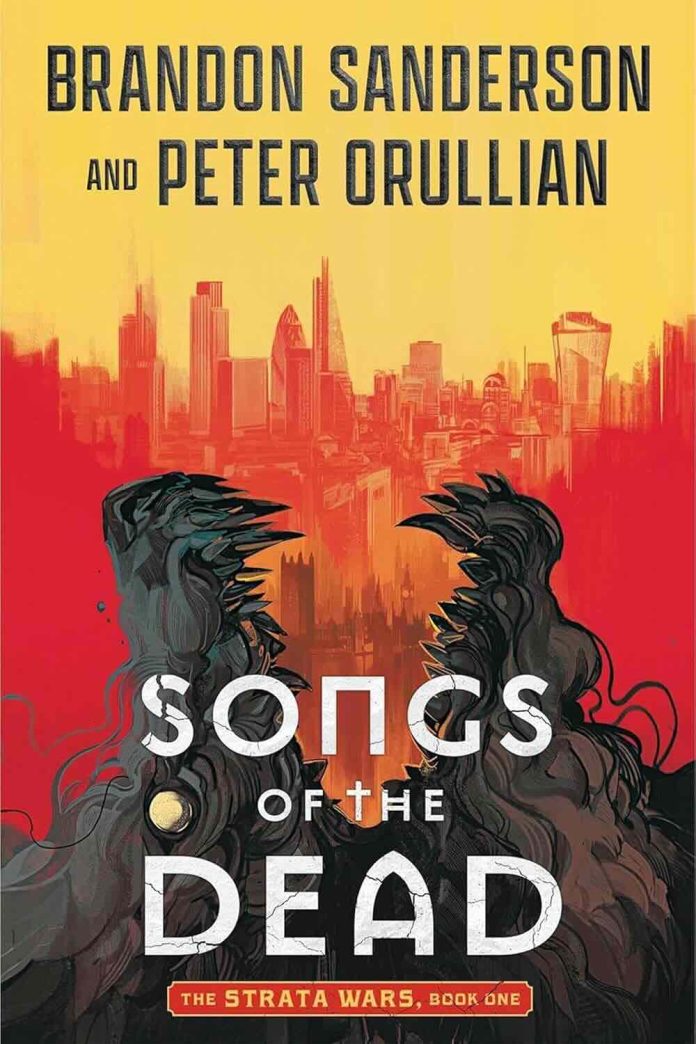
There is a moment near the start of this book where a struggling metal singer gets sacked from his own band by email, walks to his favorite pub to lick his wounds, and then gets shot dead in a back alley. Most stories would call that a tragedy. Songs of the Dead by Brandon Sanderson and Peter Orullian calls it the sound check, and uses it as the doorway into one of the more inventive contemporary fantasy worlds I have read in a while.
This is the opening salvo of The Strata Wars, and it arrives carrying a reputation. It is the first adult novel Brandon Sanderson has co-written, grown from an idea he tinkered with for over a decade before handing the keys to musician and author Peter Orullian. The result feels less like a typical doorstopper epic and more like one of Sanderson’s leaner Secret Project books, played at a much higher volume.
The Setup: Death Is Only the First Verse
Jack Solomon is an American transplant grinding away in London’s West End, chasing a music dream that keeps slipping through his fingers. When he is killed outside his mentor’s flat, he does something most of the dead cannot. He claws his way back into his own body.
That return is his initiation. Jack learns he is a thanatist, a wielder of magic built from light and music, and that beneath modern London lie the Strata: layered eras of the past, stacked all the way down to recorded history and crowded with the lingering dead. Some of those dead are restless. Some are furious. And a society of magicians has started aiming that fury straight at the living world above.
I will keep the plot vague past this point, because half the pleasure of Songs of the Dead by Brandon Sanderson and Peter Orullian is descending those stairs beside Jack with no idea what waits on the next landing.
A Magic System Tuned to Light and Sound
If you have read Sanderson before, you know the man builds magic like someone wiring an amplifier. Every rule clicks into the next. Here, that engineering gets a musician’s ear laid over the top of it, and the combination is the strongest instrument in the whole book.
The mechanics feel fresh:
- Light reveals what a person truly is. Hold a flame to a shadow and you can read whether someone is living, a bound soul, or something far worse.
- Living fire exposes the wounds of the heart. Grief, betrayal, and loss appear as dark spots inside a person’s shimmering pattern.
- Music does the heavy lifting. Songs bind souls, steady shaking nerves, and power the magic itself. A chorus can be a weapon or a key.
What makes this land is how the worldbuilding doubles as character work. The deeper Jack walks into the past, the harder his own history presses back on him. The book makes emotional pain literal in a way that is clever rather than cheap. The trade-off is density. The opening third throws a lot of new vocabulary at you at once, and some readers will wish for a glossary tucked in their back pocket.
Jack Solomon and the People Who Stay
The heart of this novel is not the necromancy. It is a runaway mother, a lost brother, and a man who has spent his whole life certain that everyone he loves will eventually leave.
Jack is haunted, and the authors handle that haunting with real tenderness. He copes through music and small private rituals, and the story never uses his pain as set dressing. It is stitched into his unfinished theme song, into his arc, into the question the whole book keeps asking: are you someone who runs, or someone who stays?
The supporting cast is where Orullian’s warmth shows most. Cassius, a Roman centurion bound across centuries, becomes the loyal and slightly baffled soul of the group. Chuey, Jack’s oldest friend, brings faith and grit. Church and Lady, fixtures at the Iron Horse pub, give the story a found family worth fighting for. These characters carry the emotional weight, and they carry it gracefully.
Where Two Very Different Authors Meet
You can hear both writers in the mix. Sanderson supplies the architecture, the escalating stakes, and that satisfying snap of a plan coming together. Orullian supplies the music, the sweat and smoke of a London metal scene, and an emotional rawness Sanderson’s solo work often keeps at arm’s length.
The seams occasionally show. A few stretches lean hard on exposition, with characters explaining the rules of death to Jack while the momentum cools. The middle act sags a little before the finale snaps back into focus. None of it is fatal, but it is the gap between a great book and a very good one, which feels about right for where reader reaction has landed.
For context, Sanderson built his name on The Stormlight Archive, the Mistborn saga, Warbreaker, and the younger thrills of Skyward and The Reckoners. Orullian is known for The Vault of Heaven series and music-driven fiction like The Sound of Broken Absolutes, along with his concept-album work. Songs of the Dead by Brandon Sanderson and Peter Orullian sits at the crossroads of both careers, and the partnership mostly earns its place.
The Verdict in Brief
Reader response to Songs of the Dead by Brandon Sanderson and Peter Orullian has settled in a fair spot, and the ledger explains why.
What lands hardest:
- A premise that turns London’s history into a living, layered underworld you can walk through.
- A magic system that feels new and pays off its own rules.
- Real emotional stakes built on grief and loyalty rather than spectacle alone.
What holds it back:
- A front-loaded learning curve that asks for patience.
- A baggy midsection heavy on explanation.
- A few side characters who deserve more room than book one allows.
If You Loved This, Cue Up These Next
- Neverwhere by Neil Gaiman, for its hidden London stacked beneath the one you know.
- A Darker Shade of Magic by V.E. Schwab, for parallel Londons and the cost of crossing between them.
- Rivers of London by Ben Aaronovitch, for magic policed through the bones of the modern city.
- The Name of the Wind by Patrick Rothfuss, for music written as something close to sorcery.
- King Rat by China Miéville, for an underground London where music and the dead share the same dark.
Final Note
Songs of the Dead by Brandon Sanderson and Peter Orullian is a confident, emotionally honest opening to a series with enormous room to grow. It is not flawless. The first act demands work, and the middle loses a step. But the world is rich, the friendships are true, and the ending earns its closing chord. If you want urban fantasy with grit under its nails and a soundtrack in its veins, climb down the stairs and start listening.
One heads-up for readers: the story deals openly with grief, abandonment, and self-harm. It handles these with care, but they run through the whole book, so go in aware if those themes sit close to home.







