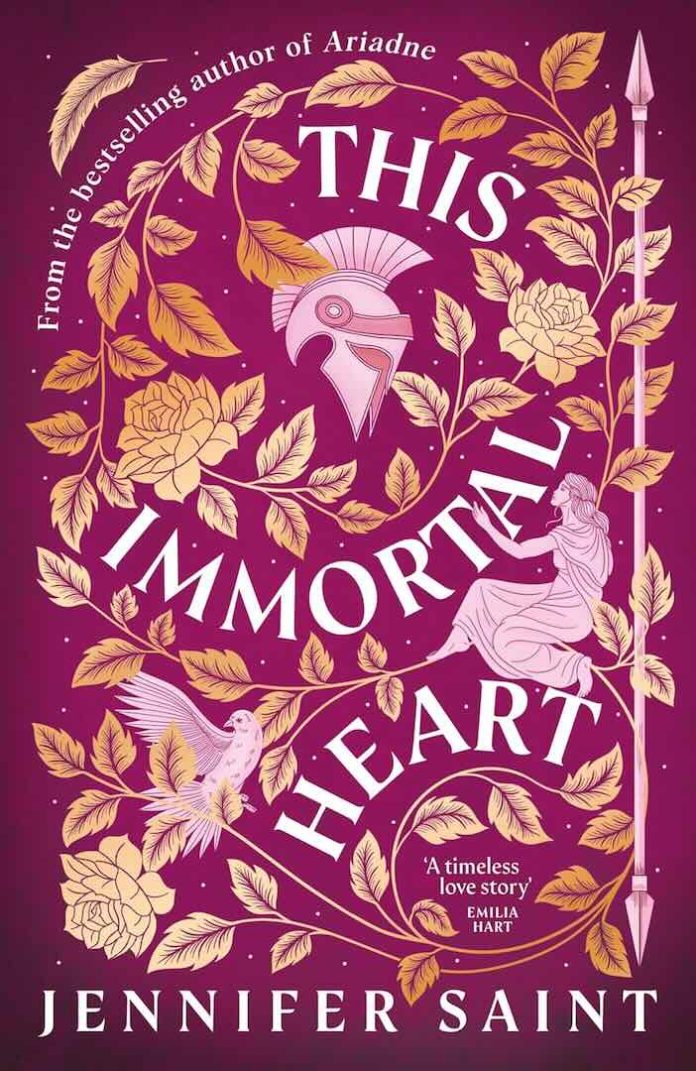
Jennifer Saint has built her career on giving the women of Greek mythology room to breathe outside the narrow frames their original poets gave them. With This Immortal Heart by Jennifer Saint, she steps onto unfamiliar ground in two ways at once. First, she hands the narration to a goddess rather than a mortal woman. Second, she leans openly into romance for the first time, threading her usual mythological scholarship through the bones of a love story that her acknowledgements freely admit is her switch into the genre.
The result is a sensuous, slow-burning retelling of Aphrodite and Ares, an affair the ancient sources usually treated as gossip, scandal, or a punchline involving Hephaestus and a golden net. Saint takes that tabloid sliver and stretches it across centuries.
Premise and Setup, Spoiler-Free
Aphrodite tells her own story. She is newly born from sea-foam and her father’s blood, comfortable in her power, devoted to her worshippers’ secrets and the quiet pleasures she stirs in mortal and divine hearts alike. Her dalliances are brief and bright, and she is determined never to marry, having watched what marriage has done to Hera.
Then a battle she cannot prevent steals away a mortal she has just blessed with a second chance. The man behind the spear is Ares, brooding, untouchable, despised by most of Olympus. Their spheres of power could not be more opposed: she stirs longing, he stirs war. Beneath the friction, the two recognise something of themselves in each other. What follows is a courtship pulled taut between desire, divine politics, and the bargains gods are forced to make in Zeus’s court.
The Voice in This Book
Saint writes Aphrodite in a register that feels deliberately drawn from her source material:
- A languorous, sensory prose style indebted to Sappho and Ovid
- Long looping sentences thick with petals, oils, salt, smoke, and skin
- A first-person narrator who is amused, observant, slightly vain, and not above admitting it
- Cool, quick dialogue that offsets the lyrical interior monologue
Readers who came to her through Hera, Atalanta, Elektra, or Ariadne will recognise her instinct for plain emotional clarity inside ornate sentences. But Aphrodite is a different kind of narrator. She is a goddess speaking in her prime, not a girl looking back on a tragedy, and the book takes its tonal cues from her appetite for the world.
What the Book Does Well
A few craft choices come through as genuinely strong:
- The mortal interludes. Phaon, Pygmalion’s Galatea, Pandora, Iphis, and Adonis each anchor a self-contained novella in miniature stitched into the larger arc, and they carry much of the book’s moral weight.
- The reframing of familiar episodes. Hephaestus’s exile, Pandora’s jar, the trial at the Areopagus. Saint diverges from the versions she used in her earlier novel Hera, and the author’s note is refreshingly honest about why.
- The chemistry. Ares is written with restraint rather than posturing. He listens before he speaks, and the slow accumulation of his presence in Aphrodite’s thoughts is one of the book’s best-paced threads.
- The Amazons sequence. The detour to Scythia, drawn from Adrienne Mayor’s nonfiction work, gives the second half fresh geographic and emotional air.
Where the Cracks Show
For a romance promising sparks between fire and passion, the early courtship sometimes runs cooler than the blurb suggests. Saint’s lyrical instincts occasionally smother the heat she is supposed to be generating, and a few central encounters are described with so much atmospheric language that the bodies and stakes inside them go a little soft.
Other readers may stumble on these points:
- Aphrodite’s mortal lovers in the first hundred pages can blur into one another, since they share a rhythm of meeting, melting, and moving on.
- The Olympian council scenes carry useful exposition but slow the pulse whenever they appear back to back.
- Hephaestus, who carries enormous narrative weight, is granted less interiority than the central pair, which makes one major turn in part two feel more engineered than inevitable.
- The mortal subplots are sometimes so vivid that the central romance suffers by comparison.
None of these are fatal flaws, but they explain why the book reads, even to admirers, as a strong four-out-of-five rather than a clear five.
Where This Sits in Saint’s Wider Work
This Immortal Heart by Jennifer Saint is her fifth novel. Ariadne was the breakout, Elektra and Atalanta both hit number one on the Sunday Times list, and Hera reframed the queen of Olympus through her grievances and her dignity. Set against those, this is the warmest book she has written. Less brutal than Elektra, less wounded than Ariadne, less politically claustrophobic than Hera. It is the book of an author granting herself permission to enjoy her gods.
It is also the first of her novels where the protagonist openly wants pleasure, and where the page lingers on it without flinching. For longtime readers, that loosening of register is the most interesting evolution on offer.
Who Will Love It
Anyone expecting a fast paranormal romance in togas may need to recalibrate. This is mythology first, romance second. It is best suited for:
- Readers who loved Madeline Miller’s Circe and want a similarly reflective, first-person goddess voice
- Fans of Natalie Haynes who enjoy mythological retellings with a feminist edge
- Romance readers willing to trade urgency for atmosphere
- Anyone who has wanted Saint to give the gods themselves the microphone
If you prefer the tighter dread of Ariadne or the white-hot vengeance of Elektra, you may find this softer at the edges. That softness is, I think, part of its argument.
Comparable Reads
If This Immortal Heart by Jennifer Saint works for you, consider:
- Circe by Madeline Miller, for the goddess-narrator voice and a long, ruminative emotional arc
- The Song of Achilles by Madeline Miller, for the ache of an impossible pairing inside divine machinery
- A Thousand Ships by Natalie Haynes, for a chorus of mythic women redirecting the story
- Stone Blind by Natalie Haynes, for sharp humour layered over old myth
- Clytemnestra by Costanza Casati, for a darker, harder cousin to Saint’s project
- The Silence of the Girls by Pat Barker, for what war does to women caught between heroes
- Daughters of Sparta by Claire Heywood, for the domestic stakes inside epic events
Closing Thoughts
This Immortal Heart by Jennifer Saint is not a flawless novel, but it is a confident one. Saint knows what her readers come to her for, and she gives them that while also taking a real risk in opening the door to romance. The book glows more than it burns, ruminates more than it races, and makes a quietly radical case inside its mythological frame: love is not weaker than war, it just outlasts it. For readers willing to sit inside that argument, This Immortal Heart by Jennifer Saint is a generous, lyrical addition to her body of work, and a promising opening if she chooses to write more in this register.







