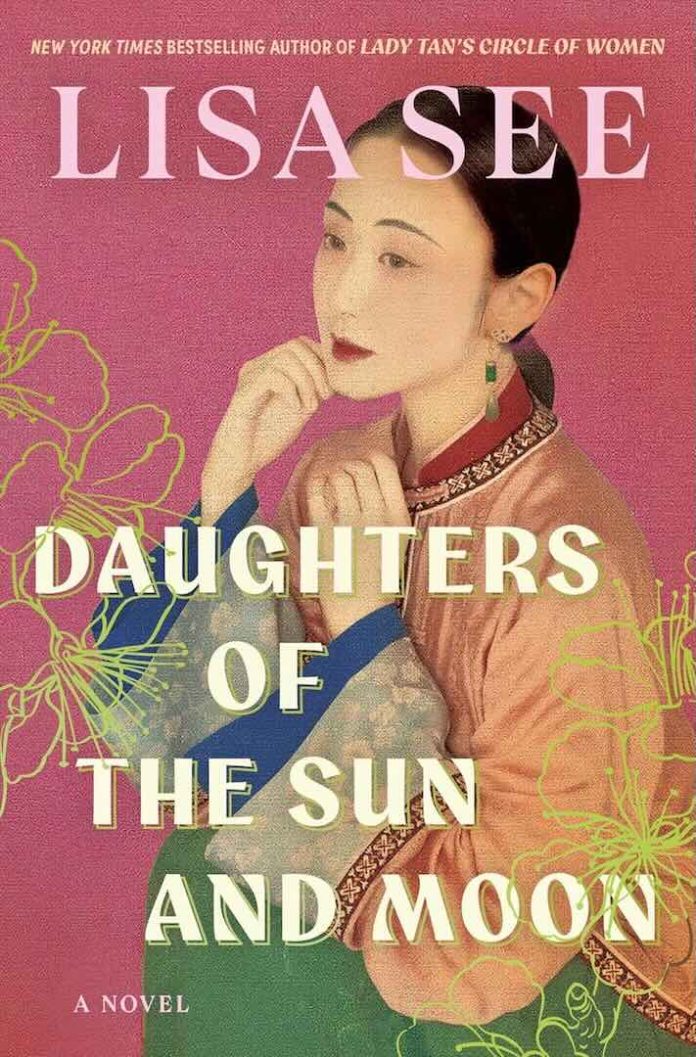
In October 1871, a mob of roughly five hundred Angelenos lynched, shot, and stabbed eighteen Chinese residents in a single night of frenzied violence. The dirt streets ran with blood. The bodies were stacked at a jail yard. Then, for more than a century, the city looked the other way. A freeway on-ramp eventually paved over the block where it happened. Lisa See has spent her career retrieving stories the official record preferred to misplace, and with Daughters of the Sun and Moon by Lisa See, she returns to her own city’s most disgraceful chapter and dares us to look directly at it.
Three Women, Three Crossings, One Pueblo
The novel braids the lives of three Chinese women who land in the dusty, drunken, half-Confederate pueblo of Los Angeles in 1870.
- Dove, seventeen, bound-footed, the daughter of a faded scholar in Canton, has been sold as a second wife to an aging merchant who will display her on a carved chair in his shop the way another man might display a porcelain vase.
- Petal, eighteen, big-footed and barefoot, is tricked onto a boat by her father, sold to the Hip Yee Tong for forty Mexican silver dollars, auctioned naked in the Queen’s Room at the Oriental Warehouse in San Francisco, and shipped south to the Midnight Garden bawdy house.
- Moon, in her thirties, born and educated in Hong Kong, married to Dr. Chee Long “Gene” Tong, the most respected Chinese man in town, walks with a limp from a childhood infection and dresses like an American to please her husband’s white patients.
They orbit each other for sixteen months along the Calle de los Negros before fate aligns them. Dove wants love. Petal wants to walk home. Moon wants justice. They will not get the things they want in the shape they asked for.
A Story Told in Three Voices
The architecture of the novel is its boldest swing. Moon narrates in the first person, looking back from 1926, an old woman of eighty-two writing because “the palest ink is better than the best memory.” Petal narrates in the first person too, but in the bruised present, with the rawness of a girl still inside the trap. Dove gets the third person, distant and beautiful, the way her husband sees her, the way the newspapers will later describe her, “she of the almond eyes.” It is a choice with a thesis. Dove is the woman who is told who she is and what she wants until the people deciding her fate cancel each other out. Pulling her language away from her on the page lets See make the reader feel that erasure in their teeth.
There are stretches where the third-person remove around Dove keeps her at arm’s length even from us, which is the price of the device. Some readers may find her the hardest of the three to hold onto. That is, almost certainly, the point. But the cost is real.
The Craft of It
Lisa See’s research has always been her quiet bragging right, and here she has poured years of archival work into the texture of every page. Justice of the Peace Gray’s actual ledger. The Wing Chung store rebranded as Forever Prosperous. The Cantonese aphorisms threaded into dialogue the way salt threads a broth. Traditional Chinese medicine treated with the same careful precision as the courtroom procedure. Lao Tzu opens each part. A newspaper clipping from the Los Angeles Gazette opens it again, in a different register, screaming the racial language of the time so that no reader can pretend it was a quiet bigotry.
A few touches that land especially well:
- Auntie Lau renaming the trafficked girls in the ship’s hold after flowers, and calling it a gift.
- A small white poodle named Winter Melon who somehow ended up in Moon’s apartment and survived the massacre, drawn from a real newspaper detail.
- The image of Dove embroidering a village pond for Petal, who has never spoken a single line to her, and slipping it into her palm when no one is looking.
- The three meanings the women’s husbands and customers attach to sex: “the husband-wife thing,” “bed business,” “clouds and rain,” each phrase a small social atlas.
Where the Novel Wavers
A book this researched can occasionally read as if it is carrying its sources on its back. The court scenes that follow the Night of Horrors are historically devastating and morally necessary, but they slow the pulse considerably, and the cycle of habeas corpus, demurrer, mistrial, reversal can become a procedural recitation when the novel’s emotional engine wants to be running elsewhere.
The aphorisms, which are part of the music, sometimes tip into instruction. A character explaining a saying to another character who would already know it is a small but recurring tic. And the supporting cast, especially the named henchmen and rival tong members, expands faster than memory can hold, so that by the time a particular Three-Finger Lee or Headman Yo returns, readers may need a beat to place him.
These are the complaints of a four-star reader, not a three. They do not undo the book. They are the friction of a writer reaching for a fuller record than fiction usually attempts.
Where It Sits in Her Body of Work
Readers who came to her through Snow Flower and the Secret Fan, Peony in Love, or Shanghai Girls will recognize her interest in women whose friendships do the work that institutions refuse to do. Lady Tan’s Circle of Women and The Island of Sea Women sharpened her ear for women as practitioners, as workers, as witnesses. Daughters of the Sun and Moon by Lisa See is the closest she has come to her 1995 family memoir On Gold Mountain, which traced her own great-great-grandfather’s arrival in this same city. The pueblo on these pages is not a stage set. It is a place she has been walking for thirty years.
Who This Book Is For
Pick it up if you read Lisa See for the woman-to-woman bond underneath the embroidery and the herbs. Pick it up if you want a piece of American history that the curriculum quietly skipped. Approach it with care if you struggle with depictions of sexual violence, trafficking, or mob killing, because See does not look away and does not ask the reader to.
If You Loved This, Try
For readers who finish Daughters of the Sun and Moon by Lisa See hungry for more:
- Pachinko by Min Jin Lee for a multigenerational saga of displaced women navigating empire.
- The Fortunes by Peter Ho Davies for a fractured Chinese American history told across four lives.
- Homegoing by Yaa Gyasi for a parallel braid of women across centuries.
- The Mountains Sing by Nguyễn Phan Quế Mai for grief, female lineage, and survival in another wartime.
- Beasts of a Little Land by Juhea Kim for the texture of Asian history through women who refuse to disappear.
- The Personal Librarian by Marie Benedict and Victoria Christopher Murray for another rescued American story hidden in the archives.
- The House of Eve by Sadeqa Johnson for two women, two cities, and a country that gave them no good options.
Closing Thought
Daughters of the Sun and Moon by Lisa See is not a comfortable read. It is also not, in the end, a hopeless one. The verdicts get reversed. The killers walk. The block gets paved. And yet three women sit on a porch in the Apablasa orchard, growing herbs, raising children, telling each other the old stories of the Moon Lady and the Spinning Maid, alive when the men with the rope wanted them dead. That is what See has done, again, with the patience of a woman embroidering a village onto silk: she has put them back where the city tried to forget them.







