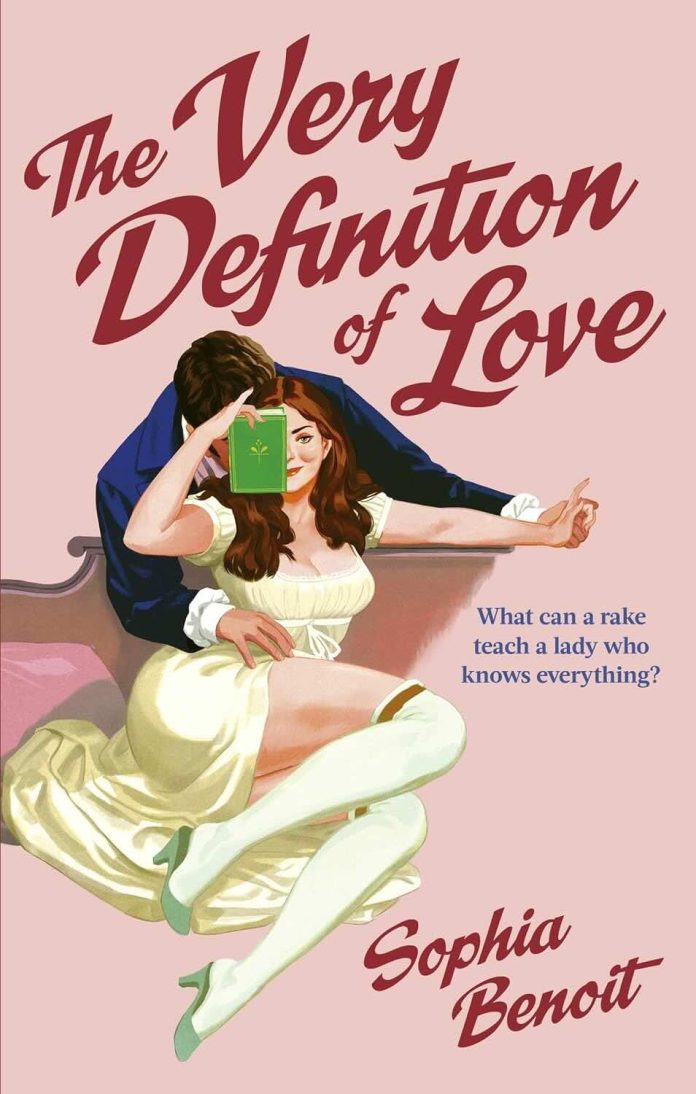
Some debut novelists tiptoe into a new genre. Sophia Benoit kicks the door open with a heroine who’d rather catalogue filthy words than dance a single quadrille. The Very Definition of Love by Sophia Benoit is the kind of Regency romance that winks at you on page one and keeps winking right up to the last line, and somehow it never wears out its welcome doing so.
A wallflower with a dictionary and a plan
Harriet Bancroft is on her fifth London season with no suitor and, frankly, no appetite for one. The eldest daughter of an earl who gambles away the family’s coin faster than she can scrape it back, Harriet spends balls holding her sisters’ wineglasses and eyeglasses while she compiles something far more interesting: a dictionary of slang and cant, the kind of vocabulary gentlemen guard like a private joke. Quim. Monosyllable. The naughty corners of the English language that no one would dare write down for a lady.
Then a late-night research trip to a host’s library goes sideways. Harriet lands in a compromising position with Lord Alexander Stirling, the ton’s most accomplished rake, and a marriage neither of them wanted becomes the only way to save her reputation and her younger sisters’ futures. Her terms are unusual. The union will be in name only, leaving each of them free to chase their own interests. Hers are words. His are women. You can feel the trouble coming a mile off, and Benoit takes her sweet time letting it arrive.
The setup is half the fun
There’s a real pleasure in watching a plan this tidy come apart at the seams. Harriet believes she has drawn up an airtight arrangement. Alexander, who has spent his adult life dodging exactly this sort of entanglement, keeps agreeing to conditions he has no intention of honouring once he works out that he’d rather talk to his wife than seduce anyone else in London. The slow drift from convenience to longing is handled with patience, and the much-promised “only one bed” moment lands precisely because Benoit has done the work of building the tension first.
A few things the book does especially well:
- The premise actually pays off. A heroine writing a dictionary of dirty words gives every conversation a reason to turn bawdy and clever at the same time. The wordplay isn’t decoration. It’s the engine of the plot.
- Consent is sewn into the heat. Alexander teaches, Harriet asks, and the back-and-forth over what each of them wants reads as genuinely sexy rather than dutiful.
- The sisters feel like people. Scandalous widow Philippa and beautiful, half-blind Caroline aren’t furniture. The Bancroft household has its own warmth and its own bruises.
- The history is pulling its weight. Benoit clearly did her homework, right down to which words Harriet could plausibly have known in 1816, and her closing author’s note tips its hat to Francis Grose’s 1811 Dictionary of the Vulgar Tongue, the real-life model for Harriet’s project.
Where the seams show
This is a four-star read rather than a faultless one, and it’s worth being straight about that. The central misunderstanding that powers the later chapters leans on the sort of avoidable miscommunication readers either forgive or grind their teeth over. If you’re the kind of person who mutters “just talk to each other” at a book, you’ll be muttering here.
The pacing dips in the middle, too. Once the marriage settles in and the lessons begin, a handful of scenes feel like variations on the same delicious note rather than forward motion, and a firmer edit might have shaved twenty pages without costing a thing. Alexander, for all his charm, reforms a touch too smoothly. His rakish past is mostly described to us rather than truly reckoned with, which softens the stakes of his change. None of this sinks the book. It simply keeps a very good romance from becoming a great one.
The voice: Carrie Bradshaw in an Empire waist
What carries The Very Definition of Love by Sophia Benoit over its rough patches is the narration. Benoit writes like someone who has spent years filing sharp, funny columns, because she has. Harriet’s interior monologue is a steady trickle of dry observation. She compares herself to a “wall-potted plant,” decides that reading a man’s mind is “like eating soup with a fork,” and waves off one suitor as simply too “Jaspery.” The modern sensibility never feels like a costume slipping. It reads like a confident author who knows her heroine wouldn’t think in the stiff cadence of a period pastiche.
The bedroom scenes earn their own mention. They’re explicit, they’re frequent, and they’re often very funny, which is harder to bring off than heat alone. Harriet treats sex the way she treats everything else, as a topic to research thoroughly, and her bottomless curiosity turns what could have been rote into something specific and charming.
A quick note on what it isn’t
Expectations matter, so a couple of fair warnings:
- This is firmly an open-door romance with graphic content. If sweet or closed-door is your preference, look elsewhere.
- The humour is contemporary in flavour. Purists who want strict period diction may bristle, though Benoit’s author’s note makes a persuasive case for her choices.
- The conflict is low-stakes by design. No murder plot, no spy ring, just two stubborn people talking themselves out of love and then back into it.
About the author
Sophia Benoit arrives at romance by way of journalism. She has written for GQ, Bustle, The Guardian, and The Cut, hosts a sex-and-relationships podcast, and published the essay collection Well, This Is Exhausting in 2021. The Very Definition of Love by Sophia Benoit is her fiction debut and the opening book in a planned Bancroft Sisters series, which all but guarantees that the scandalous Philippa and the lovely Caroline have books of their own on the way.
If you loved this, read these next
Readers who fall for The Very Definition of Love by Sophia Benoit have a rich shelf waiting in this corner of the genre. Six well-matched picks:
- Devil in Winter by Lisa Kleypas, the gold standard for a wallflower who tames a rake through a marriage of convenience.
- Romancing Mister Bridgerton by Julia Quinn, starring a wallflower with a secret writing life of her own.
- A Week to Be Wicked by Tessa Dare, for brainy heroines, banter, and warmth in roughly equal measure.
- Bringing Down the Duke by Evie Dunmore, if Harriet’s bookish, faintly subversive streak is the hook for you.
- Nine Rules to Break When Romancing a Rake by Sarah MacLean, with a list-making heroine set on misbehaving on her own terms.
- The Duke Who Didn’t by Courtney Milan, for crackling wit and a heroine who flatly refuses to shrink.
The final word
The Very Definition of Love by Sophia Benoit is a smart, filthy, big-hearted debut that wears its cleverness lightly and its feelings openly. It trips where so many romances trip, on a stubborn misunderstanding and a sagging middle, yet the wordplay, the warmth, and Harriet’s irrepressible nosiness more than settle the account. If you want a Regency that treats a woman’s pleasure and a woman’s mind as equally worth studying, this one defines the assignment and then writes its own entry for it.







