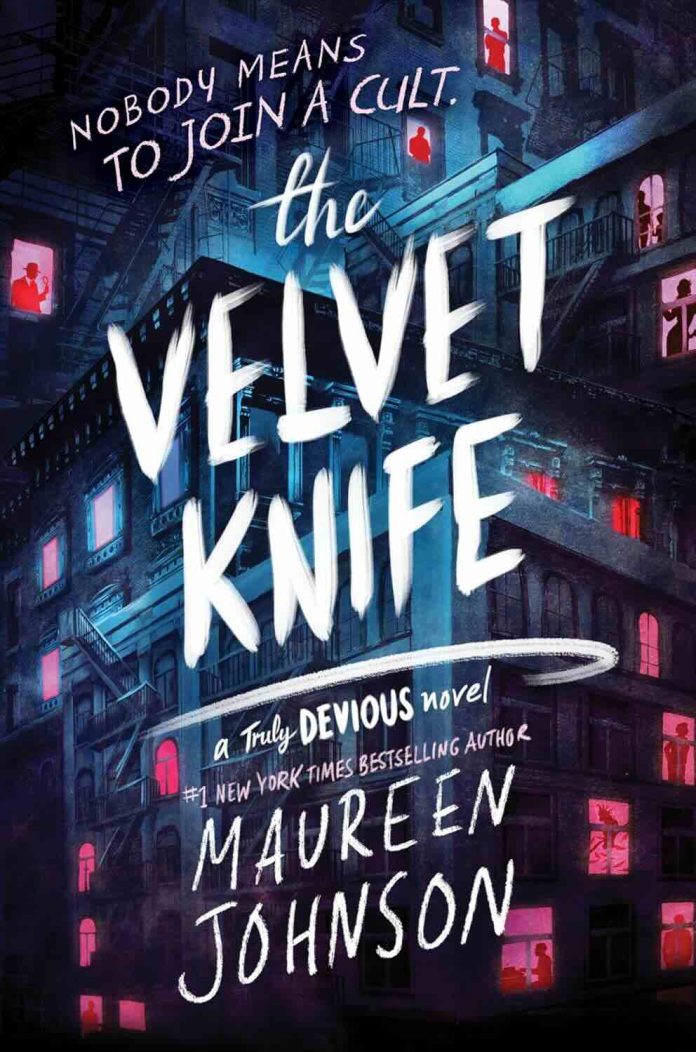
Every series eventually has to answer the question of what its detective is actually for. Five books in, Stevie Bell has solved a 1936 kidnapping, four murders at a summer camp, and a death in England, and The Velvet Knife by Maureen Johnson opens with all of that turned against her. She is eighteen as of chapter two, she has just been dumped on a London street with no explanation, and she has scored twenty per cent on an oral exam about Watergate because a loop of the moment she found out has crowded everything else out of her head. Her professor gives her one retake. Then she breaks off relations with her parents and goes to New York for the holidays, and a woman two doors down decides that the girl who solves murders has arrived at exactly the right moment.
Where The Velvet Knife Sits in the Stevie Bell Mysteries
This is book six, and it is the strongest since the original trilogy, for a reason that has nothing to do with the plot. It is the first one in which Stevie’s skill is examined rather than simply deployed. People keep asking her how she does it: an old woman at a kitchen table wants to know how you establish what is true when lying is so easy. Stevie’s answers are not impressive. She looks. She listens. And she sorts what matters from what does not. The Velvet Knife by Maureen Johnson takes that seriously enough to build its whole structure on it.
Newcomers should know two things. The mystery stands alone; the five books of friendship behind it do not, and you will sense a great deal of history you have not been given. And the series is called the Stevie Bell Mysteries, though everyone knows it by the first book. In order: Truly Devious; then The Vanishing Stair and The Hand on the Wall, which finish that first case; then The Box in the Woods; then Nine Liars; then this.
The Guard Who Noticed the Tape
The Watergate retake is the best structural idea Johnson has had in years, because she uses it as a method rather than a subplot. Stevie finally drags herself to an exhibit at the New York Public Library and stands in front of a photograph of the security guard who found a strip of duct tape holding a door latch open, removed it, came back half an hour later to find it replaced, and called the police. A man who noticed a small wrong thing twice.
That is the shape of the whole novel. The Velvet Knife by Maureen Johnson is a book about tiny inconsequential wrongness: jars of flour and sugar shelved in the wrong order in a dead woman’s kitchen, a cushion propped at a slightly different angle, a sticky patch on a floor, a plastic fruit cup in an alley where nobody thought to look. And the thing that finally cracks it is a doorman’s sign-in book, which is the most Watergate object imaginable. The thesis Stevie eventually offers her professor is the thesis of the book: the original crime is rarely what brings anyone down. What brings them down is the tidying up afterwards.
What Maureen Johnson Does With 1976
The other half is where this becomes more than a good mystery. Interleaved with the present, in chapters headed only by month, is the story of a young woman who leaves a college she hated for the East Village in 1976, is noticed in the street by a man in a plumed hat and the girls who follow him everywhere, and taken up the mountain above Ellenville to a house with a view and no other houses in it.
It is an anatomy, and a clinical one. You are given a new name on your first day. You do not discuss where you came from, and you never mention your birthday, because those are old games. Punishment is dealt out by whichever housemate you have just named as your favourite, and the whole group embraces you afterwards. Johnson writes all of this from inside, with the reader permanently half a page ahead of the narrator, and it is the most frightening material The Velvet Knife by Maureen Johnson has, precisely because nobody raises their voice for the first hundred pages.
The two halves meet in a slow-burning joke. The man from that house now sells a smarter version of the same thing in SoHo, and theatre people pay well to have their worst secrets excavated by somebody with no clinical training at all.
Where The Velvet Knife Gives Ground
Four things hold The Velvet Knife by Maureen Johnson back.
- The present-day murder is thin. Where the historical strand is patient and specific, the second death on the eighth floor turns on one piece of dropped litter and is then resolved by a confession delivered in a single sitting by two characters who have been largely offstage.
- Stevie is unconscious for her own climax. She catches influenza, faints, and loses two days, and the remainder of the 1976 plot reaches us as a recording that explains it aloud. It is a great scene and a slab of exposition at the moment the detective should be working hardest.
- The villain gets one scene. He is confronted in the middle of the book, never appears again, and the novel closes before anyone is arrested.
- The relationship plot takes a great deal of room. Readers who have been waiting five books for it will be delighted. Readers who came for the case will notice it stopping.
Read It If, Skip It If
Read it if:
- You want a dual-timeline mystery where the historical half is the better one.
- You have followed Stevie since Ellingham and want the emotional business finally handled like an adult.
- A closed circle of eight apartment doors is your favourite shape for a murder.
Skip it if:
- You need the detective present and upright for the solution.
- Depictions of coercive control and one very violent death are a hard no.
- This is your entry point and you dislike sensing five books of backstory you do not have.
Content Notes
A seventeen-year-old is held down, cut with a knife and beaten to death on the page; her body is dismembered and an attempt is made to burn it. A mass killing by sabotaged vehicle. A fall from an eighth-floor window. A body found by the narrator. Coercive control throughout, including forced nudity, ritual humiliation and sanctioned slapping. Repeated non-consensual drugging with psilocybin. A cult leader has sex with members, one aged seventeen. Runaways are groomed. A woman is blackmailed over a child she gave up. Panic attacks and prescription medication. Infidelity discussed at length. AIDS bereavement recalled. Underage drinking and drug use. Frequent profanity.
Read These Next
Five of ours for readers who finish The Velvet Knife by Maureen Johnson and want more.
- Death at Morning House by Maureen Johnson if you want more Johnson without committing to a series.
- Kill Joy by Holly Jackson for the other great teenage detective working a closed circle.
- Very Dangerous Things by Lauren Muñoz for privilege, secrets and a body.
- Dinner for Vampires by Bethany Joy Lenz for the real version of the 1976 half, by someone who lived it.
- Young Adult Book Tropes if you want the wider map of the shelf.
Worth Your Shelf
The guard who kept checking that door was called Frank Wills, and the exhibit Stevie visits is right to treat him as the most important person in the story, because everything followed from one man declining to accept a small oddity. That is the standard The Velvet Knife by Maureen Johnson holds its heroine to, and mostly the book meets it: a fruitcake left at a door with a note, a bird screaming for help for a full day, a cage door found open. All of it means something, and all of it was in plain sight.
The Velvet Knife by Maureen Johnson has a slack present-day murder and hands its ending to a tape recorder. It also contains a hundred and fifty pages about how a lonely twenty-year-old is talked out of her own name, one genuinely great dying woman, and a series heroine who is finally allowed to decide what she is for. Six books in, that is not a holding pattern. That is the best one in years.







