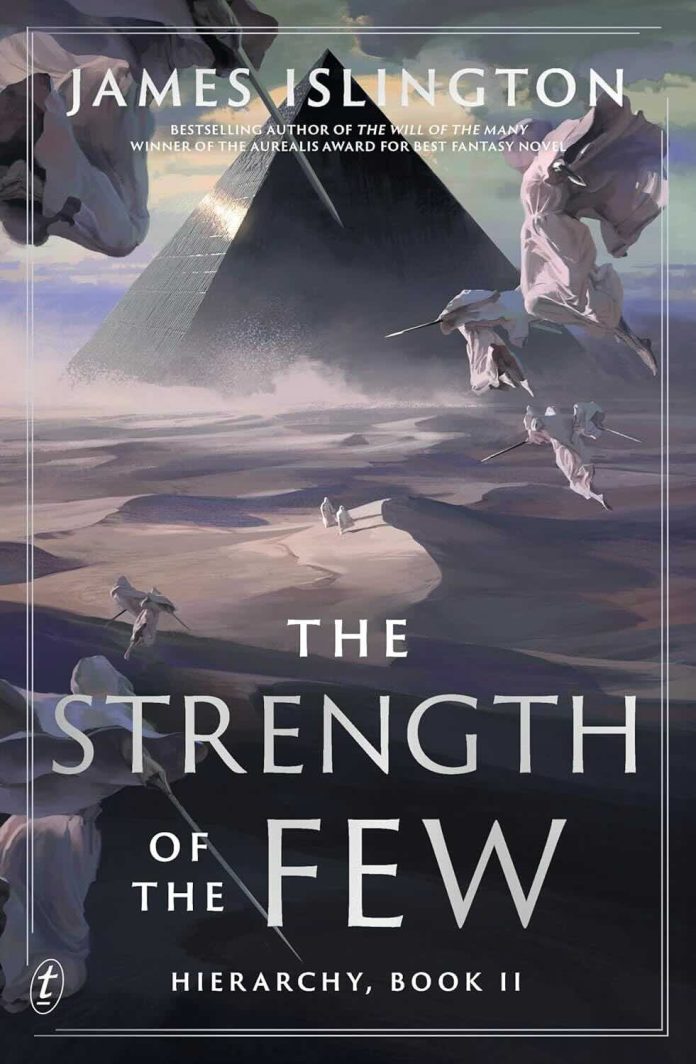
James Islington’s The Strength of the Few arrives as the highly anticipated second installment in the Hierarchy series, following 2023’s acclaimed debut The Will of the Many. Where many sequels struggle under the weight of expectation, Islington boldly restructures his narrative framework, transforming what began as a tightly focused coming-of-age story into an ambitious multiverse epic that challenges both protagonist and reader to navigate three simultaneous realities.
The novel opens with a revelation that redefines everything: Vis Telimus, our battle-scarred hero, discovers he has been replicated across three parallel worlds—Res (his original home), Obiteum, and Luceum. Each version of Vis faces distinct challenges, surrounded by different allies and enemies, yet all three share a singular, devastating purpose: preventing an approaching Cataclysm that threatens to annihilate civilization across all three realities. This central conceit elevates The Strength of the Few beyond standard fantasy fare, demanding readers juggle multiple narrative threads while maintaining investment in each iteration of the protagonist.
The Architecture of Three Worlds
Islington demonstrates remarkable narrative ambition in his structural approach. Rather than following a single Vis through his journey, the author interweaves three distinct storylines, each set in a different world with its own political landscape, cultural norms, and immediate dangers. In Res, Vis navigates the crumbling Catenan Republic, now fractured by civil war as Military, Governance, and Religion vie for supremacy. The city of Caten itself becomes a character—once a gleaming symbol of Hierarchy power, now a war-torn slaughterhouse where former neighbors hunt each other through blood-soaked streets.
The Obiteum sections transport readers to a world conquered by an ancient enemy called the Concurrence, ruled by a god-like figure known as Ka who commands legions of the undead. Here, Islington crafts a distinctly different atmosphere: oppressive, alien, and suffused with the eerie light of a massive pyramid that illuminates an enclosed desert city. The third world, Luceum, offers yet another variation—a place where druids wield power and ancient Celtic-inspired cultures clash with the familiar trappings of Catenan civilization.
This tripartite structure proves both the novel’s greatest strength and its most significant challenge. Islington succeeds in making each world feel distinct and consequential, yet the constant perspective shifts inevitably interrupt momentum. Just as readers become deeply invested in one storyline, the narrative pivots to another, creating a reading experience that demands patience and careful attention.
The Price of Power and the Weight of Impossible Decisions
At its core, The Strength of the Few explores the corrupting nature of power and the moral compromises demanded by impossible circumstances. Vis, already burdened by trauma and loss from the first book, now faces choices that would break lesser characters. Each version of himself must navigate different ethical labyrinths:
The moral complexity deepens through several key conflicts:
- The Res version struggles with his role in the civil war, forced to choose between protecting friends and serving the greater good
- Political manipulation becomes survival as Vis learns to play senators against each other while maintaining his cover
- The question of whether ends justify means pervades every decision, particularly regarding the use of iunctii—the resurrected dead
Islington refuses to offer easy answers. Characters make devastating mistakes with the best intentions. Allies become enemies not through betrayal but through conflicting interpretations of justice. The phrase “the strength of the few” echoes throughout as both justification and condemnation, representing how those with power rationalize their actions while sacrificing the many.
Characters Who Breathe and Bleed
The emotional anchor of the narrative remains Vis’s relationships, particularly with Eidhin and Aequa, his closest companions from the Academy. These friendships, forged in the crucible of the first book’s trials, face their ultimate test as war tears them apart. Islington excels at depicting loyalty strained to breaking point—moments where trust fractures not from deception but from fundamentally different moral calculations.
The loss of Callidus, Vis’s friend from Book One, casts a long shadow over the sequel. Islington handles grief with remarkable subtlety, showing how trauma doesn’t announce itself in grand gestures but in the small moments when memory intrudes unbidden. The scene where Vis visits Callidus’s stripped dormitory bed demonstrates the author’s ability to convey profound loss through simple, observed details rather than melodramatic proclamations.
New characters add depth to an already rich ensemble. Caeror, Ulciscor’s supposedly dead brother, emerges as a complex guide through Obiteum’s mysteries. Ostius, who can somehow traverse between worlds, brings moments of dark humor and unpredictability. Even antagonists like Decimus receive development that makes them comprehensible if not sympathetic—driven by their own losses and desperate to protect what matters to them.
The Intricate Machinery of Plot
Islington demonstrates his background in epic fantasy through layered plotting that rewards attentive readers. The mystery surrounding the Cataclysm unfolds gradually, revealing an ancient war, the concept of “Synchronism” (being present in all three worlds simultaneously), and the terrible truth that preventing apocalypse may require impossible sacrifices. The author seeds clues throughout, maintaining engagement through revelation rather than mere action.
However, this complexity occasionally works against the narrative. The middle sections, particularly in Obiteum, can feel dense with world-building exposition. Characters pause for extended discussions about the Gate, the Rending, and the nature of Will across different realities. While this information proves essential for understanding the larger stakes, it sometimes slows the pacing to a crawl.
The action sequences, when they arrive, showcase Islington’s considerable skill. The Battle of Caten unfolds with tactical precision, tracking multiple assault points and military maneuvers without losing sight of individual characters’ experiences. The use of Will—essentially magical energy that can be ceded, stored, and weaponized—creates fight scenes with strategic depth beyond simple sword-swinging.
Prose That Serves the Story
Islington’s writing style favors clarity over ornamentation, appropriate for a narrative already juggling substantial complexity. His sentences tend toward the straightforward, occasionally punctuated by evocative imagery when describing alien landscapes or moments of high emotion. The prose rarely calls attention to itself, instead functioning as a transparent window into the unfolding drama.
Dialogue flows naturally, with distinct voices for major characters. Eidhin’s terse responses contrast with Aequa’s sharper wit, while Vis’s internal monologue carries the weight of someone forced to constantly calculate and dissemble. The author particularly excels at conversations laden with subtext, where characters say one thing while meaning another, playing political games even among supposed allies.
The Challenges of Sequel Syndrome
Despite its considerable achievements, The Strength of the Few occasionally suffers from middle-book syndrome. The novel concludes with clear setup for Book Three rather than providing satisfying resolution to its own narrative arcs. Several plotlines remain deliberately unresolved, and while this creates anticipation for the finale, it can leave readers feeling they’ve experienced half a story rather than a complete one.
The expanded scope also means reduced page time for individual storylines. Readers who fell in love with the Academy setting and the tight focus on Vis’s personal journey may miss that intimacy. The political intrigue of Caten, while fascinating, competes for attention with the alien mysteries of Obiteum and the druidic conflicts of Luceum. Each thread deserves more development than the page count allows.
A Series Finding Its Identity
What elevates The Strength of the Few above typical sophomore efforts is Islington’s willingness to fundamentally transform his series’ structure. Rather than simply escalating stakes, he reimagines the narrative architecture itself. This ambition doesn’t always succeed perfectly—transitions can jar, pacing fluctuates, and the sheer amount of information occasionally overwhelms—but it demonstrates an author unafraid to challenge both himself and his readers.
The thematic exploration of identity proves particularly resonant. When three versions of yourself exist, each shaped by different experiences and choices, which one represents the “real” you? Islington uses his multiverse premise to examine how circumstance molds character, how trauma shapes decisions, and whether redemption remains possible when every path seems to lead through blood.
For Readers Who Appreciate
The Strength of the Few will particularly appeal to fantasy readers who enjoy:
- Complex plotting with multiple narrative threads demanding close attention
- Morally ambiguous characters making impossible choices in shades of grey
- Political intrigue as central as magical systems
- World-building that favors depth and internal consistency over spectacle
- Emotionally resonant character relationships tested by circumstances
- Mystery elements woven through epic fantasy frameworks
Companion Reads for the Discerning Fantasy Reader
Readers captivated by Islington’s multiverse approach and moral complexity should explore:
- Red Rising by Pierce Brown – shares the political machinations and protagonist forced to infiltrate oppressive systems
- The Poppy War by R.F. Kuang – similarly examines the costs of power and war’s dehumanizing effects
- The Greenbone Saga by Fonda Lee – for readers appreciating complex family dynamics within larger political conflicts
- Mistborn by Brandon Sanderson – those enjoying intricate magic systems and heist-like plotting
- The Shadow of What Was Lost by James Islington – Islington’s Licanius Trilogy offers similar complexity in a complete trilogy
Final Verdict: An Ambitious Expansion That Mostly Succeeds
The Strength of the Few represents a significant evolution for both Islington and his series. While not without flaws—the pacing occasionally stumbles, the scope sometimes spreads too thin, and resolution remains deliberately deferred—it demonstrates remarkable ambition and largely delivers on its promises. The multiverse concept provides fresh narrative possibilities while maintaining emotional continuity through Vis’s fractured existence.
Islington has crafted a sequel that expands without losing sight of what made the first book compelling: a protagonist we care about, faced with impossible choices in a world where simple heroism proves inadequate. The Strength of the Few demands patience and attention but rewards both with a reading experience that challenges as much as it entertains. For those willing to engage with its complexity, this second volume establishes the Hierarchy series as one of modern fantasy’s most intriguing ongoing sagas.







