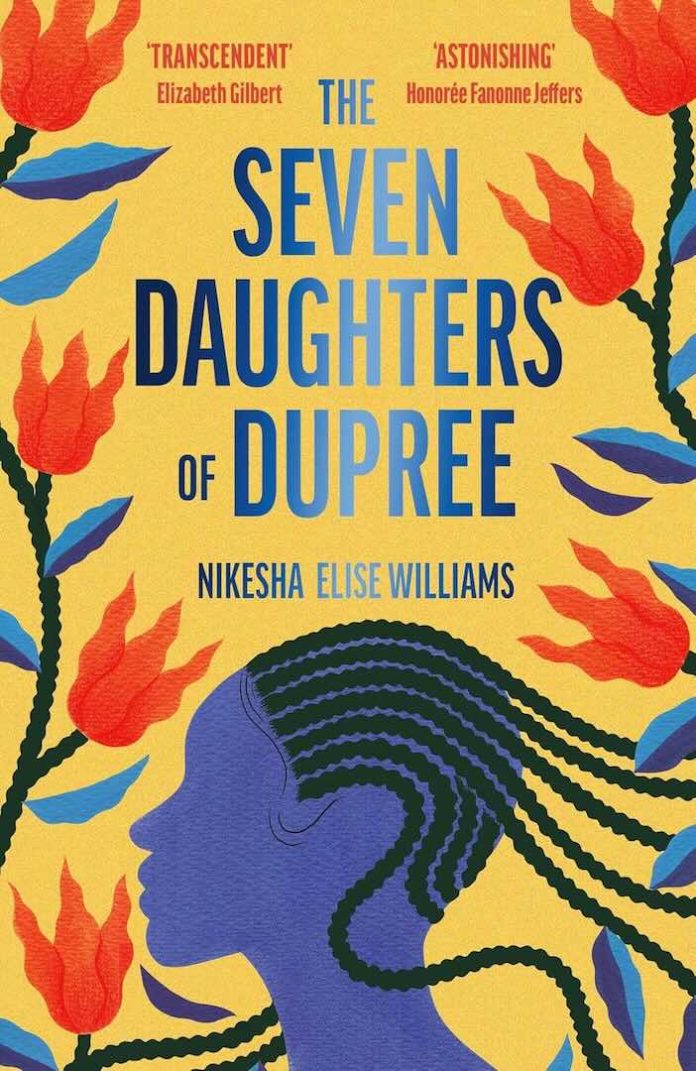
The weight of unspoken truths can crush generations. In The Seven Daughters of Dupree by Nikesha Elise Williams, this suffocating silence becomes a character itself, threading through over a century of Black women’s lives with the persistence of a curse and the stubbornness of love. Williams, a two-time Emmy Award-winning producer and host of the Black & Published podcast, constructs a literary monument to maternal lineage that refuses to let readers look away from the uncomfortable truths families bury in service of survival.
The Architecture of Inheritance
At fourteen, Tati Merét wants what seems impossibly simple: to know her father’s name. But in the Dupree household, where her mother Nadia chain-smokes secrets and her grandmother Gladys guards the past like a dragon hoarding gold, even basic truths feel like dangerous contraband. This contemporary mystery anchors a narrative that spirals backward through time, revealing how the weight of 1995 is actually the accumulated gravity of 1980, 1953, 1934, 1917, 1870, and ultimately, the brutality of enslavement in the 1860s.
Williams employs a structure reminiscent of Yaa Gyasi’s Homegoing, moving between timelines with deliberate purpose. Each generation receives its own carefully rendered spotlight, and the author demonstrates remarkable control in making these temporal shifts feel less like disruptions and more like the natural rhythm of memory itself. The book doesn’t simply tell us that trauma echoes through bloodlines—it makes us feel the reverberations in our bones.
The Chorus of Daughters
The Seven Daughters of Dupree by Nikesha Elise Williams introduces readers to women who share DNA but not always understanding. From Sarah(?), the enslaved woman whose brutal story opens wounds that never fully heal, to Emma, the mixed-race daughter who inherits land soaked in her mother’s blood, to Jubilee who attempts to pass for white, each woman grapples with impossible choices in impossible circumstances.
Williams writes these women with a complexity that resists easy categorization. Gladys emerges as particularly fascinating—a grandmother whose coldness toward Nadia stems from her own violation, a woman who fled Alabama’s violence only to carry it north in her very cells. The author refuses to paint her as simply cruel or simply sympathetic; she exists in that uncomfortable middle ground where real people live, making survival choices that damage those they love most.
The mother-daughter relationships pulse with authenticity that borders on painful. Nadia’s repeated refrain of “I’m enough” to Tati echoes with defensive desperation, while Gladys’s inability to nurture Nadia directly traces back to traumas she can barely articulate. Williams understands that the line between protection and neglect often blurs for women trying to shield their daughters from knowledge that might destroy them.
Language as Legacy
Williams adapts her prose style to match each era she chronicles, a risky technique that pays significant dividends. The contemporary sections featuring Tati crackle with adolescent urgency—journal entries, poetry fragments, and the raw language of a teenager desperate to be seen. When the narrative shifts to the Jim Crow South or Reconstruction-era Alabama, the language becomes more measured, weighted with the careful enunciation of people aware they’re being watched.
The historical sections, particularly those featuring Sarah(?), demonstrate Williams’s commitment to honoring the unspeakable. Rather than exploiting trauma for shock value, she renders violence with controlled precision that emphasizes its dehumanizing horror without becoming gratuitous. The enslaved ancestor’s story unfolds with devastating clarity, her attempted escape and subsequent punishment serving as the genesis point for generations of grief.
Yet The Seven Daughters of Dupree by Nikesha Elise Williams isn’t without structural challenges. The narrative occasionally struggles under the weight of its own ambition. Some contemporary chapters feel rushed compared to the luxurious detail afforded to historical sections, creating an uneven pacing that can jar readers from the story’s spell. The 1995 storyline sometimes reads as a framing device rather than a fully realized narrative in its own right.
The Blessing and the Burden
The novel’s central conceit—a family “curse” ensuring Dupree women only birth daughters—functions as both literal plot point and rich metaphor. Williams explores how this biological peculiarity shapes family dynamics, with Gladys’s unexpected sons becoming sources of both joy and confusion. But the curse operates on deeper levels too: the curse of secrets, of inherited trauma, of mothers unable to mother because they themselves were never properly mothered.
Williams demonstrates particular strength in illustrating how historical violence manifests in contemporary dysfunction. When Tati finally confronts Roman Brown, her absent father, the scene crackles with the accumulated pain of all the Dupree women who came before her—women abandoned, violated, or forced into impossible choices. Roman’s dismissal of his daughter doesn’t exist in isolation; it’s the latest iteration of centuries of Black women being denied full humanity.
Critical Observations
While The Seven Daughters of Dupree by Nikesha Elise Williams succeeds as ambitious historical fiction, certain elements feel underdeveloped. The character of Roman Brown, for instance, never quite transcends the archetype of the “sorry man” that Tati hears about in her mother’s salon. His motivations remain frustratingly opaque, rendering him more symbol than person.
Additionally, some readers may find the sheer scope overwhelming. Williams attempts to give equal weight to seven distinct generations, and while this democratic approach honors each woman’s story, it sometimes results in narrative whiplash. Just as we’ve invested in one woman’s journey, the timeline shifts, forcing us to reorient ourselves emotionally.
The contemporary sections occasionally rely on melodrama that contrasts with the historical chapters’ restraint. Family revelations at Thanksgiving dinner, dramatic confrontations in hair salons—these moments feel more orchestrated than organic, as if Williams trusts the historical material to speak for itself but worries the modern story needs heightening.
The Resonance of Recognition
What elevates this novel beyond its occasional stumbles is Williams’s deep understanding of how Black women navigate impossible landscapes. From Jubilee’s decision to pass, which costs her her daughter, to Nadia’s refusal to romanticize Roman’s abandonment, to Gladys’s complicated relationship with her own femininity after assault—these women make choices that resist simple judgment.
The author’s background in journalism serves her well here. She approaches each character with a reporter’s eye for detail and a poet’s ear for the unspoken. The result is a novel that feels researched without feeling academic, emotionally resonant without becoming maudlin.
The Seven Daughters of Dupree by Nikesha Elise Williams stands as a worthy addition to the growing canon of multi-generational Black family sagas. While it may not achieve the sustained brilliance of Ayana Mathis’s The Twelve Tribes of Hattie or the structural perfection of Yaa Gyasi’s Homegoing, it brings its own fierce intelligence and emotional honesty to familiar territory.
For Readers Seeking Similar Journeys
If this exploration of generational inheritance speaks to you, consider:
- The Twelve Tribes of Hattie by Ayana Mathis – Following a mother and her twelve children through the Great Migration
- Homegoing by Yaa Gyasi – Tracing two sisters and their descendants across centuries
- The Love Songs of W.E.B. Du Bois by Honorée Fanonne Jeffers – An epic journey through a Black family’s history in the American South
- The Vanishing Half by Brit Bennett – Exploring themes of passing, identity, and sisterhood across generations
- These Ghosts Are Family by Maisy Card – A Caribbean family reckoning with secrets across time
- One Blood by Denene Millner – Three generations of women confronting inherited trauma
Williams has crafted a novel that demands readers sit with discomfort while offering the hope that speaking truth—however painful—can begin to heal what silence has broken. It’s a flawed but powerful debut that announces an important new voice in literary fiction.