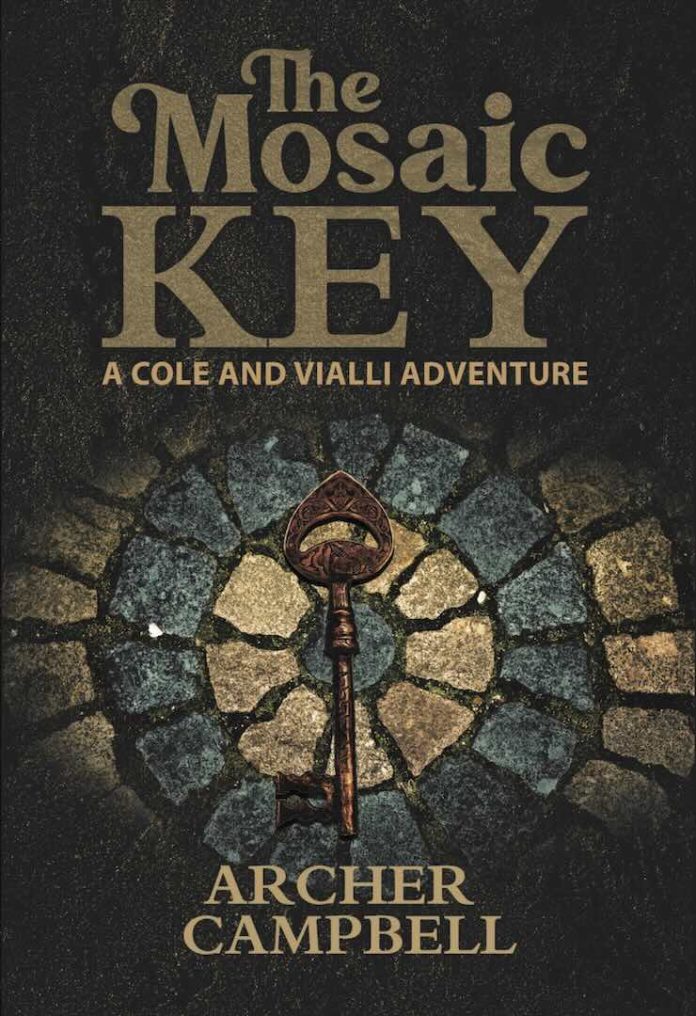
There is a particular kind of novel that does not ask you to simply read it. It asks you to decode it, to hold each sentence up to the light the way one might examine a shard of stained glass, searching for the pattern hidden in the break. The Mosaic Key by Archer Campbell is precisely that kind of novel — a debut thriller that weaves art history, global conspiracy, and lyrical prose into something that reads like a love letter to the idea that truth, no matter how deeply buried, insists on being found.
Set against the atmospheric backdrops of Vancouver, Venice, Dubrovnik, Paris, Zurich, and Alexandria, the novel introduces us to Ethan Cole, a former museum security specialist, and Clara Vialli, a sharp-witted art historian. When a catastrophic explosion tears through a Vancouver museum and leaves Ethan accused of a crime he cannot remember committing, the two are pulled into a centuries-old conspiracy involving coded mosaics, secret archives, and a shadowy organization that has made an industry of editing the world’s collective memory. What follows is a chase that spans continents, archives, and centuries — a puzzle constructed from glass, light, and the dangerous idea that history is only as stable as those who choose to guard it.
A Debut That Reads Like Lived Experience
What makes The Mosaic Key by Archer Campbell immediately distinctive is the confidence of its voice. This is a debut novel, and yet the prose carries the weight and rhythm of a writer who has spent years studying the texture of the world he describes. Campbell is a Canadian author who, before turning to fiction, built a career that exposed him to extraordinary people and places. That background bleeds through every chapter. The Venice of this novel is not a postcard Venice; it is a city of workers and pigeons, of alleys slick from early rain, of water that rises against stone with a patience that feels almost conspiratorial. Alexandria arrives as a geometry of light and pale stone, sea wind carrying brine and diesel and cumin. Each city is rendered not as a setting but as a character — one with its own agenda.
Campbell’s writing style deserves particular attention. He favours short, declarative sentences that punch, alternated with longer, image-laden passages that linger. His metaphors are precise and unexpected: a woman’s voice that could be a lullaby if lullabies issued court orders, a table that looks carved from money, guards whose suits fit like decisions. This is thriller writing that refuses to sacrifice beauty for speed, and the result is a reading experience that feels simultaneously urgent and contemplative.
The Architecture of Conspiracy
At the heart of the novel lies a fascinating concept. The conspiracy in The Mosaic Key by Archer Campbell is not about hidden treasure or lost gold. It is about something far more unsettling: the deliberate editing of collective memory. The antagonists do not destroy history. They curate it, trimming a protest from a newsreel here, shifting the coordinates of a mass grave by a decimal there, inserting a donor’s name into a placard to rewrite who funded what. These are small alterations, but Campbell understands that small alterations, accumulated over centuries, reshape the entire landscape of what a culture believes about itself.
The central artifact — a Byzantine mosaic rosette encoded with micro-grooves that function as a kind of ancient data storage — is a brilliantly conceived MacGuffin. It is part cipher, part ledger, part mirror. And the mechanism by which it reveals its secrets is perhaps the novel’s most philosophically resonant idea: the truth it contains cannot be unlocked by a single person in a dark room. It requires witnesses. It requires a public.
Key Themes Worth Noting
- The fragility of historical truth and how easily it can be reshaped by those in power
- The tension between preservation and erasure — and whether curating the past is a form of mercy or control
- The idea of witness as an act of courage, not merely observation
- The relationship between art and memory, between glass and the stories reflected in it
Characters Who Carry Their Scars Lightly
Ethan Cole is not a typical thriller protagonist. He is bruised, cautious, and self-aware in a way that makes him feel earned rather than manufactured. His dry humour surfaces at exactly the right moments, and his reluctance to trust — even himself — gives the narrative its emotional backbone. When Clara asks him to join her, his decision feels less like a hero answering a call and more like a man choosing to stop standing still.
Clara Vialli, meanwhile, is the kind of character who elevates every scene she enters. She is whip-smart, fearless without being reckless, and possesses an emotional intelligence that makes her partnership with Ethan feel genuinely equal. She does not exist to be rescued, nor to rescue. And she exists to decode, to challenge, and to carry the story’s intellectual weight alongside its emotional one.
The supporting cast is equally well-drawn. Detective Lin, who follows his conscience further than his badge should allow. Garnier, the Parisian archivist who risks everything to preserve what others would erase. Dr. Samira Halim, whose combination of warmth and scholarly precision makes her one of the novel’s most memorable figures. And the antagonist, Dr. Elena Rossi, who is rendered with a complexity that elevates The Mosaic Key by Archer Campbell above the genre’s frequent tendency toward one-dimensional villainy.
Pacing, Structure, and the Art of the Chase
The novel is structured across twenty chapters, each titled with an evocative phrase — The Postcard, The Glass City, The Mirror Network, The Witness — that mirrors the mosaic motif of the story itself. Each chapter is a tessera, a piece of coloured glass, and the full picture only becomes visible when you step back far enough to see how they interlock.
Campbell’s pacing is relentless without feeling breathless. He understands that a great thriller needs both the sprint and the pause, and he uses his quieter moments — a conversation in a Venetian archive, a dawn departure from a pension where the innkeeper collects clocks — to deepen character and theme without slowing momentum.
What Sets This Book Apart from Other Historical Thrillers
- Prose quality: Campbell writes with a literary sensibility uncommon in the genre, every sentence polished and purposeful
- Intellectual ambition: The central mystery is not just a puzzle to solve but a philosophical question to sit with
- Global scope without tourist fatigue: Each location serves the story rather than decorating it
- Restraint in revelation: The novel trusts readers to connect the pieces rather than over-explaining
A Foundation Built in Glass
As the first instalment in the planned Cole and Vialli Adventure series, The Mosaic Key by Archer Campbell accomplishes something rare: it tells a complete, satisfying story while leaving just enough threads to make the next book feel not like a commercial inevitability but an artistic necessity. The sequel, The Glass Archive, promises to take the protagonists deeper into Cairo’s shadowed libraries, and based on the strength of this debut, that is a journey worth waiting for.
Campbell has announced a five-book arc for the series, with subsequent titles including The Winter Ledger, The Iron Crossing, and The Silent Constellation. If the ambition displayed in this first outing is anything to measure by, the Cole and Vialli Adventures may well become a defining series in the historical thriller genre.
If You Loved This, Read These
For readers who found themselves drawn to the world of The Mosaic Key by Archer Campbell, the following books offer similar pleasures:
- The Da Vinci Code by Dan Brown — The benchmark for art-meets-conspiracy thrillers, with a globe-trotting pace and puzzle-box structure
- The Shadow of the Wind by Carlos Ruiz Zafon — A literary mystery set in post-war Barcelona that shares Campbell’s reverence for the written word and hidden archives
- The Rule of Four by Ian Caldwell and Dustin Thomason — A cerebral thriller centred on the decoding of a Renaissance text
- An Instance of the Fingerpost by Iain Pears — A richly layered historical mystery told from multiple perspectives, exploring how truth shifts depending on who tells it
- The Historian by Elizabeth Kostova — A sweeping, atmospheric novel that combines historical research with a slow-burning thriller narrative across European cities
- The Flanders Panel by Arturo Perez-Reverte — A masterful blend of art, chess, and murder that shares Campbell’s fascination with the secrets hidden inside beautiful objects
Final Reflections
What lingers after closing this novel is not a particular twist or revelation — though there are plenty of both — but rather the feeling of having spent time inside a world where beauty and danger are the same thing viewed from different angles. Campbell has written a thriller that respects its audience, rewards close reading, and asks a question that matters: when the people who control what we remember decide to edit the record, who has the courage to become a witness?
Every truth waits for its witness. This novel is proof that the right story can make witnesses of us all.