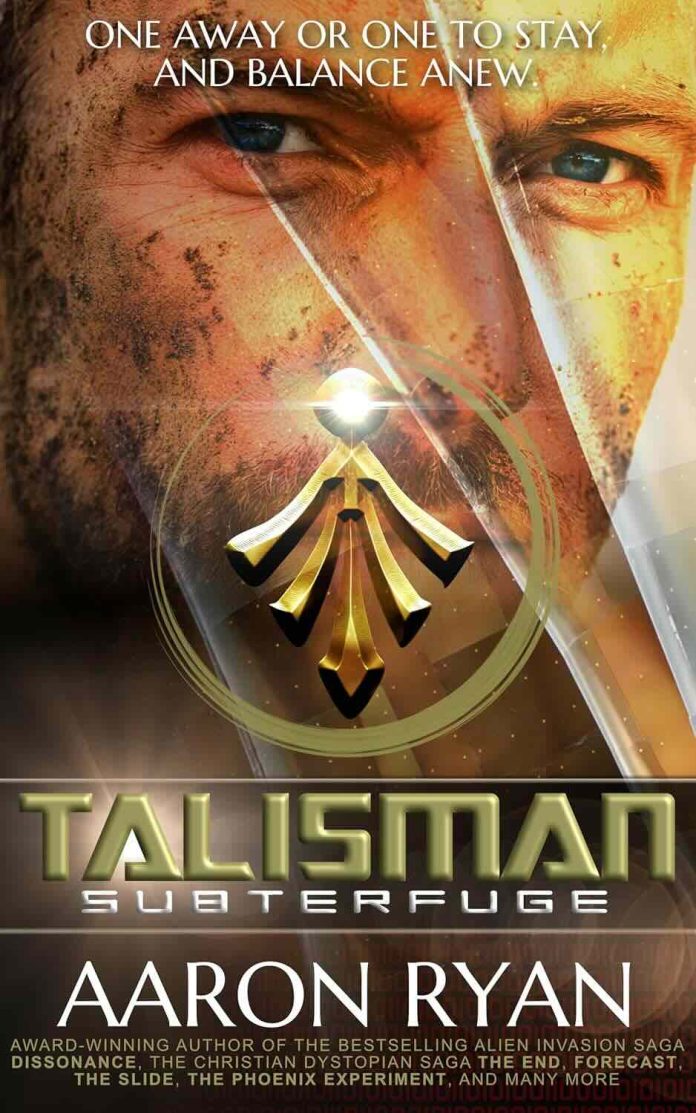
Aaron Ryan’s Talisman: Subterfuge plunges readers into a world seventeen years removed from catastrophic alien invasion, yet still bearing the scars. This isn’t the immediate aftermath of apocalypse, but rather the long, uncomfortable recovery—a civilization that has learned to live with trauma while desperately clinging to normalcy. Ryan, known for his bestselling Dissonance hexalogy, returns to this universe with a story that feels both intimately connected to his previous work and daringly independent in scope and tone.
The novel operates as both a continuation and a fresh entry point. While characters and events from the Dissonance series appear, Ryan crafts his narrative so newcomers won’t feel lost. Instead, they’ll discover a richly textured world where humanity survived two waves of gorgon attacks—parasitic aliens with telepathic paralysis abilities—only to face a new kind of threat: one from within their own ranks, powered by forces beyond comprehension.
The Weight of Impossible Choices
At the heart of Subterfuge lies Liam Fox Mayfield, once celebrated as a war hero who helped liberate Earth from alien occupation. Eight years after losing his wife Janine to a rogue gorgon, Liam has transformed into something else entirely: The Talisman, a shadowy figure who materializes at moments of crisis, saves lives with supernatural precision, and vanishes leaving only mysterious golden trinkets behind. Ryan’s portrayal of Liam masterfully captures a man hollowed out by grief yet driven by desperate hope.
The premise Ryan constructs is devastatingly elegant: save one thousand souls, and the enigmatic Aeterium Axis will resurrect Janine. Fail, abandon the mission, or lose the medallion that grants him power, and someone else he loves dies. It’s a devil’s bargain wrapped in cosmic bureaucracy, and Ryan explores every agonizing facet of this arrangement. The author doesn’t shy away from the moral complexity inherent in Liam’s mission—to save lives, he must sometimes take them, operating on a brutal calculus where four deaths can be justified if seven are saved. This arithmetic of survival gives the novel a philosophical weight that elevates it beyond standard superhero fare.
A Study in Isolation and Surveillance
Ryan introduces journalist Onyx Sleater as both pursuit and mirror. Her investigation into the “Dark Ghost” provides the narrative with crucial external perspective, allowing readers to see Liam through fresh eyes while gradually unveiling his identity and purpose. The dynamic between hunter and hunted shifts throughout the novel, becoming something more complex as Onyx bears an uncanny resemblance to Janine.
The author demonstrates particular skill in crafting Onyx as a fully realized character rather than a plot device. Her dogged journalism, her growing sympathy for Liam’s plight, and her eventual entanglement in his cosmic obligation feel earned rather than forced. The scenes between them crackle with tension—not romantic, but rather the friction between someone desperate to remain hidden and someone constitutionally incapable of letting mysteries lie. When Onyx makes a choice that inadvertently changes everything, the consequences ripple through the remainder of the novel with devastating authenticity.
The Architecture of Subterfuge
Ryan’s title proves apt as the novel operates on multiple levels of deception and hidden truth. Liam conceals his identity from the world while the Aeterium Axis conceals their true nature and motives. Former President Vance Cordova, Liam’s father-in-law, harbors deep resentment masked by political calculation. The Zorander, Liam’s supernatural adversary, lurks in shadows hunting for any thread that might unravel The Talisman’s carefully constructed secrecy.
The Zorander deserves particular mention as Ryan’s most chilling creation in this novel. A former talisman who failed or abandoned his own mission, The Zorander represents what Liam could become—bitter, vengeful, and consumed by hatred for the cosmic forces that manipulated him. His chapters, written in an archaic, formal style that mirrors his alien consciousness inhabiting human forms, provide disturbing glimpses into a being that views humanity as insects to be crushed. The contrast between Liam’s weary determination to protect and The Zorander’s gleeful destruction creates genuine stakes.
Pacing and Structure as Narrative Weapons
The novel employs a three-part structure that mirrors Liam’s journey from isolated operative to cornered fugitive to desperate protector. Ryan’s pacing accelerates with each section, building tension through accumulating complications. The early chapters establish mystery and method—we watch Liam work, understand his abilities, and piece together his history alongside Onyx. The middle section intensifies as multiple forces converge and secrets spill. The final section becomes breathless, a cascade of action and revelation that expertly sets up future installments.
This structure serves the novel’s thematic concerns beautifully. Just as Liam can never find equilibrium—his mantra “one away or one to stay, and balance anew” mocking the impossibility of his task—the narrative itself refuses to settle into comfortable rhythms. Ryan keeps readers perpetually engaged, delivering revelations at precisely the right moments.
Technical Craft and World-Building
Ryan’s prose demonstrates considerable range throughout Subterfuge. Liam’s chapters carry a noir-inflected weariness, internal monologues that recall hardboiled detective fiction filtered through superhuman exhaustion. Onyx’s sections pulse with journalistic clarity and mounting urgency. The Zorander’s chapters unsettle with their alien syntax and casual cruelty. This stylistic variance prevents monotony while reinforcing how each character perceives and interacts with the world differently.
The world-building deserves recognition for its restraint and integration. Rather than frontloading exposition about the gorgon wars and humanity’s recovery, Ryan trusts readers to absorb context through lived detail. Characters reference Blockades—underground shelters where humanity survived—as casually as one might mention subways. The lingering trauma manifests in small ways: people instinctively checking the sky, defensive architecture, the slow resurrection of pre-invasion institutions. This creates a vivid sense of a world that has changed permanently, where victory didn’t mean return to normal but rather adaptation to a new reality.
Emotional Resonance and Human Cost
Perhaps the novel’s greatest achievement lies in maintaining emotional authenticity amid supernatural circumstances. Liam’s relationship with his estranged sons Joseph and Carson, who blame him for their mother’s death, provides gut-wrenching counterweight to his cosmic mission. His fractured friendship with Cameron “Jet” Shipley, his war buddy who struggles to believe in the Aeterium Axis, adds another layer of isolation. Every life Liam saves brings him closer to Janine’s resurrection but further from the living people who once mattered to him.
Ryan understands that the true cost of Liam’s bargain isn’t the 1,000 lives he must save but the humanity he loses in the process. There’s a haunting moment when Liam saves 31 people from a wedding cliff collapse but loses the groom—his count increases, but the arithmetic feels obscene. These moments prevent the novel from becoming a simple power fantasy and instead position it as a meditation on the corrupting nature of impossible obligations.
Setting Up the Saga
Talisman – Subterfuge ends on a compelling cliffhanger that simultaneously satisfies immediate narrative arcs while opening vast new territories for exploration. The revelation of The Refuge—Liam’s secret shelter deep in Svalbard’s glaciers—and the assembling of various characters there suggests intriguing dynamics for future installments. The capture of Liam’s sons by The Zorander raises stakes to unbearable heights while forcing Liam to confront whether he’ll sacrifice Janine’s return to save their children.
This ending demonstrates Ryan’s confidence in his series structure. He embraces serialized storytelling’s potential for sustained tension and evolving character dynamics, rewarding readers who commit to the journey with rich emotional payoffs and tantalizing promises of what’s to come.
Echoes and Influences
Talisman – Subterfuge by Aaron Ryan will appeal to fans of morally complex superhero narratives like Watchmen and time-loop action films like Edge of Tomorrow, while carving its own identity within those traditions. The post-apocalyptic setting recalls Cormac McCarthy’s The Road in its emotional weight, though Ryan’s world retains more hope and structure. The cosmic beings manipulating humans from afar evoke Alastair Reynolds’ Revelation Space series, while the journalist-investigates-vigilante plotline pays homage to superhero comics without becoming derivative.
Readers who enjoyed Emily St. John Mandel’s Sea of Tranquility for its meditation on time, loss, and human connection will find similar thematic richness here in Talisman – Subterfuge, albeit in a more action-oriented package. Those who appreciate CL Clark’s The Faithless or Tade Thompson’s Jackdaw for their complex protagonists navigating impossible moral terrain will recognize kindred spirits in Liam’s struggle.
Similar Reads Worth Exploring
For readers captivated by Talisman: Subterfuge, several titles offer complementary experiences:
- Jeff VanderMeer’s Borne explores post-apocalyptic survival with similar emotional depth and strange supernatural elements
- Peter Watts’ Blindsight examines first contact with Ryan’s same intellectual complexity
- N.K. Jemisin’s Broken Earth trilogy matches this novel’s blend of personal trauma and world-ending stakes
- Richard K. Morgan’s Altered Carbon offers comparable mixtures of supernatural abilities and noir sensibility
A Powerful Opening Salvo
Talisman: Subterfuge announces Aaron Ryan’s ambition to expand beyond his already impressive Dissonance series into something even more narratively complex and thematically rich. This opening volume successfully establishes a protagonist worth following through whatever trials await, a world that feels lived-in and consequential, and stakes that transcend simple survival. Ryan’s willingness to leave his hero broken, his mission incomplete, and his future uncertain demonstrates the kind of narrative courage that distinguishes memorable series from forgettable ones.
Ryan has crafted the beginning of what promises to be a compelling examination of grief, duty, and the terrible prices we pay for second chances. The multiple perspectives add depth, the cosmic mythology invites speculation and discussion, and the cliffhanger ending ensures readers will eagerly await the next installment. In a genre sometimes content with spectacle over substance, Subterfuge delivers both in equal measure, establishing itself as essential reading for anyone who appreciates superhero stories with genuine heart and philosophical complexity.







