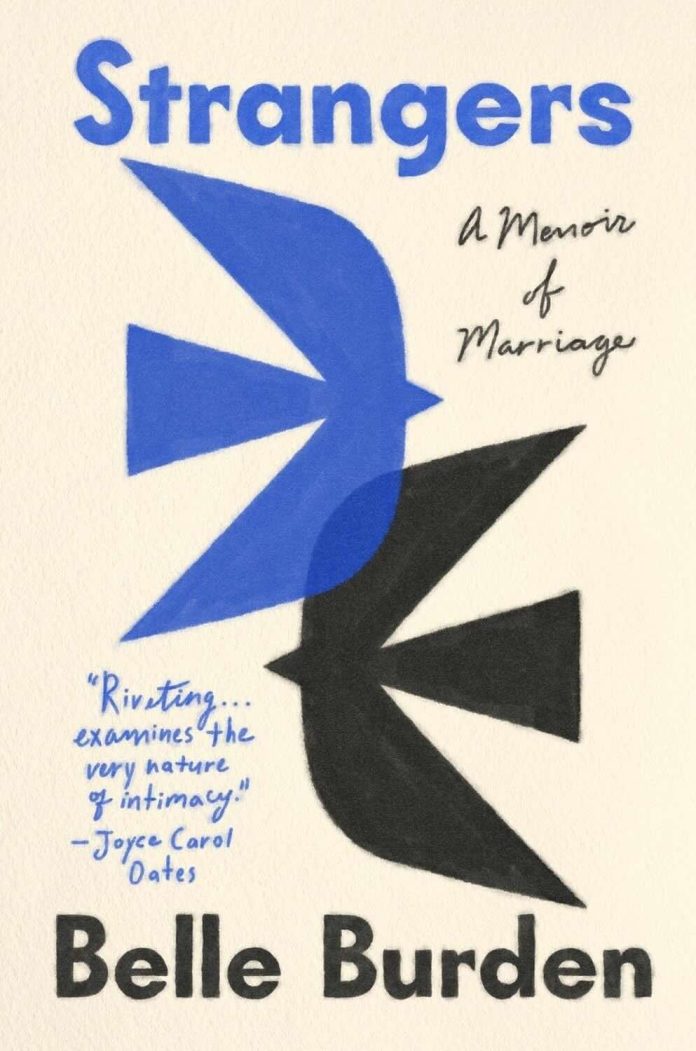
The floor is being mopped when the phone rings, and the voice on it belongs to the other woman’s husband. It is 21 March 2020, the first night of spring, four days into lockdown on Martha’s Vineyard. By six the next morning the marriage is over, the house and the apartment have been offered up, custody has been surrendered without being asked for, and the man is on a boat off the island. Strangers by Belle Burden begins there, which is a problem the book has to solve, because almost every divorce memoir begins with the same scene and then asks the reader to care about a stranger’s grief for three hundred pages.
It solves it in two ways, and both are worth being specific about.
Where Strangers by Belle Burden Sits
The divorce memoir is currently a crowded shelf. Leslie Jamison, Lyz Lenz and Maggie Smith have all published in the last few years, and the pipeline that produced this one, a Modern Love column expanded into a book, is by now a recognised route rather than a surprise. Anyone picking up Strangers by Belle Burden has almost certainly read three of these already.
What distinguishes it is that Burden is a lawyer, and the book is at its best when she writes like one. The financial architecture of her marriage is laid out with the flat exactness of a document you would not want served on you: a prenuptial agreement amended days before the wedding at her husband’s request so that only jointly titled assets would be split; two trusts emptied to buy an apartment and a house, both then placed in joint name; a meeting in July 2019 whose agenda carried one unactioned line at the bottom about extinguishing the prenup; tax returns signed and never read. Her verdict on the last of these is the sharpest sentence in the book, and she turns it entirely on herself: he had not hidden any of it, she had chosen not to look.
The second distinguishing feature is a lineage most readers will find hard to look away from. Burden is the daughter of Carter and Amanda Burden and the granddaughter of Babe Paley, which means the family’s most famous betrayal was already a matter of public record decades before this one, published by a friend who was trusted. Three generations of women in this book were trained to clean up quietly after men. The decision to publish is the break in the chain, and Burden lets that speak for itself instead of announcing it.
What Belle Burden Adds to the Essay
Readers who know the column will find the marriage’s collapse largely familiar. What the book adds is everything that happens for the next three years, and the strongest of it is not about the husband at all.
What works
The strengths of Strangers by Belle Burden are almost all in the peripheral vision rather than the centre of the frame.
- The chorus. This is the book’s real subject and its real achievement: a sustained, unsparing catalogue of how a community narrates a woman’s abandonment back to her. A dinner guest who reframes the wreckage as somebody else’s love story, because his own father left and was happy afterward. A woman on a porch, days after the exit, telling the table at length how much she adores the husband. A host who cheerfully names the aggressive lawyer he recommended and predicts years of litigation. A gynaecologist who observes, mid-examination, that women become less interesting to men when they stop working.
- The club rule. Only one spouse may remain a member; the other reapplies from scratch. Members are overheard debating whether it should be her, while she is on the island with three children and he is in Manhattan with the affair. It is a small social detail that does more to explain the world of this book than any amount of scene-setting.
- The custody fact, stated plainly. Her lawyer sends a fifty-fifty agreement. It comes back stripped of everything except dinner on Thursdays. He buys a two-bedroom apartment and makes the second bedroom an office. Several of his friends repeat his reasoning to her almost word for word.
- The immigration work. Burden practises pro bono law with juvenile clients, and those cases give the book its only genuine zoom-out. She is honest that it functions as one, and honest about what it costs her to notice.
- The refusal of a villain. Late on, she finds childhood photographs and reconstructs the boy her husband was, and arrives at something that is not forgiveness and not excuse. It is the most generous page here and it does not ask to be applauded.
Where it gives ground
Four things keep Strangers by Belle Burden from being the book its best chapters promise.
- The wealth is a permanent draft in the room. She names it constantly and a psychiatrist tells her the loss is real regardless, which is true. It does not dissolve the difficulty of spending two hundred pages on whether a Vineyard house and a downtown apartment must be sold.
- The husband never becomes legible. He is a pseudonym who refused to explain himself, and the memoir closes by admitting no answer ever came. That is honest, and it leaves a hole where the antagonist should be. Long stretches are one person interpreting another who declines to appear.
- The chorus repeats its own shape. Someone says a thoughtless thing, she is winded, she and her stepmother read it generously, she resolves to keep showing up. Four or five times. Each instance is good; the movement becomes predictable.
- The last act narrows. The final third is largely about publishing the essay and surviving the reaction, which is a smaller subject than the one the book opened with.
Do you need the Modern Love essay first?
No, and there is a case for reading it afterward rather than before. The book contains its own account of the essay’s composition, submission and publication, and the reaction to it forms the final movement, so arriving with the column already in mind flattens a genuine turn. Read the memoir cold. Read the column when you reach the chapter about sending it.
Content notes for Strangers by Belle Burden
Infidelity, abandonment and sustained gaslighting. A third party’s suicide attempt, described briefly. Extended suicidal ideation in the author, with intrusive images, named and treated on the page. Depression and antidepressant use. A parent’s sudden death; a friend’s death from cancer; a death by overdose. Covid-19 illness and death, including a client’s. A demeaning remark from a doctor during a gynaecological examination. Online harassment and body-shaming, summarised rather than quoted at length. Divorce litigation and financial coercion throughout.
Read these next
Five books that sit well alongside Strangers by Belle Burden, for different reasons:
- Memorial Days by Geraldine Brooks. Sudden loss written with the same refusal to be consoled on schedule.
- All the Way to the River by Elizabeth Gilbert. A partnership examined afterward, with a comparable willingness to indict the narrator.
- Dear Writer by Maggie Smith. Smith’s You Could Make This Place Beautiful is the obvious companion volume; this one is about making the work that follows.
- Splinters by Leslie Jamison. The closest current comparison, and the more formally restless of the two.
- Heartburn by Nora Ephron. Burden pictures her own psychiatrist as Ephron, which makes this the ancestor the book has already claimed.
The Last Word
Strangers by Belle Burden is not, in the end, a book about a man who left. He walks out on page thirty and never returns as anything more than a set of emails and a figure in a suit at two graduations. It is a book about the machinery that engages around a woman afterward: the friends who close the distance and the friends who cross the road, the language available for widowhood and the total absence of any for this, the two words she was handed in place of a reading of her own work, cathartic and revenge, and the judgement that landed hardest, which was that a good mother would have kept quiet. Her answer arrives in the last pages, and it is not defiance. It is the possibility that saying what happened might be the thing that stops it happening again to the three people who share her house. She never gets her explanation. She stops needing one, which turns out to be the harder and better ending.







