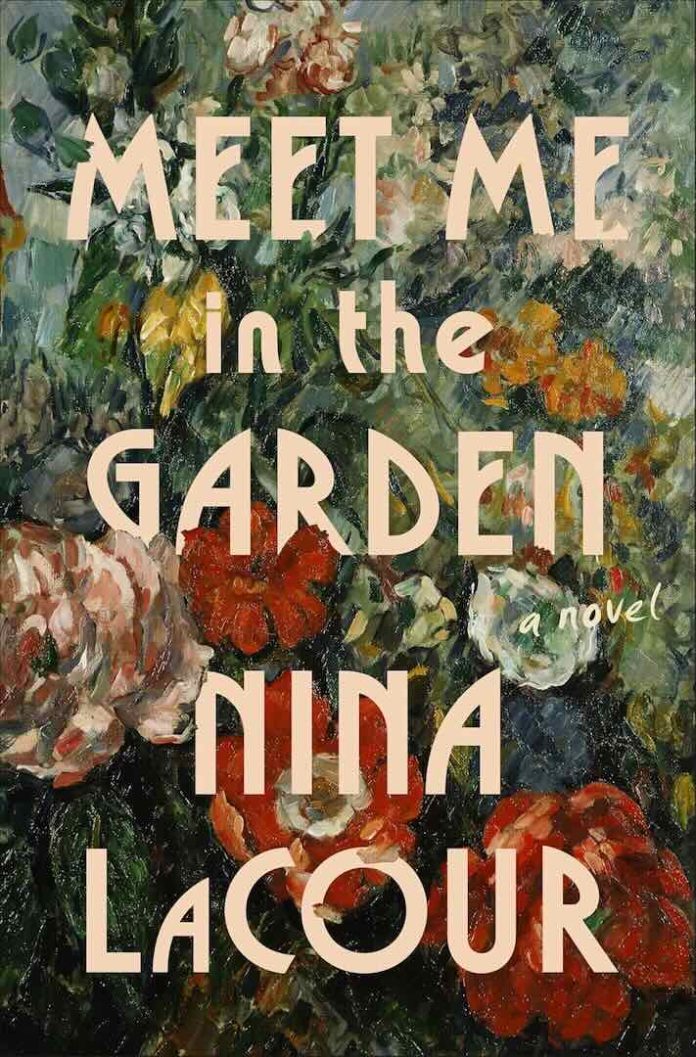
A photographer’s window on Magazine Street, 1944. In it, a portrait of a beautiful young woman, lit and posed like any other bride-to-be. Beside it, screwed to the same wall, a sign announcing who is permitted inside. Odette Honoré stands on the pavement and cannot work out who the joke belongs to. Meet Me in the Garden by Nina LaCour opens on that image and then spends twenty-one years and four hundred pages refusing to let go of it, because the whole novel is contained in the two things hanging side by side and the girl on the street who understands both.
Readers who know LaCour from We Are Okay or Watch Over Me should adjust their expectations. This is her second novel for adults after Yerba Buena and her first properly historical one, running from wartime New Orleans through Compton and Willowbrook to the August of 1965, in first person and in the present tense from the first line to the last.
The Present Tense of Meet Me in the Garden
That tense choice is not a stylistic tic, and it is the single best decision in the book. Present tense means Odette is never wiser than the moment she is standing in. There is no older, calmer voice arriving to explain that this will pass, that the arrangement was a mistake, that the woman she keeps turning away will still be there in a decade. She makes each choice with exactly as much information as she has, which is not much, and the reader is trapped alongside her with no vantage point to retreat to.
It also means the book cannot editorialise about its own history. The Great Migration is not a subject here; it is a train leaving on a Tuesday. When a girl in a psychiatric ward is described as having been committed for loving her friend, the sentence sits there and does not underline itself. Meet Me in the Garden by Nina LaCour trusts its material to be legible without being announced, and it is right to.
What Meet Me in the Garden Refuses to Say Out Loud
Concealment is the through line of Meet Me in the Garden by Nina LaCour, and LaCour tracks it with something close to accountancy. Wrists shown at a dance-hall doorway so a doorman can decide. A drawing cut out of a sketchbook with a razor so that nobody finds it. A life-drawing study with a deliberate blankness where the body should be. Paintings stacked in a kitchen cabinet for years. A sister buying a house in a development where her own family could not live. Odette conceals twice over, and the novel is precise about how the two concealments differ: one she was born into and can sometimes trade on, the other she chooses daily and pays for nightly.
The moral architecture of Meet Me in the Garden by Nina LaCour arrives in two lines twenty pages apart, both spoken by Lionel Dumas, the friend who works at the same plant. Early on, he asks whether it makes her feel any kind of way that she can be served a coffee where he cannot. Much later, when the city is burning and she cannot go out and he can, he asks her the same question in reverse. Nothing else in the novel does as much work in as few words.
Against all that hiding, LaCour sets the Hollywood pressing plant, where Odette talks her way into the Listening booths by pointing out that a rival department has just binned a thousand records. She takes the job because it lets her draw all day. The detail here is superb: the sleeves, the shifts, the union of women who become her actual community. It is the one room in her life where she is not performing anything.
The Arrangement, and What It Charges
Roughly a quarter of the way in, a demand is made from inside a locked ward that reorganises the next two decades of Odette’s life. Everything downstream follows from it: a marriage on paper to a Pullman porter who wants the same protection she does, a daughter raised on a lie, and fifteen years of refusing the woman she loves. The marriage is the most unusual thing in the novel and LaCour declines to play it as tragedy. Felix wants a family and certain freedoms; Odette wants a husband on the census form. The annulment scene, with a priest who has been told the truth, manages to be devastating and dryly funny in the same breath.
The love story at the centre of Meet Me in the Garden by Nina LaCour is genuine and hard-won. Ginny is butch, funny, raised in her family’s restaurant, and utterly certain about what she wants, which makes her the only fixed point in a book where everyone else is negotiating. One late scene, in which she gives Odette back a wedding day and lets her choose differently this time, is as tender as anything published this year.
Where Meet Me in the Garden Gives Ground
Five things keep this from being the flawless novel its best fifty pages suggest.
- Twenty-one years is a lot of years. The 1951 to 1959 section accumulates rather than advances. Dinners, birthdays, gallery talk, one more canvas made and hidden. Individually lovely, collectively slack.
- The Ginny loop repeats. Circle, refuse, part, circle again, three times across three parts. That the repetition is the point does not stop it being tiring by the third pass.
- The art-world characters are instruments. A wealthy friend’s money produces a gallery precisely when the plot requires one, and two male critics exist solely to be right and wrong on cue.
- One absent man stays absent. The person responsible for Delphine’s ruin never appears on the page and never becomes a human being, which leaves a hole in a novel otherwise generous to everyone.
- The best section is the last. Watts arrives around page 330 of 375 and is written with an urgency that makes some of the preceding domestic accumulation look like runway.
Content notes
Meet Me in the Garden by Nina LaCour earns a full set, and none of it is decorative. Involuntary institutionalisation, with insulin-coma and electroconvulsive therapy described plainly. Psychosis and schizophrenia on the page. A miscarriage, shown. A father who dies alone and is buried unclaimed. Racist violence, including the Jet photograph of Emmett Till, police beatings and a fatal police shooting, and the Great Migration and the 1965 Watts uprising as sustained context rather than backdrop. Corporal punishment of children. A mutilated animal left as a threat. Period racist and homophobic language, including colourism within a family. Explicit sex between women, roughly three chillies out of five: unhurried, specific, and never gratuitous.
Read these next
For readers who finish Meet Me in the Garden by Nina LaCour and want to stay in the same century:
- The Vanishing Half by Brit Bennett. The obvious companion, and the one most readers will reach for: two sisters, two racial lives, one family that cannot hold both.
- Keeper of Lost Children by Sadeqa Johnson. Institutions, motherhood and the paperwork of who is permitted to keep a child.
- Kin by Tayari Jones. Family, class and the long consequences of a decision made young.
- The Price of Salt by Patricia Highsmith. Odette reads it in 1952 and argues about whether its ending is happy, which makes it the novel’s own chosen ancestor.
- Yerba Buena by Nina LaCour. Her first adult novel, contemporary rather than historical, and the clearest measure of how far this one reaches.
What Stays With You
Meet Me in the Garden by Nina LaCour ends where a book like this has to end, with three plain words spoken in a living room to people who cannot un-hear them. What makes them land is the four hundred pages of arithmetic that came first, every hidden canvas and severed drawing and careful sentence adding to a bill that comes due all at once. The novel is honest about how long that takes and how little of it is heroic. Odette does not become brave; she becomes tired of paying. LaCour’s real achievement is that a book so interested in what people conceal turns out to be most moving in the moments when someone simply looks at someone else and declines to pretend. The portrait was always in the window. It just took twenty-one years for anyone to be allowed to say whose it was.







