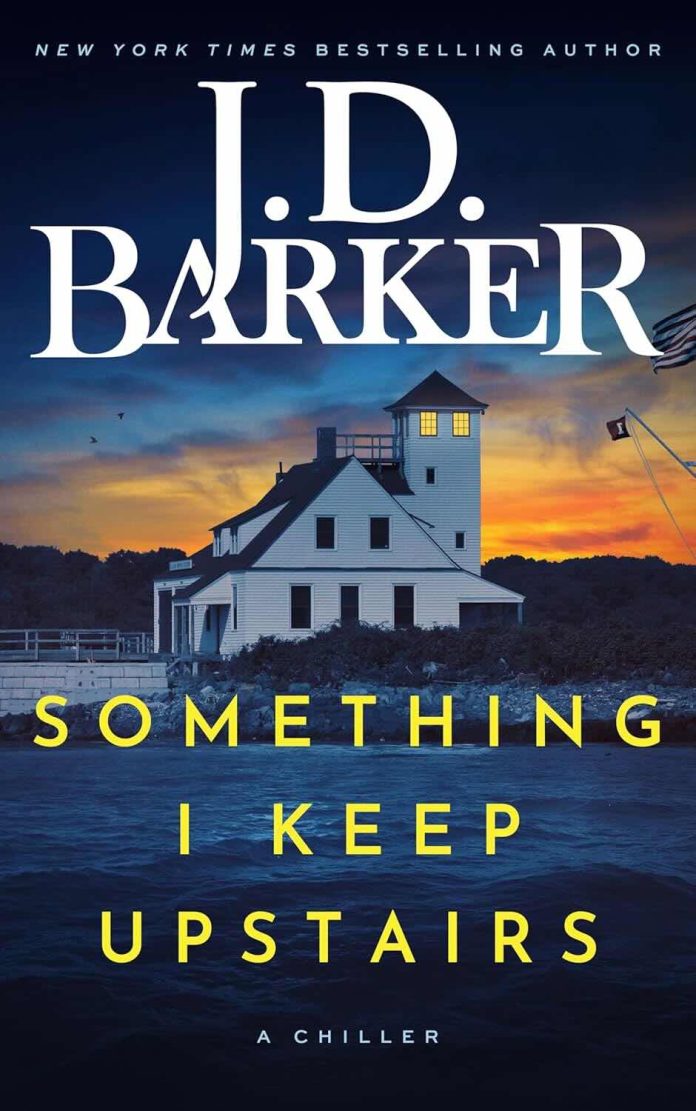
J.D. Barker’s Something I Keep Upstairs is not just another haunted house story—it’s a chilling, multilayered narrative of memory, trauma, and youthful recklessness wrapped in gothic horror and slow-burning suspense. Set on a remote island off New Castle, New Hampshire, the novel immerses readers in a deeply atmospheric world where every corner whispers with secrets, and every silence feels like a scream waiting to be released.
Known for novels like The Fourth Monkey, Dracul (with Dacre Stoker), and his collaborations with James Patterson (The Noise, Death of the Black Widow), Barker returns to his roots with this solo effort that reads like an homage to Stephen King and Shirley Jackson, while carving out its own chilling identity.
Plot Summary: The Island That Remembers
Seventeen-year-old Billy Hasler recounts the unforgettable summer of 2010—the summer when his best friend, David Spivey, inherits a house on a private island after the sudden death of his estranged grandmother, Geraldine Rote. What begins as the ultimate teenage dream—an unsupervised island retreat—soon becomes a descent into psychological horror as the house reveals a dark legacy and a set of strict rules that seem increasingly urgent to follow:
- Never lock the doors.
- Don’t answer the phone.
- Anyone here at sunset must stay until sunrise.
- Please feed Emerson.
As Billy and his friends test these rules, digging into the house’s past and literally the basement floor, they awaken forces that tether the living to the dead. The novel alternates between light-hearted teenage escapism and dark, otherworldly dread until it tightens into a claustrophobic, gut-punching finale.
Thematic Core: Memory, Grief, and the Disintegration of Innocence
At its heart, Something I Keep Upstairs is a coming-of-age tale cloaked in horror. Barker deftly explores the fragile threshold between adolescence and adulthood—when friends become enemies, secrets unearth consequences, and life’s simplicity shatters into trauma.
David Spivey’s leukemia and dysfunctional home life add emotional gravity, contrasting Billy’s more privileged background. The novel asks: what do we owe to our friends, to the dead, and to the versions of ourselves we try to escape?
This book doesn’t rely on jump scares. Instead, it unsettles readers by gradually peeling back layers of psychological tension—mirroring the slow excavation of the haunted house’s basement, where cursed artifacts are buried in hopes of manufacturing a haunting.
Characters That Haunt Long After the Last Page
Barker’s characters are sharply drawn, infused with enough emotional nuance to make their choices resonate. Some highlights:
- Billy Hasler: The narrator, who oscillates between loyalty and guilt. His reflective, almost confessional tone gives the novel a documentary-style intimacy.
- David Spivey: The heart of the story. Intelligent, introverted, and increasingly erratic, he represents both tragedy and control gone awry.
- Kira Woodward: Billy’s girlfriend, a bright presence in the darkness, whose descent into belief mirrors the reader’s own slip into uncertainty.
- Chloe (a.k.a. “Thursday”): The goth-girl-turned-occultist who provides the book’s supernatural credibility and some of its most memorable lines.
- Geraldine Rote: Though deceased, her presence looms large. The strange rules she leaves behind suggest a mind unhinged—or perhaps a last effort to protect the living.
Barker excels at crafting believable teen dynamics—the teasing, the posturing, the flirtations, and most critically, the fragility of their group bonds under pressure. These characters feel lived-in, flawed, and painfully real.
Barker’s Writing Style: Seamless Tension with Literary Texture
J.D. Barker’s prose style in Something I Keep Upstairs is an impressive blend of cinematic detail and literary restraint. The novel feels like a journal being unspooled in real time—streamlined, emotionally raw, and punctuated with moments of lyrical introspection. Billy’s voice, while sardonic at times, always feels authentic.
Barker shows remarkable control of pacing. The early chapters lull you into a nostalgic coming-of-age comfort zone before slowly introducing unease. By the midpoint, the tone shifts unmistakably, and every flickering candle or unexpected noise sends a tremor down your spine.
Praise: What Makes This a Memorable Horror Novel
- Atmosphere: The island is the novel’s greatest character. Its isolation, history, and the eerily immaculate house conjure a mood reminiscent of The Shining’s Overlook Hotel.
- Slow-burn dread: Instead of immediate horror, Barker builds unease organically, mirroring the characters’ psychological unravelling.
- Intelligent supernatural design: The haunted house is not just haunted—it’s constructed to hold dark energy, turning the teens into unintentional occultists.
- Teen dynamics done right: Unlike many horror novels that treat teens as stereotypes, Something I Keep Upstairs gives them agency, emotional depth, and tragedy.
- Inventive structure: The book’s framing as a kind of testimonial from Billy—post-trauma, post-death—is both effective and haunting.
Criticism: Where the Novel Stumbles
Despite its strengths, the novel isn’t without flaws. Here are a few critical notes:
- Overstuffed cast: As more characters join the group, particularly in the latter half, some become little more than horror cannon fodder. While this may be intentional, it slightly weakens the emotional punch.
- Ambiguity fatigue: Barker’s choice to keep some elements unexplained (e.g., Emerson’s true identity, Geraldine’s full motivations) may frustrate readers who want more concrete answers by the end.
- Pacing dip around mid-book: A section devoted to building “Project Poltergeist” slightly overstays its welcome. The ritualistic burying of haunted objects feels repetitive, even though it’s critical to the narrative arc.
Genre Placement: Where Does It Sit Among Other Horror Titles?
Fans of It by Stephen King, The House on the Strand by Daphne du Maurier, or The Haunting of Hill House by Shirley Jackson will find much to appreciate here. The blend of realistic adolescent horror with eerie, slow-building dread is Barker’s specialty.
It also echoes elements of Grady Hendrix’s My Best Friend’s Exorcism, but with a darker, more brooding undertone. Unlike most young adult horror novels, Something I Keep Upstairs takes its characters’ inner lives and trauma seriously.
Final Verdict: A Quietly Devastating, Chilling Triumph
Something I Keep Upstairs earns its place in the modern horror canon through careful characterization, immersive world-building, and emotional depth. It’s not a slasher or gorefest; it’s a psychological and supernatural mystery that slowly uncoils, crushing your breath as it tightens.
Barker challenges the reader to consider the power of history, the legacy of abuse and neglect, and the cost of uncovering what should have stayed buried—both literally and emotionally.
While it leans heavily on genre tropes, it does so with a literary flair and authentic emotional core that elevates the reading experience.
Recommended For:
- Readers who love layered horror with emotional stakes
- Fans of coming-of-age meets supernatural stories
- Those who appreciate slow-burn psychological thrillers
- Readers looking for a unique haunted house mystery
Similar Reads:
- The Chalk Man by C.J. Tudor
- Something Wicked This Way Comes by Ray Bradbury
- The Queen by Nick Cutter
- The Ritual by Adam Nevill
- The Whisper Man by Alex North
Something I Keep Upstairs by J.D. Barker reminds us that not all hauntings are spectral—some begin in the choices we make, and the people we lose. And some… never leave.