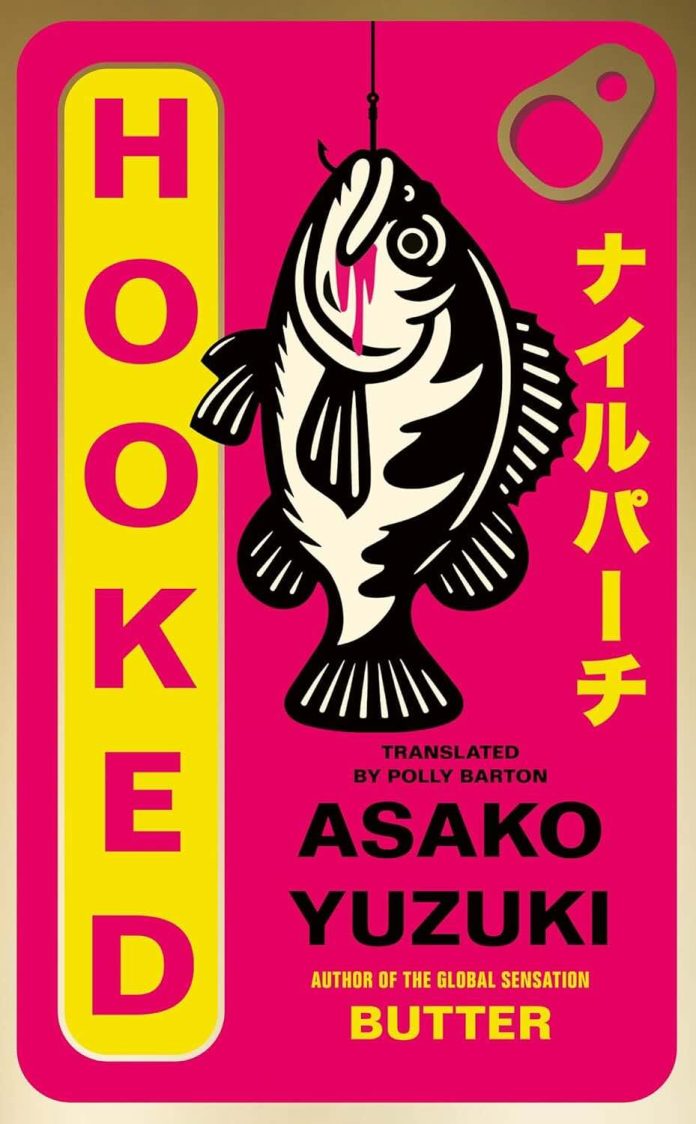
Eriko Shimura is, on paper, the kind of woman who wins. She works at a prestigious Tokyo trading firm, lives in a spotless apartment, and moves through professional life with a composure that other women find both admirable and slightly unreadable. What she lacks — and what gradually consumes her — is a friend. Not a contact or a colleague, but a woman she can call something-chan: someone whose wedding she would attend, someone who would pick up her call, someone to go to the cinema with. She is thirty, successful, and entirely alone.
Shōko, meanwhile, writes a popular lifestyle blog under the persona “Hallie B” — cheerful, laidback, frank about her mess. She and her easy-going husband live simply in Tokyo, and her blog documents a life of deliberate smallness. Her online persona is an edited version of contentment, maintained with practiced lightness, until someone decides to look behind it.
Hooked by Asako Yuzuki opens with these two women orbiting the same city without touching, then brings them together with the quiet inevitability of a trap being set. Eriko engineers a “chance” encounter at a family restaurant. Shōko, genuinely charmed, does not question the convenience. From that first Denny’s meeting, the novel never quite lets either woman breathe again.
The Nile Perch in the Room
One of the most quietly brilliant structural choices in Hooked by Asako Yuzuki is the use of Eriko’s professional assignment as the novel’s running metaphor. She is tasked with reintroducing the Nile perch — a carnivorous freshwater fish native to Africa — into the Japanese market. The Nile perch is large, invasive, and devastatingly adaptive. It wiped out hundreds of native species when introduced into Lake Victoria, yet its flesh is mild and light, suited perfectly to the delicate Japanese palate. It is a creature that causes widespread harm while appearing entirely harmless.
Yuzuki does not overwork the analogy. It runs alongside the narrative — surfacing, submerging — so readers feel the resonance before they fully articulate it. It reflects the gap between surface and reality everywhere in the novel: in Eriko’s polished exterior and the damage she leaves behind, in Shōko’s Hallie B persona and the life it increasingly distorts, and in a broader cultural habit of consuming what looks appealing without asking too many questions about its origins.
Two Women, Precisely Rendered
Eriko is the more arresting creation. Yuzuki gives her an internal logic so complete and self-justifying that she reads as a genuine study in psychological isolation. Her obsession has the feverish quality of someone who has been starving for connection so long that, when they finally encounter something like warmth, moderation becomes impossible. She does not want to destroy Shōko; she wants to freeze the friendship in amber at its most perfect moment. The forum posts, the blog comments spiraling from longing to accusation to desperate pleading — all of it lands with awful authenticity.
Shōko is the subtler and ultimately more complex portrait. She is not simply a victim. Her initial attraction to Eriko is real, rooted in genuine admiration for the precision and certainty that Eriko embodies. When the friendship sours, Shōko’s reluctance to name what is happening is as much a preference for avoidance as it is fear. Her parallel storyline — an estrangement from a difficult father, a creeping ambivalence toward the persona she has assembled for public consumption — gives the novel its second emotional axis and some of its most genuinely moving passages.
What Yuzuki Is Actually Writing About
At its core, Hooked by Asako Yuzuki is a novel about the exhausting work of being perceived. Both women are perpetually performing: Eriko performs competence, Shōko performs ease, and the society around them demands both simultaneously. The novel is at its most caustic when Eriko watches a group of women laugh together on a plane and oscillates between contempt and aching envy, then hates herself for both reactions.
Yuzuki is precise about what contemporary Japanese culture asks of women — attractiveness, a good career, publicly visible female friendships, and the appearance of not trying too hard at any of it. The obsession between these two women is not simply a character study in dysfunction. It is an indictment of a culture that packages female connection as an aspirational lifestyle trend while providing no road map for how a woman in her thirties who has never sustained a genuine friendship is supposed to begin again. This social commentary never tips into lecture. It stays rooted in the specific texture of two specific lives, which is exactly where it should be.
Craft, Structure, and the Work of Translation
The novel alternates between Eriko’s and Shōko’s close third-person perspectives with considerable control. In the earlier half, each section reframes what the last established — the same conversations, the same evenings, seen from different angles with quietly disorienting effect. The dual structure is the novel’s backbone and its occasional limitation. The pacing loosens in the middle sections; certain sequences in Eriko’s professional life, while thematically relevant through the Nile perch material, hold the story’s momentum slightly longer than necessary.
Polly Barton’s translation is excellent throughout. The prose is precise and restrained without drawing attention to itself, which is exactly right for a story in which every character is performing for someone. The specificity of place — family restaurants, open-plan offices, a Hakone onsen in winter — feels lived-in rather than illustrated.
Readers familiar with Butter, Yuzuki’s previous novel about a murderous, magnetic woman and the journalist entangled in her story, will find that Hooked by Asako Yuzuki occupies the same thematic territory at a quieter register. Where Butter worked through excess and provocation, Hooked works through accumulation. The dread it builds is entirely ordinary, which is what makes it linger.
Strengths and Hesitations
What the Novel Does Exceptionally Well
- The Nile perch metaphor — sustained, layered, and never overexplained
- Eriko’s interior logic: sympathetic, precise, and genuinely disturbing
- The dual perspective in the first half, which makes familiar scenes feel newly strange
- Social commentary that stays embedded in character rather than drifting toward argument
- Shōko’s parallel narrative, which gives the novel emotional depth beyond the central obsession
Where It Holds Back
- The middle section loses momentum, particularly in Eriko’s workplace sequences
- Eriko’s final trajectory feels somewhat less defined than Shōko’s more grounded resolution
- Readers seeking cathartic closure may find the ending’s deliberate ambiguity unsatisfying, at least initially
The resolution arrives appropriately undramatically. Both women are left in states of altered possibility rather than clean conclusions. This is the faithful, difficult choice. The minor complaint is that Eriko, after everything she has inflicted and endured, deserves a little more definition in those final pages.
If You Enjoyed This, Consider Reading
Hooked by Asako Yuzuki sits at the intersection of literary psychological fiction and social critique. These titles share something of its territory:
- Butter by Asako Yuzuki — the author’s previous novel; a more overtly provocative study of a woman who refuses to be legible to polite society
- Convenience Store Woman by Sayaka Murata — Japan, social conformity, and a woman who cannot perform normalcy, rendered with dark wit
- My Year of Rest and Relaxation by Ottessa Moshfegh — sealed-off psychology and the cost of being seen
- Intimacies by Katie Kitamura — quiet psychological unease and the instability of other people’s inner lives
- Acts of Desperation by Megan Nolan — losing oneself in pursuit of another’s approval, written with uncomfortable clarity
- The Push by Ashley Audrain — the performance of acceptable femininity and the damage it conceals beneath the surface







