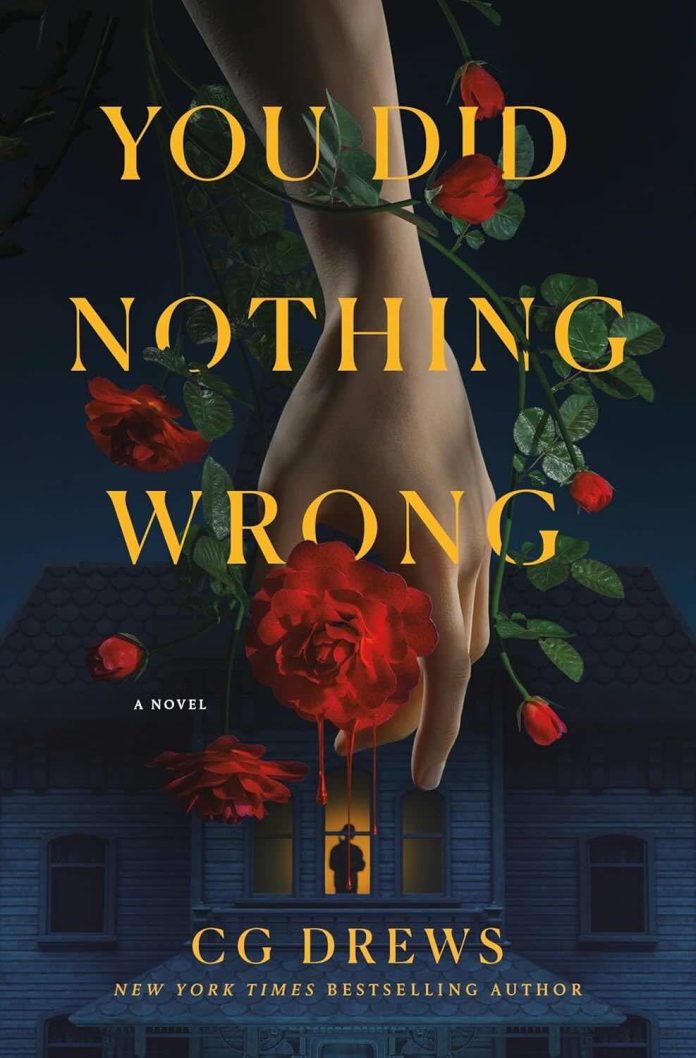
The walls are breathing. Or maybe they aren’t. Maybe it’s just Elodie, pressed up against the plaster with her ear to the dark, listening for something she can’t name and shouldn’t want to find. This is the gnawing, exquisite discomfort that You Did Nothing Wrong by C.G. Drews lodges under your skin from its opening lines and refuses to remove until long after the final page.
When the Fairy Tale Rots from the Inside
Elodie January has rebuilt herself. She’s married golden-retriever-devoted Bren, moved into his crumbling Victorian family home in Virginia, and is expecting a new baby. Her autistic son, Jude, has a nursery filled with antique toys and hand-replicated wallpaper patterned with hedgehogs in tidy jackets. Everything looks like a storybook.
Then Jude says the house is breathing.
What follows is a slow, suffocating descent through psychological suspense, unreliable motherhood, and a Gothic horror that operates less like a haunted house story and more like a dissection performed without anesthesia. C.G. Drews does not simply write about a woman unraveling. Drews hands you the thread and makes you pull.
The Architecture of an Unreliable Heart
What makes You Did Nothing Wrong by C.G. Drews so devastatingly effective is its refusal to offer safe ground. Elodie is our only lens, and she is a narrator who lies to everyone, including herself. Every declaration of love comes braided with control. Every protective instinct curdles into something possessive and frightening.
The prose mirrors this instability with surgical precision. Drews writes in a visceral, body-horror register where emotions are always becoming physical: love is a thing that leaves holes in lungs, jealousy is a beast in the mouth, exhaustion owns her. The language is lush and feverish, every metaphor dripping and organic, as if the novel itself is the rotting house, wallpaper peeling back to reveal something wet and wrong underneath.
This is not comfortable reading. It is reading that grabs your hair and holds your face to the wall and whispers, Do you hear it breathing?
Motherhood as Gothic Horror
The novel’s central achievement is its unflinching examination of toxic motherhood dressed in the language of devotion. Drews navigates this territory with remarkable nuance, presenting a mother who genuinely, desperately loves her child while simultaneously being the worst thing for him.
Several elements make this portrayal so haunting:
- The games as control — Elodie’s “Simon Says” and “Let’s play a game” rituals begin as charming parenting strategies and gradually reveal themselves as mechanisms of manipulation, culminating in her methodical campaign to convince her six-year-old he is four
- The competing hungers — Elodie craves Jude’s affection with a consuming intensity that mirrors the house’s own appetite, and the parallel is never accidental
- The generational wound — flashback chapters reveal how Elodie’s own childhood of neglect, blame, and devastating loss created the fractured mother she becomes, generating sympathy even as her actions grow more indefensible
- Autism portrayed without flinching — Jude is rendered with tremendous care and specificity, his sensory world vivid and real, and the book makes clear through its acknowledgments and its title that he was never the problem
The representation of an autistic child within a psychological thriller walks a razor’s edge, and Drews largely walks it with grace. Jude is never reduced to a plot device or a list of symptoms. He is a child who lines up wooden animals with careful tenderness, who needs the comfort of a destroyed stuffed rabbit, who communicates his love in ways his mother cannot recognize because she is too busy measuring affection by her own desperate metrics.
The House That Knows Your Secrets
As a haunted house narrative, the novel plays a brilliant long game. Is the Victorian genuinely sentient, its walls bleeding and its floors breathing? Or is Elodie’s fractured psychology projecting her guilt into the architecture around her? Drews never fully commits to either answer, and this ambiguity is the story’s greatest tension engine. The house operates as a Gothic mirror, reflecting back each character’s deepest fears and hungers.
Bren’s relationship with the house carries its own unsettling undertones. His obsession with restoring his dead parents’ home, his insistence on doing every renovation himself, his dream of recreating the perfect family he lost, all take on darker dimensions as the novel unfolds and secrets crack open like load-bearing walls.
Where the Floorboards Creak
For all its devastating power, You Did Nothing Wrong by C.G. Drews is not without its structural wobbles. The pacing in the middle act occasionally stalls as certain emotional beats repeat; Elodie’s spiraling anxiety, while thematically deliberate, sometimes circles the same drain one too many times before advancing the plot. Readers may find themselves wanting the narrative to push forward when it lingers in yet another description of the walls’ fleshy dampness.
Additionally, while the past-timeline chapters provide essential backstory, their placement occasionally disrupts the present-day tension rather than amplifying it. The reveal architecture is ambitious, layering secrets upon secrets, and certain readers may find one or two twists too many stacked atop one another in the final act, creating a velocity that sacrifices some emotional clarity for shock.
Bren, too, remains somewhat opaque as a character. This is partly by design, filtered as he is through Elodie’s distorting perspective, but there are moments where his motivations feel underserviced, particularly regarding the revelation about his years-long obsession. More interiority from his side, even in fragments, could have deepened the novel’s final devastating confrontation.
The Author Behind the Walls
C.G. Drews is no stranger to dark, emotionally complex fiction. Their previous novels include A Thousand Perfect Notes, The Boy Who Steals Houses, the New York Times bestselling Don’t Let the Forest In, and Hazelthorn. With You Did Nothing Wrong by C.G. Drews, they have made a sharp pivot into adult psychological horror, and it is a transition that feels less like a departure and more like an arrival. The themes that have always driven their work, found family, childhood trauma, the ache of belonging, are simply turned inside out here, exposed and bleeding.
The Verdict, Served Raw
This is a novel that will divide readers, and it should. It asks you to spend three hundred pages inside the head of a woman who drugs her toddler, lies about her child’s age, dismembers her husband, and names her second child after the brother whose drowning she walked away from. It asks you to understand why.
The fact that you almost do is the most terrifying thing about it.
You Did Nothing Wrong by C.G. Drews is not a book for the faint-hearted. It is a book for readers who want their psychological suspense to leave bruises, who appreciate fiction that interrogates motherhood without sanitizing it, and who understand that sometimes the most haunted house in the story is the human body itself. It sits comfortably alongside the darkest domestic thrillers of recent years while carving out its own unsettling niche.
A confession, then, offered in the spirit of Elodie’s own tortured disclosures: St. Martin’s Press placed an advance copy of this book in my hands before it hit shelves, asking only for honesty in return. Having now walked through every rotting room of this narrative and emerged blinking into daylight, honesty is the least of what I owe it. This story earns its keep.
Similar Books to Read If You Survived This One
If You Did Nothing Wrong by C.G. Drews left you wrecked and hungry for more, these titles traffic in similar dark territory:
- The Push by Ashley Audrain — Another searing exploration of a mother who fears something is fundamentally wrong with her child, told through an unreliable narrator whose love and terror are indistinguishable
- Baby Teeth by Zoje Stage — A domestic horror about a mother and her manipulative young daughter that shares this novel’s claustrophobic intensity and refusal to offer easy sympathies
- Mexican Gothic by Silvia Moreno-Garcia — For readers drawn to the decaying house as a living, consuming entity, this Gothic horror delivers atmospheric dread with teeth
- The House of Hollow by Krystal Sutherland — A dark, body-horror-inflected story about sisters and the monstrous things that live inside family bonds
- Don’t Let the Forest In by C.G. Drews — The author’s own New York Times bestseller, which explores obsession, isolation, and the terrifying spaces where love becomes consumption
- Sharp Objects by Gillian Flynn — A psychological thriller rooted in toxic mother-daughter dynamics, generational trauma, and the violence hidden inside domesticity