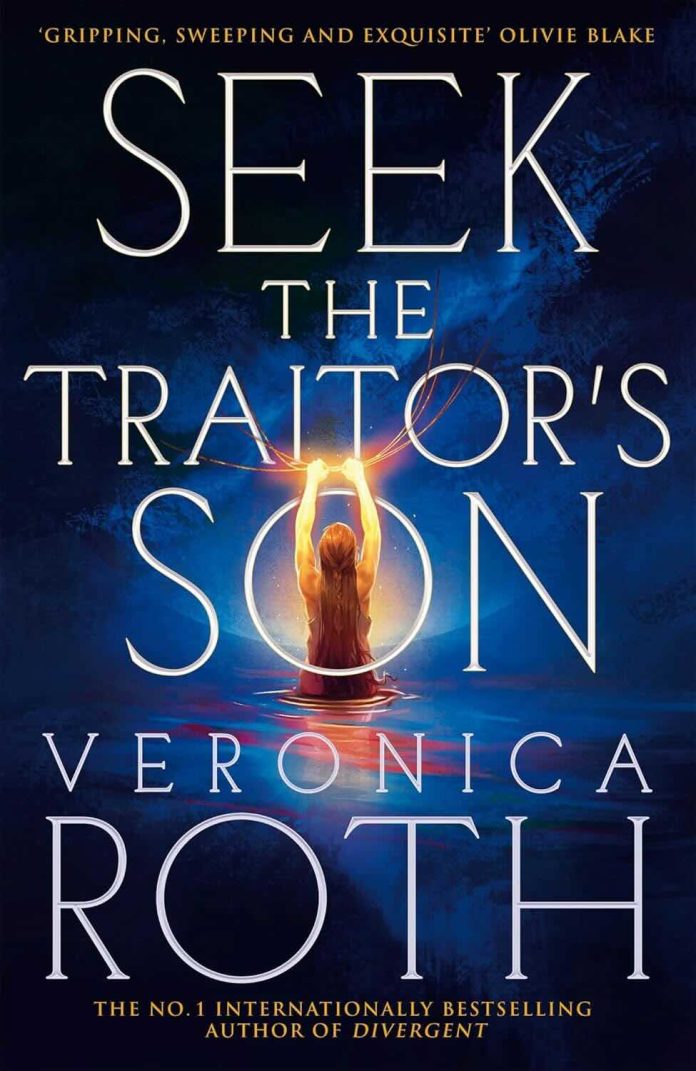
There is a moment early in Seek the Traitor’s Son by Veronica Roth where Elegy Ahn Rosyk, a soldier of the small, quarantined nation of Cedre, kneels on a salt flat with her husband’s fingers laced through hers and prepares to hear a prophecy she did not ask for. The Cenobium looms behind her. Somewhere across the white expanse, her enemy waits to hear the same words. The setup is operatic. The execution, though, is what makes this book worth your evening: Roth keeps it grounded in small textures, mismatched socks rolled into boots, a husband’s calloused thumb, the dry sting of salt on cuticles.
This is Book 1 of The Burning Empire duology, and it announces itself with confidence. Roth has called it a romantic dystopian fantasy, and that description is accurate, but it is also a quiet meditation on chosen lives, inheritance, and what it costs to be told who you are supposed to love.
The Premise, Without Spoiling Anything
Elegy belongs to Cedre, a society that has sealed itself off from the Fever, a virus that kills every person it infects and brings half of them back transformed, gifted with retrocognition or precognition or stranger talents. The Talusar empire, which worships the Fever as a god, has swallowed nearly the entire planet. When ten augurs summon Elegy and the Talusar general Rava Vidar to hear a prophecy, the two women learn that their fates are tangled around a man Elegy is destined to fall in love with. Elegy is already married to Shir Alexios, whom she loves without reservation. The augurs are not interested in inconveniences like that.
What follows is a slow-burn collision course involving Knights sworn to die for the Sword’s heirs, a library custodian with a Talusar exile mother and a quiet kind of stubbornness, and a “Before” thread set on a distant gate-traveling ship that hints at a galaxy much larger than Cedre suspects.
Worldbuilding That Earns Its Strangeness
Roth’s invented planet is one of the more confident pieces of worldbuilding I have read this year. The Fever functions as both biology and theology. Cedre keeps elixir flowing through its technology because elixir burns away in Fever-infected blood, so even the wiring of a clock becomes a political statement. Cedre Station orbits overhead like a barrel in the sky. Augurs draw fulcrums in chalk. The Talusar use ritualized pronouns to mark status, and the small detail that Elegy clocks this in conversation tells you everything about how lived-in this place feels.
Some readers will be impatient with the early chapters, which take their time placing every chess piece. The first sixty pages are essentially scaffolding. If you sit with it, the payoff arrives once the geography stops being a map and starts being a personal map for the people walking it.
Characters Who Resist Their Own Tropes
Elegy is a soldier, not a chosen one in the wide-eyed mold. She curses, she gets impatient, she rolls mismatched socks into the toes of her boots, and her grief over what the prophecy will cost her marriage is one of the most honest emotional arcs Roth has written. And she does not glide toward her prophesied love the way a paint-by-numbers fated-mates novel would script it. She resents the very idea.
Theren is the quiet surprise. A library custodian who keeps a practice sword by the door and tutors himself on the side, son of a Talusar exile mother who insists on Cedre customs in public, he carries an inheritance he never wanted. His chapters land with a more contemplative weight than Elegy’s. Roth threads him through scenes of memory work, ritual, and slow physical recovery, and it is in those passages that the book’s romantic engine begins to hum.
The supporting cast deserves its own paragraph: Hela the adopted sister, Shir the husband who is allowed to be a real person, Isre the brother who survives by feel, the Sword’s chilly motherhood, and Rava Vidar herself, who is too calculated to make a simple villain.
What Works Beautifully
The strongest currents in Seek the Traitor’s Son by Veronica Roth are ones Roth has been honing since Carve the Mark:
- Slow-burn intimacy. Touches, glances, and a thumb on a faded scar do more here than a chapter of declared feelings ever could.
- A magic system bound to mortality. The Fever’s fifty-fifty kill rate keeps the supernatural element from feeling weightless. Power has a price, and the price is measured in funerals.
- Sister relationships. The bond between Elegy and Hela, and the more complicated one with the Sword, are treated with as much care as the romance.
- Dual POV that earns the swap. Theren and Elegy each carry their own grief, and the chapters do not duplicate information.
- A galactic mystery that respects the planetary one. The “Before” interludes tease without distracting.
Where the Book Stumbles
A four-star reception feels right for Seek the Traitor’s Son by Veronica Roth, and the half-star it leaves on the table has reasons. The first act takes its time, almost too much of it. Several political factions and rituals are introduced in quick succession, and a reader who is not taking notes may find the early chapters effortful. The middle section leans on a memory-ritual device that does heavy plot lifting in places where a scene played in real time might have landed harder.
Roth’s prose is clean and propulsive, but a few sequences in the second half rely on the same emotional beat more times than the story strictly needs. Readers who came hoping for the brisk, lean shape of Divergent will find a longer, more discursive book. That is the cost of the bigger canvas, and most readers will think it worth paying.
Read This If You Loved
Veronica Roth’s earlier books Carve the Mark and The Fates Divide are the closest cousins in her own catalog, sharing the sci-fi-fantasy hybridity and prophesied destinies. Poster Girl and Chosen Ones show her recent interest in messy adult protagonists, which carries straight into Elegy. Older Roth fans coming from the Divergent trilogy should expect a more adult, slower-paced read here.
For comparable reads outside Roth’s bibliography, try:
- An Ember in the Ashes by Sabaa Tahir, for two opposing soldiers and a romance carrying the weight of empire.
- The Jasmine Throne by Tasha Suri, for women on opposite sides of a divided world.
- The Poppy War by R.F. Kuang, for military fantasy with religious supernatural powers.
- A Memory Called Empire by Arkady Martine, for sci-fi politics where language and culture cut as sharply as blades.
- Red Rising by Pierce Brown, for dystopian stakes and a protagonist forced into a role they did not choose.
Final Word
Seek the Traitor’s Son by Veronica Roth is an ambitious opening to The Burning Empire duology, the kind of book that gets richer in its second half and lingers after you close it. It will not satisfy every appetite for tidy romantasy, and the pacing requires patience early on. Stay with it. The book Roth is building is larger than its first hundred pages, and the questions it leaves for Book 2 are the kind that make you check whether the sequel has a release date yet.







