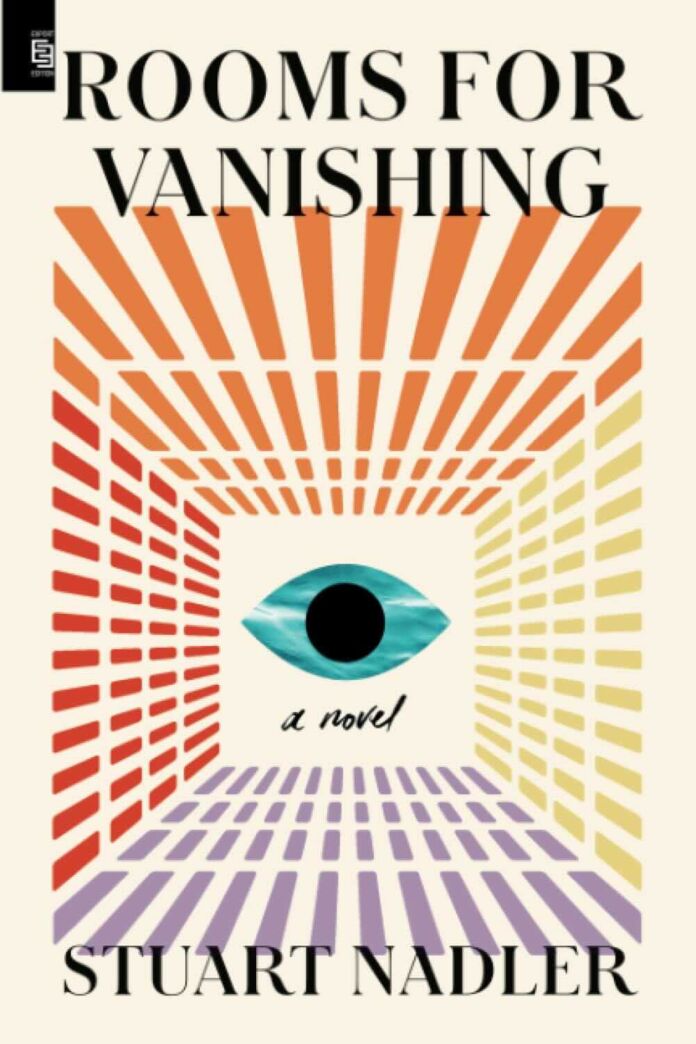
Stuart Nadler’s Rooms for Vanishing is not so much a novel as it is a requiem—a deeply immersive and sorrowfully resonant composition of a family fragmented across time, continents, and metaphysical boundaries. It is a book that does not whisper its intentions, but rather murmurs them through walls, across continents, through time, and often through the porous veil separating the living from the dead. In this latest work, Nadler (author of Wise Men, The Book of Life, and The Inseparables) takes a bold step forward in form and theme. While his earlier works explored identity, assimilation, and familial tension, Rooms for Vanishing feels like an exhalation of something far older and more mystic—a disassembled myth stitched from Jewish diaspora trauma, Holocaust memory, and the poetry of grief.
Plot Overview – Four Rooms, One Family, Infinite Ghosts
At its core, Rooms for Vanishing is the shattered mosaic of the Alterman family, Vienna-born and war-torn, their lives torn asunder by the Holocaust and scattered like ash on the wind.
- Sonja, the daughter, grieving the loss of her child Anya and the disappearance of her husband Franz, lives in a liminal space between mourning and madness.
- Fania, the mother, is haunted—sometimes literally—by the version of herself she abandoned, and the life she once held before Montreal swallowed her.
- Moses, the son, haunted by ghosts both metaphoric and spectral, returns to Prague, seeking the shadow of a friend long gone.
- Arnold, the father, living with absence as a permanent state, receives a note that might be from his long-lost daughter—and chooses to believe it.
Their narratives are nonlinear but interlinked, each character suspended in a different “room,” a term Nadler uses not just spatially, but cosmically—separate existences echoing one another through memory, hallucination, and inexplicable reunions. The narrative doesn’t offer reunion so much as it offers simultaneous longing: characters imagining each other across time, space, and death.
Writing Style – A Language of Longing
Adapting a distinctly poetic and elegiac style, Nadler writes with the tremor of someone chronicling the unfilmable—the emotions too vague for visual media, too complex for speech. His prose is lyrical but intentional, and every sentence reads like it has been weighed for memory.
The voice is fragmented, reflective of the characters’ fractured identities. Sonja’s grief, especially, becomes a proxy for the Holocaust’s generational trauma—personal, yet archetypal. Nadler’s genius lies in blending this voice across four characters while keeping each identity distinct. The novel reads like a chorus where each singer mourns in harmony and disharmony simultaneously.
Yet, at times, this very lyricism becomes overwhelming. The density of metaphor, the layering of hallucination over reality, can make readers feel like they too are leaning against a wall, trying to hear something that’s only partly there.
Themes – Between the Real and the Remembered
1. Grief as Geography
Each chapter in Rooms for Vanishing is a different emotional country. Grief is never just sadness—it is architecture, it is language, it is inheritance. Nadler turns sorrow into terrain, one in which each Alterman has built a secret dwelling. They do not live with grief. They live in it.
2. Holocaust Memory and Inherited Trauma
Sonja’s childhood on the Kindertransport, Moses’ spectral visions, Arnold’s search for Sonja—all are echoes of Jewish survival turned into mythic repetition. Nadler does not fictionalize the Holocaust; rather, he lets its silences speak volumes. The trauma does not appear as scenes but as psychological residues—phantoms inhabiting modern-day London, Montreal, Vienna, and Los Angeles.
3. Doppelgängers and Doubled Lives
Fania seeing her double in a hotel basement, Sonja watching a woman on TV who looks exactly like her, Franz’s delusional sightings of Anya—all suggest identity as a mutable thing. These are people who were never allowed to become whole, always split between the lives they lived and the ones stolen from them.
Character Analysis – Fragmented Souls
Sonja Alterman
Sonja’s sections—by far the most emotionally harrowing—are portraits of a woman unmoored. Her pain is not subtle; it is loud, operatic, and often painfully introspective. The death of her daughter Anya isn’t the beginning of her unraveling, but it becomes the moment she stops pretending she’s still woven together. Her monologues, bordering on stream-of-consciousness, are lyrical yet devastatingly grounded.
Franz
A conductor by profession, Franz becomes the most enigmatic presence. His vanishing, which initiates the book’s narrative, mirrors his emotional withdrawal long before he physically disappears. He exists more vividly in memory and hallucination than in action—an absent father, a grieving husband, a man building new myths to survive the unbearable.
Fania & Arnold
Fania’s doppelgänger encounter and Montreal exile embody the conflict between past and present self. Arnold, the least explored, perhaps intentionally so, becomes the final thread—an old man clinging to the impossible hope that someone might still be out there.
Strengths of the Novel
- Inventive Structure: The novel reads like a chamber piece: multiple movements, different instruments, variations on a theme. Each chapter is a different room and voice, making the book feel deeply architectural in design.
- Powerful Emotional Resonance: Nadler taps into deep wells of human sorrow without ever making it feel performative. His grief is earned.
- Use of Magical Realism and Ghosts: The ghosts in this novel are neither horror nor fantasy. They’re emotional placeholders—flickers of what could have been, what was, and what never had a chance to become.
- Exploration of Post-Holocaust Identity: Without recounting horrors in graphic detail, Nadler shows their long shadows—how trauma is inherited, spoken through generations in fragmented stories and inherited silences.
Critiques and Challenges
Despite its brilliance, Rooms for Vanishing is not without its flaws:
- A Demanding Read: The prose, while beautiful, can be exhausting. The narrative’s non-linearity and heavy use of symbolism require full attention and emotional bandwidth.
- Limited Momentum: Readers seeking plot-driven WWII fiction may struggle with the book’s lack of forward propulsion. This is a novel of reflection, not revelation.
- Character Distance: The poetic tone, while exquisite, sometimes places a glass wall between the reader and the characters. We observe their grief more than we inhabit it.
Similar Reads – If You Liked This Book…
If Rooms for Vanishing resonates with you, consider these thematically or stylistically adjacent works:
- Everything is Illuminated by Jonathan Safran Foer
- The History of Love by Nicole Krauss
- The Book Thief by Markus Zusak
- Lost Children Archive by Valeria Luiselli
- The Emigrants by W.G. Sebald
- House of Names by Colm Tóibín (for its mythic layering)
Wrapping It Up – A Book Worth Listening To in Silence
In Rooms for Vanishing, Stuart Nadler composes a fugue of grief and longing, where each movement returns to the same mournful chord: absence. The novel demands something rare from its reader—stillness. It’s a work that must be read slowly, like a sacred text or a faded photograph rediscovered in a drawer decades after the war. It doesn’t offer resolution, but rather the dignity of remembering, of listening closely for footsteps through the walls.
For those willing to listen, Nadler’s novel offers something unforgettable: the realization that sometimes, the only way to bear the unthinkable is to vanish into a room where memory and desire still live.







