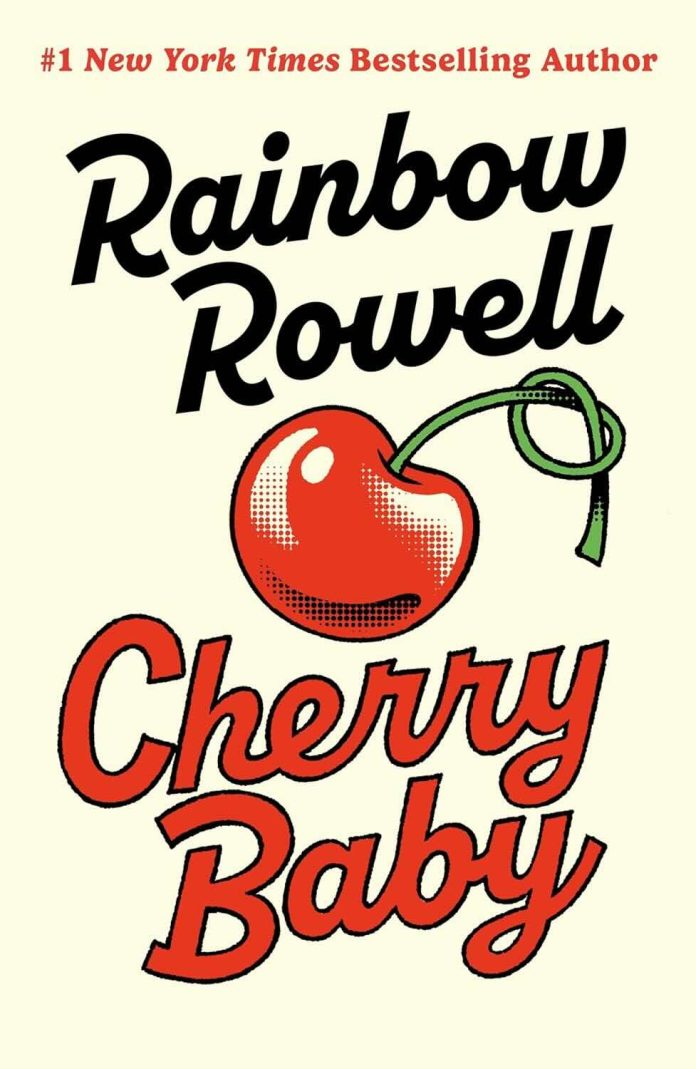
Rainbow Rowell writes about ordinary love with the kind of precision that makes you feel caught. Not swept away — caught. Like she already knows the specific way you scroll past something painful before your first coffee, or the exact tone you use to say “It’s okay” when it really isn’t. Cherry Baby by Rainbow Rowell is that kind of book: wickedly familiar, quietly devastating, and occasionally so funny you have to put it down and look at the ceiling for a second.
Who Cherry Is, Before Anyone Else Decides
Cherry Fairway is thirty-six, fat, stylish, and mid-divorce from a man who became famous partly because of her. Her husband Tom created a webcomic called Thursday, a semi-autobiographical series that turned into bestselling graphic novels and then into a major motion picture. Somewhere in the middle of all that success, Tom stopped coming home. Cherry is left in their Omaha house with Stevie (the dog Tom always wanted), four very loud sisters messaging her across six simultaneous group chats, and the persistent awareness that a British actress is currently wearing prosthetic padding to play a version of her on a studio lot.
That last detail is the fulcrum of this novel. Baby — the character Tom based on Cherry, drawn with exaggerated hips and a double chin, and introduced in his comic as “the most beautiful girl” — follows Cherry everywhere now. Strangers recognise her at the grocery store. The movie theatre walls are covered in her caricature. And Cherry never signed up for any of it.
Self-Knowledge as Its Own Superpower
What makes Cherry Baby by Rainbow Rowell extraordinary is Cherry herself. She is not a character who needs to learn to love herself by chapter thirty. She already knows she is fat. And she says so plainly, without flinching or performing. She also knows she has incredible hair, genuine dimples, really nice freckles, and excellent taste in clothes. She holds all of this at once, without apology. Rowell gives Cherry the rare gift of being fully legible to herself while still having things to figure out — namely, who she is when her husband turned her into a symbol and then left.
That gap, between the person Cherry is and the person the world sees through Baby, is where the novel’s emotional weight lives. Rowell refuses to make body positivity a lesson Cherry is in the process of learning. It is something she already holds. The question is whether the people close to her can hold it too.
The Group Chats Are Doing Real Work
One of the sharpest structural decisions in the book is the sister group chat transcripts woven throughout. Cherry has four sisters:
- Hope — the eldest, newly thin after semaglutide, sharp and quietly struggling
- Honny (Honor) — ferociously funny, pushiest of the five, always first to stir the pot
- Joy — excitable, easily influenced, loves a dramatic overreaction
- Faith — the baby, sweet and stubbornly bossy, makes you feel guilty for disagreeing
Their messages arrive at all hours, across multiple threads, and they are genuinely good reading. Rowell uses these conversations to accomplish things that prose chapters often struggle with: delivering exposition organically, revealing family dynamics through argument, and landing real laughs without breaking the novel’s emotional register.
The sisters’ collective response to the Thursday movie trailer — which Cherry flatly refuses to watch — is particularly sharp. Their outrage on her behalf, filtered through jokes about fat suits and which actress “should” have played Baby, is both funny and, underneath the jokes, a form of fierce love. The novel also handles Hope’s weight loss storyline with more care than expected. It would have been easy to make her the villain or the cautionary tale. Instead she is a woman who made a private medical decision and then watched her sisters take it personally. One conversation between Cherry and Hope in a supermarket car park is among the most honest things Rowell has written.
Where Things Don’t Quite Land
Cherry Baby by Rainbow Rowell earns genuine admiration, but not without friction. Tom is the most significant figure in Cherry’s emotional life, and yet he remains frustratingly underwritten. He is quiet, awkward, prone to sulking — traits that read as personality rather than depth. His most expressive moments come through Thursday itself and through Cherry’s memories of their early relationship, but the novel struggles to make him feel fully present in the scenes they share directly.
The romantic subplot with Russ Sutton, the politically ambitious Omaha local who becomes Cherry’s unexpected companion, also carries some unevenness. Russ is charming and vain in an oddly endearing way, and the novel tests their relationship in ways that feel genuine. But when things fracture between them in the later chapters, the resolution moves quickly. One particular moment at a movie theatre, where Russ’s discomfort with Cherry’s public identity surfaces and then gets papered over with apology, deserved considerably more room to breathe.
The middle third also loses momentum in places, as Cherry’s day-to-day Omaha life stretches across chapters without always earning the space.
What Rowell Does Better Than Almost Anyone
At the sentence level, Cherry Baby by Rainbow Rowell is constantly alive. Rowell writes short. She trusts fragments. Her parenthetical asides carry enormous emotional weight. The narration follows Cherry’s mind the way water follows a slope — quick, natural, always finding the lowest point of the feeling. A scene early in the novel where Cherry discovers the Thursday strip in which Tom first drew her, labelled in a thought bubble as “the most beautiful girl,” unfolds in a paragraph that moves from confusion to ego to grief without announcing any of those shifts. It is quietly brilliant.
Readers familiar with Rowell’s backlist will find her in recognisable territory but reaching further. Eleanor & Park gave us young love that was tender and fragile. Landline explored what happens when a marriage quietly stalls. Slow Dance, her most recent novel before this one, followed adults navigating the gravity of old feelings returning. Cherry Baby continues that trajectory into fully adult emotional territory, and it is her most confident work in that register.
Cherry is stubborn, funny, occasionally petty, and endlessly watchable. She is the kind of fictional woman you want to have dinner with — or at minimum, to be in the group chat with. This is not a perfect novel, but it is a remarkably good one: a book about what it means to be seen, to be misrepresented, and to eventually, carefully, start deciding what your life looks like on your own terms.
If This One Found You, These Might Too
- Good in Bed by Jennifer Weiner — a fat woman protagonist whose ex writes publicly about their relationship; the emotional DNA here is very close
- Romantic Comedy by Curtis Sittenfeld — a woman whose creative work is entangled with a famous man’s perception of her
- Fleishman Is in Trouble by Taffy Brodesser-Akner — a marriage slowly coming undone, told with the same dry wit and genuine feeling
- Attachments by Rainbow Rowell — her debut, and essential reading for understanding her voice
- Queenie by Candice Carty-Williams — a woman navigating a breakup, identity, and a complicated family, with similar pacing and warmth







