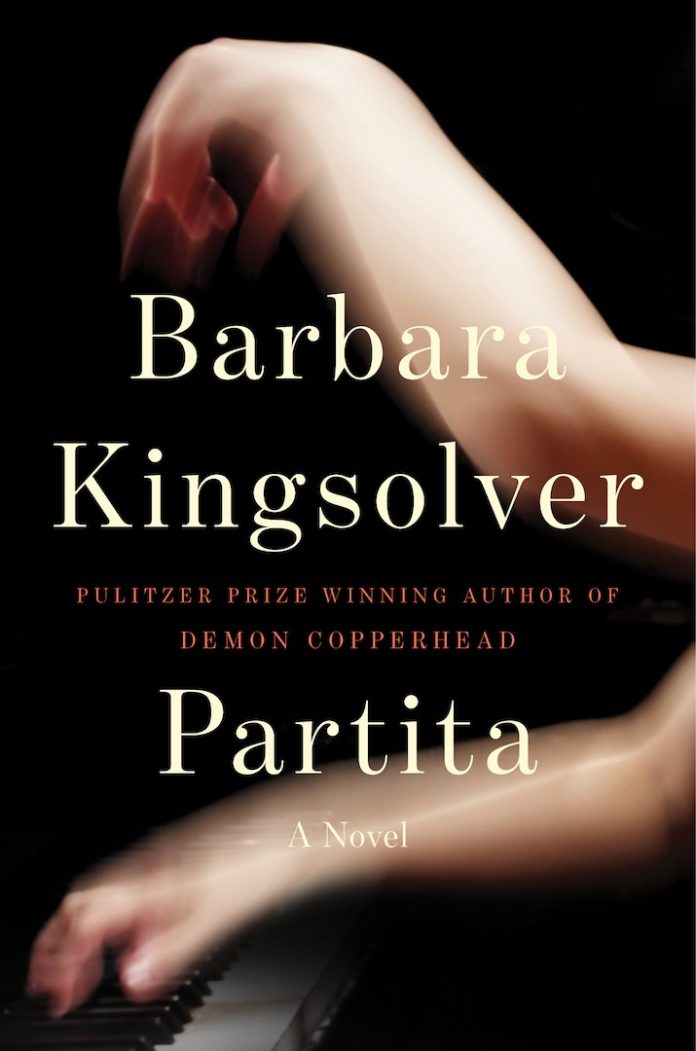
After the sprawling social fury of Demon Copperhead, the new novel from one of America’s most decorated living writers returns to the same Appalachian soil with a smaller cast and a quieter ambition. Partita by Barbara Kingsolver is a memory novel built like a baroque suite, named after the J.S. Bach form that organizes loose dances around a shared key. The structural choice is not ornament. It is the engine.
Livia Cable, a piano teacher on a small Tennessee dairy, gets a phone call from a man she has not heard from in over twenty years. He asks to come see her. He gives her a week to decide. What follows is not a plot in the usual sense but a reckoning, paced through movements titled Allemande, Toccata, Sarabande, Fugue, Pathétique, Da Capo, and Al Fine, with seven numbered preludes braided between them.
The Story, Kept Spoiler-Free
In her younger life, Livia was Livia Bohusz, a scholarship student at a serious music conservatory, the first in her family to leave the tobacco-and-cattle county where she was raised. The seven days she gives herself to decide pull her backward into memories of her brother’s early death, a mother she could never please, a roommate she liked more than she loved, and the stranger who arrived one spring with a leftist tabloid and changed the shape of her life. The present-day stakes are quiet. The past-tense stakes are not.
Kingsolver lets none of this arrive as exposition. It arrives the way memory actually arrives, in fragments tied to a pair of empty shoes left under a piano, a song her brother used to whistle, a court report buried in an old envelope. The reader earns the picture in pieces, often turning back a page to confirm that a small detail just turned seismic.
A Country Voice, Tuned for the Page
The first thing readers will notice is the cadence of the narration. Livia speaks the way a smart country woman speaks who has spent years translating Tennessee for Indiana and still prefers, in the end, the original.
A few measures of how the voice carries itself:
- A child cannot hate her mother without putting the load-bearing walls of the known world at risk.
- Bodies are what we have, underneath all the mind’s drama, just pitiable flesh.
- College is a cloister; you forget what a thin little spine you are on the big loud bookshelves of the living.
This is plain writing that earns its plainness through years of looking. The voice in Partita by Barbara Kingsolver feels closer to Prodigal Summer and Animal Dreams in temperament than to the wider-angle Poisonwood Bible or the angrier Demon Copperhead. It is older, drier, more interior.
What the Musical Structure Actually Does
Readers who do not know classical piano repertoire may worry the form will lose them. It does not. Kingsolver has placed a Listening List at the front of the novel, naming each piece her characters play, from Chopin’s Raindrop Prelude to Ravel’s Gaspard de la Nuit to the J.S. Bach C Minor Partita that gives the book its title. The list is generous. Reading without it loses very little of the story.
What the musical structure does is something subtler. Each dance carries the emotional shape of its baroque form. The Sarabande, traditionally slow and weighted, carries the heaviest grief. The Toccata moves fast and shows off. The Fugue layers voices that contradict one another and refuses to settle. The Pathétique borrows the wrenching dignity of the Beethoven sonata. By the time the Da Capo arrives, the reader feels in the bones of the prose what it means to repeat a theme in a changed key.
What Lands Hardest
A few elements are the strongest reasons to read this novel:
- Class. Few mainstream novelists write working-class rural characters with this much accuracy and this little sentimentality. The arguments between Livia and her lover about meritocracy, and the campus segregation between college kids and shift workers, are the most honest version of that conversation in recent fiction.
- The marriage. Livia’s husband Charlie is the kind of secondary character who could go badly wrong, the patient good man waiting at home. Instead he is given his own injury, his own gravity, his own surprises. He is among the quiet astonishments of the book.
- The mother. A hoarder, a withholder, a woman whose disappointments have run her life. Kingsolver refuses to make her either villain or victim, and what the daughter finds in that wreck of a house arrives with a force the reader does not see coming.
- The hand. Livia’s right hand is injured early. Kingsolver writes the loss of an artist’s instrument with the precision of someone who has lived close to it. The acknowledgments confirm she has.
Where the Book Is Less Sure of Itself
A four-star novel is not a five-star one, and Partita by Barbara Kingsolver has its honest seams. Without spoiling anything:
- The pacing in the middle section drags. The cleaning out of the mother’s house, while thematically essential, occupies more pages than its narrative weight can quite hold.
- The lover, in his older incarnation, occasionally flattens into a vehicle for political argument rather than a man with present-tense desires. He is sharper in memory than in the now.
- The density of classical-music vocabulary, while translated patiently, will ask some readers for more patience than they bargained for from a literary novel.
- The closing notes are tender. A few readers will find them earned, others a touch too soft for a story that has been bracingly hard up to that point.
These are not fatal flaws. They are the small frictions that keep a very fine novel from being an unimpeachable one.
Who Should Read This Novel
Readers who loved the interior, memory-soaked work of Olive Kitteridge or Crossing to Safety will feel at home here. Readers who came for the social anger of Demon Copperhead may be surprised by the smaller scope, but rewarded if they let the book set its own tempo. Anyone who has ever played a hard piece badly, lost a brother, married the wrong man, married the right one, or stood at the edge of a life they did not pick will find a sentence here that finds them back.
Similar Reads to Try Next
If Partita by Barbara Kingsolver lands well for you, the following sit on the same shelf in different ways:
- An Equal Music by Vikram Seth. A classical musician’s interior life and lost love, written with comparable musical precision.
- Tom Lake by Ann Patchett. Memory, art, and a long marriage looking backward, at a similar pace.
- Crossing to Safety by Wallace Stegner. Two marriages, a slow meditation on the choices that bend a life.
- Olive Kitteridge by Elizabeth Strout. A difficult woman in a small place, told in linked movements.
- Trust Exercise by Susan Choi. A conservatory romance, ambition, and the unreliability of who tells the story.
- The Goldfinch by Donna Tartt. Art and grief in a longer, denser register.
Coda
The Toni Morrison line at the front of the book gives away the thesis: sometimes you do not survive whole, you survive in part. Partita by Barbara Kingsolver is six hundred and some pages of evidence that the part you do survive can still make a sound worth hearing. It is not her loudest novel and it may not be her most plot-driven, but for readers willing to slow down and listen, it is a generous and quietly major piece of work from a writer who is still writing as if every sentence has to earn its keep.







