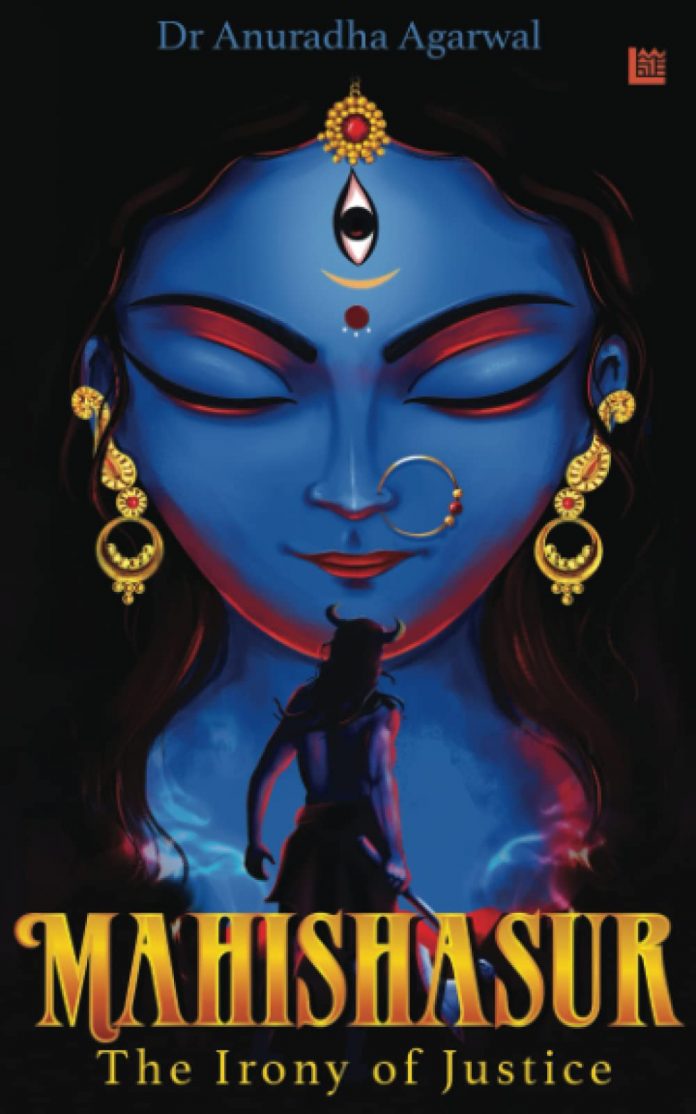
Title: Mahishasur: The Irony of Justice
Author: Dr. Anuradha Agarwal
Publisher: One Point Six Technologies Pvt Ltd
Genre: Mythology
First Publication: 2022
Language: English
Book Summary: Mahishasur: The Irony of Justice by Dr. Anuradha Agarwal
Is evil hereditary? Is righteousness a birth-right? Are the Gods guilty of favouritism and nepotism?
A discriminatory and divisive society often treacherously conspires against its brothers, turning them into loathsome creatures. Marginalized by a judgmental world and misguided by a vile Guru, Mahishasur becomes the tyrant he never wanted to be. On the other hand, Indra – the narcissistic, complacent King of Amaravati, faces the demons of his past and tries to rise above his petty insecurities and bloated vanity.
The central characters vacillate between the ambiguous values of morality and truth. The chasm between wrong and the wronged narrows drastically in this fast-paced, adrenaline-infused, and thought-provoking narrative. Blinded by malignant revenge, and seething with hatred, Mahishasur starts on the labyrinthine path towards elusive justice. He destroys the world and himself, till the tragic hero comes face to face with his invincible nemesis: the Divine Mother.
Will the absolute definitions of good and evil be rewritten by the Devi?
Will the merciful Mother pardon her fallen son?
Or will evil truly die, or will it expose its fangs again?
Book Review: Mahishasur: The Irony of Justice by Dr. Anuradha Agarwal
In Hindu mythology, Mahishasura was half human half buffalo and was the most powerful Asur of all time. He is infamous for being a sly demon who shape-shifts in order to pursue his nefarious goals. Since the Devas and the asuras were always at odds with one another, Mahishasura, in his capacity as an asura, waged war against the Devas. The boon that Mahishasura had received was that no man could kill him. In the conflicts that took place between the gods (devas) and the demons (asuras), Mahishasura was successful in defeating the devas, who were led by Indra. He was eventually killed by the goddess Durga, who used her Trishul to smite him to the ground.
“Mahishasur: The Irony of Justice” by Dr. Anuradha Agarwal retells this mythology from the standpoint of Mahishasur. The story begins with Mahishasur’s victory against Indra, and then it goes back in time to describe Mahishasur’s childhood and how he came to rule Paatal Lok as the Asur King. The narrative that is presented here is in no way exhaustive, yet it is an excellent way to get acquainted with the structure of the hierarchy that exists among the gods in mythology. And it’s quite complicated, with the most powerful individual not being the one who has assumed the leadership. Even though Indra is a powerful individual, he would be nothing without the gods who helped him in establishing his authority over the Indralok.
In this novel, Anuradha Agarwal chooses to focus on a figure from Hindu mythology that isn’t often depicted as the primary protagonist. This is similar to what many other writers have done with characters from the Ramayana and the Mahabharata. The narrative of the novel is structured around the significant turning points in Mahishasur’s life, with each section building upon the one that came before it in terms of intrigue. While each of these elements is fascinating in and of itself, the feature of this story that most intrigues me is not the plot but the method in which author Anuradha recounts the events that occur.
As for the cast of characters, we encounter gods and demons, humans and immortals, animals and monsters, and everything in between during the course of this book. We are presented with a wide range of characters, most of whom only appear for a short period of time (a few pages). But, do not let this daunt you, as it is not meant to remember everyone. It is inherent in the majority of mythologies for a large number of temporary figures to emerge and go, and as a result, for the enormous quantity of tales to meld together into hundreds of characters with as much variation as you can possibly conceive.
This well-known story is brought to life by Dr. Anuradha Agarwal in a manner that is neither condescending nor presumptuous, since she does not assume that the audience has any previous intellectual knowledge. She organises the book in such a manner that it can be appreciated by readers who have a deep knowledge of this mythology as well as others who are delving into it for the very first time, and this is a magnificent achievement on her part.







