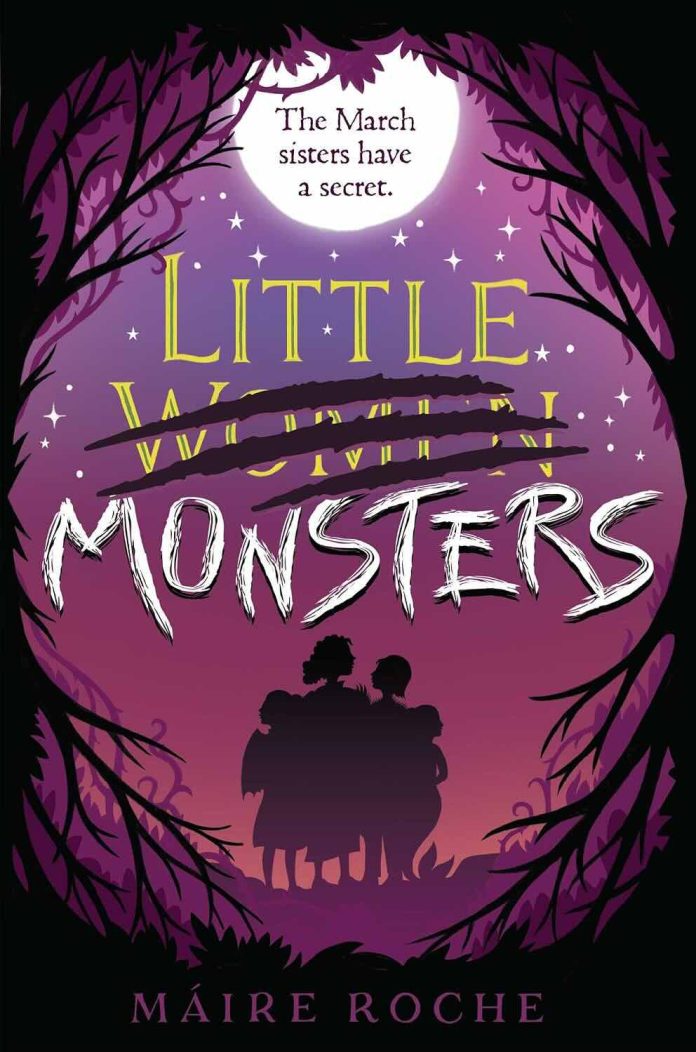
Every March sister has a rule. Jo goes furry when she is upset, and worse near a full moon. Beth grows bat wings at night and tends to fly off. Amy sprouts a fanged, fishy tail if she gets too close to salt water. And thirteen-year-old Meg, who is in charge of all of them, grows long twisted claws and a mouthful of sharp teeth whenever her feelings get too big, which is most of the time. Little Monsters by Máire Roche sets these rules out in its opening pages and then, in the week before Halloween in Salem, sets a real monster loose in the woods to see what happens when a girl who hides everything starts to wonder if the monster is her.
How Máire Roche Builds Her Salem
The four sisters have been in foster care since Meg was about four. They have moved between so many homes that Meg has learned the one rule that matters: be helpful, be quiet, and never give an adult a reason to send you away. Their new foster mother, Marmee, is kind, very tall and strangely hard to read. After six months with her, the girls have lasted longer in her cottage than anywhere in years, and Meg is waiting for it to end.
The plot is a monster hunt. Chickens are disappearing, a henhouse is shredded, and a local farmer offers a cash reward for proof. Meg needs the money, because she is secretly working next door to buy her sisters Halloween costumes. The trouble is that she keeps waking up in the forest with no memory of the night, moss under her nails and her shoes gone.
Meanwhile a new boy has moved in next door, John Brooke, known as Brooks. He is quiet, draws terribly, loves Van Gogh and notices far too much.
Readers who know the source will enjoy the game Roche is playing. Little Monsters by Máire Roche keeps almost every name from Little Women: Laurie and his gruff grandfather next door, Annie Moffat and Sally Gardiner as Meg’s classmates, the Hummels, and even a Farmer Bhaer. Brooks is Laurie’s tutor in the original, and the book finds a sly way to honour that on Halloween night. Children who have never heard of Alcott lose nothing, and adults reading along get a string of small jokes.
What Máire Roche Is Really Writing About
Beneath the spooky mystery, Little Monsters by Máire Roche is a book about being the eldest child in a family that has no one else to lean on. Meg notices what everyone likes for breakfast, mends Beth’s sweaters on a portable sewing machine, rescues Jo from “fur emergencies” in the school bathroom, and gives away her own toast. No foster parent has ever asked her what her favourite subject is.
Roche, a former teacher, turns anxiety into something visible. Meg’s claws come out when she panics and retreat when she breathes, and a new friend who quietly breathes alongside her becomes the first person who helps. The book’s argument is that holding everything in does not make feelings disappear. It makes them sharper. For young readers who recognise parentification from their own lives, even without the word, it will land hard.
It is also very good on how children in care are treated by adults who should know better. A pair of police officers single out the girls’ house for questions, a teacher shames Meg in front of the class, and Meg lists the foster parents who packed her belongings into a bin bag. None of it is preachy. It is simply what Meg expects.
What Works
- Meg herself. Prickly, funny, exhausted and deeply loyal, she carries the book and earns every reader’s sympathy.
- The sisters. Jo’s swearing and crushes-are-gross bravado, Beth’s quiet sensory needs, Amy’s influencer dreams: each one feels like a real kid.
- Marmee. A foster mother who notices, waits and hides Go-Gurts for the child who never gets one is the book’s quiet triumph.
- The mystery. In Little Monsters by Máire Roche the clues are fair, the misdirection is clever, and the reveal of the second monster makes sense of details planted early.
Where Máire Roche Gives Ground
- The middle loops. Meg hides her claws, lies, gets caught, snaps at someone and hides again, several times over. The pattern is the point, but it drags.
- The villains are broad. The worst adults in the book are cruel in obvious, cartoonish ways, which takes some edge off the horror.
- The world arrives late. Salem’s “seam cities” and its secret community are hinted at for most of the book, then explained in a single long conversation near the end.
- Brooks is almost too perfect. He is lovely, but a little more friction would have made the friendship, and the gentle crush, more interesting.
Read It If / Skip It If
Read Little Monsters by Máire Roche if:
- you want a Halloween book for eight to twelve year olds that is spooky rather than terrifying;
- you have a kid who takes care of everyone, or who was one;
- you love Little Women and want to see what a modern, monstrous version looks like.
Skip it if:
- your reader wants genuine horror with real scares;
- you prefer a tightly plotted mystery with no repetition;
- you are after a faithful retelling rather than a playful remix.
Content Notes
Content notes: foster care instability and fear of separation; panic attacks; an abusive parent who restricts a child’s food, locks her up and hits her; police officers intimidating a child; animal deaths, including chickens and a pet rabbit; a child badly bitten; an angry mob with torches. There is mild swearing, never spelled out. Little Monsters by Máire Roche keeps all of this at a middle-grade level.
Read These Next
Five for readers who finish Little Monsters by Máire Roche and want more:
- Little Women by Louisa May Alcott. The original March sisters, for readers ready to meet them.
- The Wish Switch by Lynn Painter. Another warm middle-grade story about family, friendship and wanting things to change.
- The Wondrous Tale of Lavender Wolfe by Karen Foxlee. A spirited heroine, a curse and a great many currant buns.
- Ramin Abbas Has MAJOR Questions by Ahmad Saber. For readers who liked Meg’s struggle to accept who she is.
- Small Spaces by Katherine Arden. A creepier autumn story for middle-grade readers who want the next step up in scares.
This appears to be Roche’s first novel for middle-grade readers.
The Verdict
The detail I keep coming back to is the peanut butter. Meg spreads it on her toast every morning, though she does not even like it, because Jo, always hungry and always late, will eat whatever she leaves. It is a tiny confession, and it sums up a girl who has spent so long giving things away that she has forgotten what she wants.
Little Monsters by Máire Roche repeats itself in the middle and saves too much explanation for the end. But it is spooky, funny and kind, with a heroine children will recognise and adults will want to hug. By the last page, Meg has learned to let her claws out and let people in, and she still has to work out which Halloween candy is her favourite.







