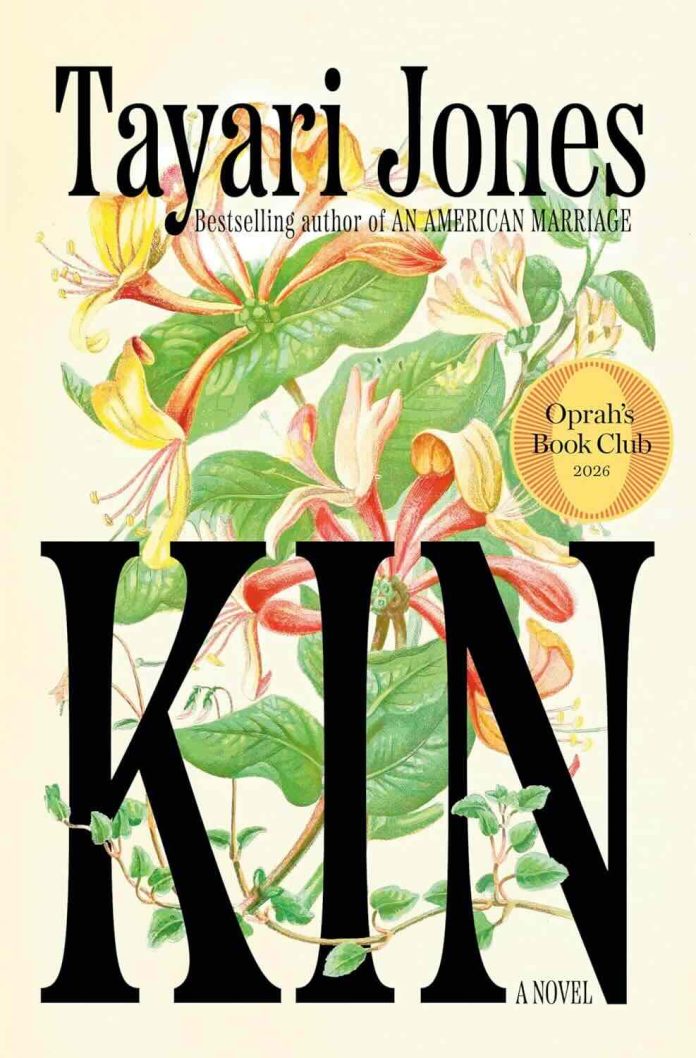
Seven years is a long time between novels. Seven years is long enough for a friendship to transform, for a woman to reinvent herself, for an entire country to change its mind about what it owes its people. Kin by Tayari Jones arrives after that kind of silence, and it arrives with the confidence of a writer who has spent those years listening rather than rushing. Jones, whose previous novels include the Oprah’s Book Club selection An American Marriage, the inventive Silver Sparrow, The Untelling, and Leaving Atlanta, has built a career on excavating the interior lives of Black Americans with surgical precision and enormous heart. With Kin, she reaches further back in time and deeper into the tangled roots of female friendship than she has ever gone before.
Set primarily in the 1950s and early 1960s, the novel follows two women raised side by side in Honeysuckle, Louisiana, a small Southern town whose name promises sweetness but delivers something far more complicated. Vernice, nicknamed Niecy, is reared by her formidable Aunt Irene after her mother is murdered by her father in a domestic horror that shadows the entire narrative without ever being exploited for shock. Annie, abandoned by her mother Hattie Lee before she was old enough to understand why, is raised by a devout grandmother whose love is real but whose understanding has limits. These two girls, rocked in neighboring cradles, become each other’s first and most enduring family.
Two Voices, Two Americas
The novel alternates chapters between Vernice and Annie, and the structural choice is far more than a formal exercise. Jones uses the dual narration to build a devastating portrait of how class, circumstance, and sheer luck can send two equally deserving women down radically different paths. Vernice earns a scholarship to Spelman College, marries into Atlanta’s Black elite, and finds herself navigating the politics of respectability with the careful footwork of someone who knows exactly how far she has to fall. Annie chases the ghost of her absent mother all the way to Memphis, where she tumbles into a world of juke joints, unreliable men, and a kind of hard-won wisdom that no college could teach.
What makes Kin by Tayari Jones remarkable is how neither path is presented as superior. Vernice’s life of limoncello afternoons with her mother-in-law and membership in secret societies is no less perilous, in its own way, than Annie’s life of mopping floors in a bar owned by a man who sees women as either profitable or disposable. Both women are navigating systems designed to consume them. Both are making choices with incomplete information and imperfect courage.
Language That Tastes Like the South
Jones writes with a lyricism rooted in Southern Black vernacular that makes nearly every page feel alive with texture and rhythm. Her sentences carry the cadence of front-porch storytelling, where a metaphor arrives not as decoration but as the most precise available truth. The epistolary sections, where Annie and Vernice exchange letters across the distance between their diverging lives, are among the novel’s finest achievements. These letters carry the weight of everything the women cannot say out loud, and Jones handles them with the restraint and emotional intelligence of a writer working at her peak.
The supporting cast is richly drawn as well. A few standout characters deserve mention:
- Babydoll, Annie’s fierce and foxy companion in Memphis, who fights with her fists and loves with a loyalty that asks nothing polite in return
- Mrs. McHenry, Vernice’s mother-in-law, whose warmth comes laced with the sharp pragmatism of a woman who built her life by knowing exactly which messes to avoid
- Joette and Marylinda, Vernice’s Spelman classmates, whose secrets and contradictions reveal the fault lines running through Atlanta’s Black bourgeoisie
- Mr. Daniel, the Honeysuckle barkeep whose refusal to be anyone’s father figure is both maddening and oddly principled
Where the Seams Show
For all its richness, Kin by Tayari Jones is not without its unevenness. The novel’s ambition occasionally outpaces its structural discipline. At times, the alternating chapters create a rhythm that feels more dutiful than organic, with certain transitions between Vernice’s Atlanta parlors and Annie’s Memphis honky-tonks arriving with the click of a metronome rather than the natural breath of a story finding its own pace. A few of Annie’s middle chapters, particularly those involving her repeated attempts to identify her mother among the women who wander into the Elektra bar, tread similar emotional ground without advancing the narrative with sufficient momentum.
There are moments, too, where the novel’s large cast works against its intimacy. Secondary characters appear with vivid introductions only to recede before they have fully earned their place in the reader’s memory. Clyde and Bobo, the men who carry Annie to Memphis, feel sketched rather than sculpted, and their departures from the story, while thematically resonant, lack the dramatic weight the plot seems to want them to carry. Jones is so gifted at interiority that her occasional shortcuts with external action feel especially conspicuous.
The pacing in the novel’s midsection also warrants mention. While the opening chapters crackle with energy and the final act builds toward a genuinely tense convergence, the middle third occasionally sags under the accumulated weight of letters, memories, and reflections that, beautiful as they are individually, sometimes delay the forward motion of the story.
The Architecture of Kinship
What ultimately elevates Kin by Tayari Jones beyond its structural imperfections is the depth of its central question: What makes someone your family? Jones refuses the easy answer. Blood, in this novel, is unreliable. Mothers kill or abandon. Fathers are absent, unknown, or dangerous. The families that actually sustain these women are built from stubbornness, proximity, and the particular kind of love that exists between two people who saw each other before they had language for what they were seeing.
The novel’s exploration of motherhood is layered and unsentimental. Consider its range of maternal figures:
- Aunt Irene, who never wanted children but raised Vernice with fierce competence
- Annie’s Granny, whose faith provides structure but whose rigidity cannot accommodate the mess of real life
- Hattie Lee, whose absence is the engine of Annie’s entire journey
- Mrs. McHenry, who offers Vernice the maternal warmth she craves, but always on terms that serve the McHenry family’s interests first
None of these women are villains. None are saints. Jones grants each of them the dignity of complication, and the novel is richer for it.
A Haiku for Honeysuckle
Two cradles, one song the road forks but the roots hold kin is what you keep
Final Impressions
Kin by Tayari Jones is an exuberant, emotionally generous novel that confirms Jones as one of the most essential voices in contemporary American fiction. It is not a perfect book. Its middle sags, its secondary male characters blur, and its structural symmetry occasionally feels constraining rather than liberating. But its imperfections are the imperfections of a novel that is trying to hold more life than most books dare attempt. When it works, and it works far more often than it stumbles, it achieves the rare quality of making you feel that you have lived inside another person’s skin.
This is a novel that understands something most fiction merely gestures at: that the people who save us are not always the people who were supposed to, and that the families we choose are no less sacred for being improvised.
If You Loved This, Try These
For readers captivated by the themes and voice of Kin, these novels offer kindred spirits:
- The Color Purple by Alice Walker, for its epistolary power and unflinching portrayal of Black women’s survival in the American South
- Homegoing by Yaa Gyasi, for its sweeping dual narrative tracing two branches of one family across generations
- An American Marriage by Tayari Jones, her previous masterwork exploring love, loyalty, and injustice in modern Atlanta
- Salvage the Bones by Jesmyn Ward, for its lyrical, storm-charged portrait of poverty, motherhood, and resilience in the rural South
- The Vanishing Half by Brit Bennett, for its examination of racial identity, sisterhood, and the divergent paths of two twins







