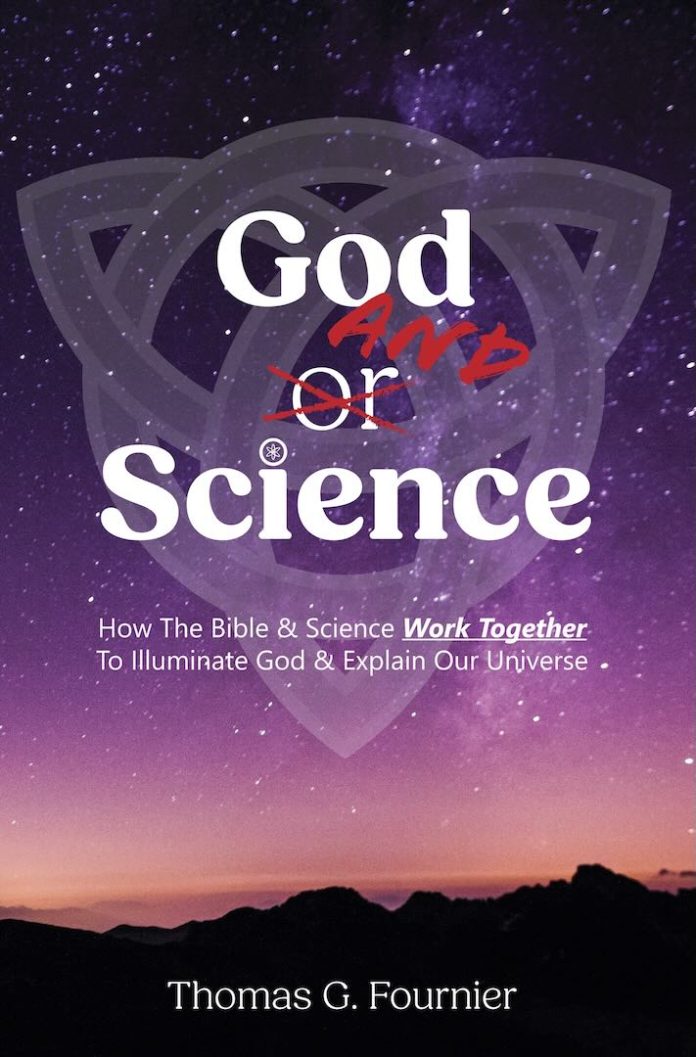
There is a quiet war being fought across pulpits and lecture halls, a war waged not with weapons but with assumptions. On one side stand the theologians who dismiss the sciences as threats to scripture. On the other, the scientists who wave away the Bible as ancient mythology. And caught in the middle are millions of ordinary people, told they must pick a side or be intellectually dishonest. Thomas G. Fournier refuses to accept that premise, and his book, God and Science by Thomas G G Fournier, makes a compelling case for why no one else should either.
Published in 2025 by TGiF Publishing, this work is not a devotional or a science textbook. It occupies the rare space in between, written by a man whose career trained him to dig beneath the surface and follow evidence wherever it leads. The result is a book that challenges conventional thinking on both sides of the faith-science divide, inviting readers to examine the evidence with fresh eyes and honest hearts.
The Author Behind the Argument
Thomas G. Fournier brings an unusual resume to the world of faith-based writing. Certified as a Professional Researcher and Writer by the National Security Agency, he spent over 25 years as a senior intelligence analyst, researcher, Korean linguist, and reporter across the NSA, the CIA, and the United States Marine Corps. This is not a man who trades in idle speculation. His analytical discipline and his deep commitment to verifiable evidence permeate every chapter of this book.
Previously, Fournier authored the science fiction thriller Ishtaq: The Second Vial, demonstrating his range as a storyteller. But with God and Science by Thomas G G Fournier, he turns his investigative acumen toward an infinitely more personal subject: reconciling his lifelong faith with the scientific discoveries that many claim contradict it. The personal thread running through the book, particularly Fournier’s account of how Dr. Gerald Schroeder’s The Science of God redirected his own intellectual journey, gives the narrative an authenticity that purely academic treatments often lack.
The Central Thesis: Two Instruction Manuals, One Author
At the heart of this book lies a deceptively simple idea. God has given humanity not one but two records through which to understand Him: His written Word, the Bible, which reveals the who, what, and why of creation, and the natural world, which reveals the when and how in far greater detail. Fournier argues that when these two records are examined honestly and in concert, they do not contradict each other. They converge.
This is the thread that holds every chapter together. Whether Fournier is dissecting the original Hebrew text of Genesis, walking readers through Big Bang cosmology, or examining the fossil record, he consistently returns to this central conviction. The perceived war between faith and science, he maintains, is a product of shallow examination on both sides rather than a genuine incompatibility in the evidence itself.
What makes God and Science by Thomas G G Fournier stand apart from many similar works is the disciplined way it builds this case. Fournier does not merely assert harmony between scripture and science; he systematically demonstrates it, chapter by chapter, subject by subject, with meticulous attention to both biblical scholarship and scientific data.
The Architecture of the Argument
The book unfolds across six substantive chapters and nine detailed appendices, each layering evidence upon the last.
Exposing the Deceit
Fournier opens by identifying the root problem: superficial examination of the evidence, on both sides. He takes aim at the Darwinian evolution propaganda machine with its repeated treatment of a largely disproven theory as established fact, and equally at theologians who dismiss scientific evidence that, properly understood, would actually strengthen the case for a Creator. His dissection of how the fossil record contradicts the core predictions of Darwinian evolution is particularly incisive:
- Life appeared on Earth as soon as conditions permitted, not after billions of years of random assembly
- The Cambrian Explosion introduced staggeringly complex multicellular organisms overnight, with no transitional forms
- After nearly two centuries of excavation worldwide, the transitional fossils that Darwin predicted simply do not exist
He pairs this with an equally sharp analysis of the odds against random protein assembly, drawing on the work of Stephen Meyer, Gerald Schroeder, and Martin Rees to demonstrate that the spontaneous origin of life through naturalistic processes is, for all practical purposes, statistically impossible.
The Biblical Text: Deeper Than We Thought
One of the book’s most intellectually rewarding sections is Fournier’s linguistic analysis of the original Hebrew text of Genesis. He draws critical distinctions between the Hebrew words bara (to create from nothing), asah (to make from existing material), and yatsar (to form or fashion), revealing layers of meaning that are invisible in English translations. This analysis leads to a remarkable conclusion: the grammar of Genesis 1:1-2 itself indicates a passage of time of unknown duration before God’s first formative command in verse 3.
Fournier further examines the Hebrew words erev (evening, meaning disorder) and boker (morning, meaning order) as used in the Genesis creation account. Rather than marking literal 24-hour periods, he argues, these terms describe the flow from a state of chaos to a state of arrangement, a reading that is consistent with both ancient Jewish scholarship and modern cosmological observation.
The Age of the Universe
God and Science by Thomas G G Fournier devotes substantial attention to the contentious question of whether the universe is young or ancient. Fournier respectfully but firmly challenges the Young Earth position, not by dismissing biblical authority, but by demonstrating that the Bible itself provides significant evidence for an ancient universe. He is careful to note that the Bible makes no direct claim about the age of the cosmos; the commonly cited figure of roughly 6,500 years is a human estimate derived from genealogies, not a scriptural declaration.
His argument here is built on multiple pillars:
- The Hebrew grammar of Genesis 1:1-2 indicates a gap of unknown duration before the creative days begin
- The word yom, consistently translated as “day,” is rarely used to indicate a literal 24-hour period elsewhere in scripture
- The specific sequence of creation events in Genesis aligns with what cosmology, geology, and paleontology reveal about formation over vast timescales
- A God who cannot deceive would not fill His creation with overwhelming evidence of antiquity if the universe were truly young
Megalithic Mysteries and Ancient Builders
Perhaps the book’s most unexpected and thought-provoking chapter examines the mysterious megalithic structures scattered across the globe, from the precision-cut stones of Puma Punku to the massive walls of Sacsayhuaman. Drawing on the work of Graham Hancock and others, and referencing the Book of Enoch, the Book of the Giants, and the Book of Jasher alongside canonical scripture, Fournier proposes that these structures were built by fallen angels and their giant offspring, the Nephilim, beings who possessed superior heavenly knowledge and extraordinary physical strength. This chapter will challenge even sympathetic readers, yet Fournier presents his case with the same careful documentation he applies to every other claim in the book, grounding it firmly in both biblical text and physical evidence.
Creation Day by Day
The fifth chapter walks readers through each of the six creative days of Genesis, comparing the biblical description with the corresponding scientific evidence. The alignment is, as Fournier suggests, too precise and too consistent to be coincidental. From the initial singularity and expansion of the universe, through the separation of light and darkness, the emergence of an atmosphere, the appearance of dry land and plant life, the clearing of the skies, and the sudden eruption of animal life in the seas and on land, the sequence described in Genesis matches the sequence confirmed by modern science.
The Fine-Tuning of the Universe
The final chapter addresses the astonishing precision with which the physical laws and constants of the universe are calibrated. Fournier surveys the testimony of prominent scientists, including Anthony Flew, Fred Hoyle, Paul Davies, and even reluctant witnesses like Richard Dawkins and Stephen Hawking, all of whom have acknowledged the overwhelming appearance of design in the cosmos. He frames the fine-tuning argument as perhaps the strongest single piece of evidence for a Creator, noting that the odds of even a handful of universal parameters aligning by chance are so vanishingly small as to be effectively impossible.
Writing Style and Readability
Fournier writes with the clarity and directness of a seasoned intelligence analyst. His prose is purposeful and accessible, free of unnecessary jargon, and structured to build understanding progressively. He has a gift for analogy: his comparison of amino acid assembly to cracking a combination lock with 10^77 possible configurations is the kind of image that lodges in the mind and refuses to leave. He is also refreshingly candid, acknowledging the limits of his own knowledge, inviting correction where warranted, and confessing to moments of intellectual laziness with a self-deprecating humor that makes the book feel like a conversation rather than a lecture.
The inclusion of extensive appendices, covering everything from the Four Beasts of Daniel to a detailed index of biblical references to fallen angels and giants, reflects Fournier’s desire to let readers verify his claims for themselves. It is the work of someone who respects his audience enough to show them the evidence rather than simply asking for trust.
God and Science by Thomas G G Fournier is not a book that demands agreement on every point. It is a book that demands engagement. It asks readers, whether believers or skeptics, to lay aside their preconceptions and examine the evidence with open minds. For those willing to do so, the rewards are substantial.
Who Should Read This Book
This book is ideal for readers who find themselves caught between faith and reason, for Christians who have been told that science is the enemy, for scientifically minded skeptics who have never encountered a rigorous biblical case for a Creator, and for anyone who values truth over tribal loyalty. It is accessible enough for a general audience yet substantive enough to challenge the well-read. Whether or not every reader agrees with every conclusion, God and Science by Thomas G G Fournier earns the right to be taken seriously by the seriousness with which it treats both scripture and science.
Similar Books You May Enjoy
If this book resonates with you, consider exploring these related works that occupy similar intellectual territory:
- The Science of God by Gerald Schroeder — the book that Fournier credits as the catalyst for his own journey, examining the convergence of biblical and scientific wisdom regarding the origins of the universe and life
- Darwin’s Doubt by Stephen C. Meyer — a detailed examination of the Cambrian Explosion and its implications for Darwinian evolution, written by one of the foremost proponents of intelligent design
- A Fortunate Universe by Geraint F. Lewis and Luke A. Barnes — an accessible and thorough exploration of the fine-tuning of the universe and its philosophical implications
- The Goldilocks Enigma by Paul Davies — an investigation into why the universe appears to be precisely calibrated for the emergence of life
- There Is a God by Anthony Flew — the story of one of the world’s most prominent atheists and how the scientific evidence eventually changed his mind
- A Matter of Days by Hugh Ross — a biblical and scientific case for an old Earth that respects the authority of scripture
- The Privileged Planet by Guillermo Gonzalez and Jay W. Richards — an argument for intelligent design drawn from astronomy and planetary science
- Fingerprints of the Gods by Graham Hancock — an exploration of megalithic structures and lost civilizations that raises many of the same questions Fournier addresses in Chapter Four
We have reviewed The Power of Paradox by Kamlesh D. Patel too, if another religious and spirituality book is what you are after.







