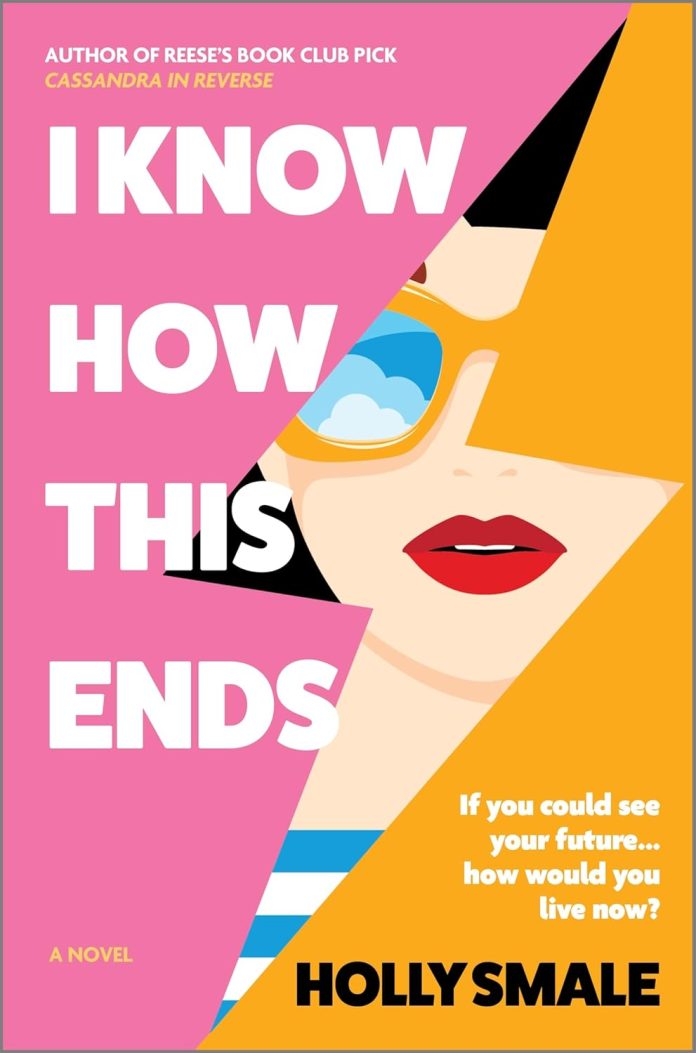
Holly Smale’s latest offering, “I Know How This Ends,” poses a question that haunts every romantic: if you could see your future unfold before your eyes, would you still choose to live it? Following her acclaimed “Cassandra in Reverse,” Smale once again ventures into the complex territory where magical realism meets contemporary romance, delivering a narrative that’s both deeply human and wonderfully otherworldly.
Margot Wayward—whose surname feels like both warning and prophecy—emerges as one of the most compelling protagonists in recent romantic fiction. A meteorologist whose life has been as unpredictable as the weather she studies, Margot is reeling from a devastating betrayal. After catching her fiancé Aaron with her bridesmaid Lily just hours before their wedding, she’s rebuilt herself as an Instagram meteorologist, channeling her rage into destroying unsuitable men on dating apps with scientific precision.
The Gift That Feels Like a Curse
When Margot begins experiencing visions of herself with Henry, a single father she’s never met, the story transforms from a simple post-breakup revenge tale into something far more sophisticated. These aren’t daydreams or wishful thinking—they’re disturbingly accurate glimpses of a potential future where she and Henry share a life, complete with his daughter Winter, a yellow kitchen, and inexplicably, a cat named Cheddar.
Smale’s handling of the supernatural elements demonstrates remarkable restraint. Rather than drowning the narrative in mystical explanations, she treats Margot’s visions as both burden and gift. The meteorologist in Margot approaches these phenomena with scientific skepticism, while the woman desperately seeking connection finds them both terrifying and oddly comforting. This duality creates a tension that propels the entire narrative forward.
The author’s meteorological background (she’s clearly done her research) adds layers of authenticity to Margot’s character. Weather becomes a metaphor for emotional states—unpredictable, sometimes destructive, but following patterns if you know how to read them. Margot’s ability to predict storms mirrors her supernatural gift, creating elegant thematic coherence.
Love in the Time of Foreknowledge
What elevates this novel beyond typical romantic fare is its sophisticated exploration of agency versus destiny. When Margot meets Henry—exactly as she’s foreseen—the story confronts fundamental questions about free will. Can you truly fall in love when you’ve already seen yourself in love? Is choice meaningful when the outcome appears predetermined?
Henry emerges as a beautifully realized character, far from the typical romantic hero archetype. As a single father and GP, he’s practical, grounded, and refreshingly skeptical of Margot’s claims about their future. His relationship with his seven-year-old daughter Winter provides some of the novel’s most tender moments, while also serving as a crucial test for Margot’s character development.
The evolution of their relationship feels genuine despite the supernatural framework. Smale avoids the trap of letting the visions drive all character development; instead, she shows how Margot and Henry must choose each other repeatedly, vision or no vision. Their conflicts feel earned rather than manufactured, particularly when Margot’s knowledge of their future creates rather than solves problems.
The Complex Reality of Blended Families
One of the novel’s greatest strengths is its nuanced portrayal of stepfamily dynamics. Through Margot’s visions of teenage Winter—angry, resentful, and clearly struggling with her father’s relationship—Smale acknowledges that love doesn’t automatically create harmony. The scenes where Margot glimpses Winter’s future hostility are among the most emotionally resonant in the book, showing how prescience can be as much curse as blessing.
Winter’s character arc, spanning from adorable seven-year-old to troubled teenager, provides emotional weight that grounds the fantastical elements. Smale doesn’t shy away from showing that even the most well-intentioned relationships can create pain, and that knowing something is coming doesn’t necessarily make it easier to handle.
Where Science Meets Heart
Smale’s prose style perfectly balances Margot’s analytical nature with her emotional vulnerability. The meteorological details never feel forced or excessive, instead serving to illuminate character and theme. Margot’s Instagram career as @MargotTheMeteorologist provides both comic relief and genuine insight into how we perform our identities online.
The supporting characters, particularly Margot’s friends Eve and Jules, and her grandfather, add depth to what could have been a claustrophobic two-person narrative. Margot’s grandfather, in particular, serves as the story’s emotional anchor—his unconditional love and gentle wisdom providing the foundation that allows Margot to risk loving again.
Minor Storms in Paradise
While “I Know How This Ends” succeeds admirably in most areas, it occasionally struggles under the weight of its own ambitions. Some of the dating app sequences, while initially entertaining, eventually feel repetitive and begin to slow the narrative momentum. The revenge-through-dating subplot, though understandable given Margot’s emotional state, sometimes seems at odds with the story’s deeper themes about healing and growth.
Additionally, certain aspects of the magical realism could benefit from slightly more development. The rules governing Margot’s visions remain somewhat unclear throughout, which works for the sense of mystery but occasionally leaves readers feeling unmoored alongside the protagonist.
The novel’s exploration of social media fame and the pressures of maintaining an online persona, while relevant, sometimes feels underdeveloped compared to the richer themes of destiny and choice. There’s material here for deeper examination of how we curate our lives for public consumption, but it remains largely on the surface.
The Verdict: A Storm Worth Weathering
Despite these minor criticisms, “I Know How This Ends” succeeds brilliantly at what it sets out to do. Smale has crafted a novel that respects both the fantasy and reality of love—acknowledging that even when you can see the future, living it requires courage, choice, and faith.
The book’s greatest achievement is its refusal to provide easy answers. Margot’s visions show her glimpses of joy and pain in equal measure, forcing her to choose whether the life she’s seen is worth the heartbreak she knows is coming. This central tension—between the safety of knowledge and the courage required to live fully—resonates long after the final page.
For readers who enjoyed Smale’s earlier work, this novel represents a clear evolution in both scope and emotional sophistication. The author’s background in young adult fiction serves her well here, bringing clarity and accessibility to complex themes without sacrificing depth or nuance.
Perfect Reading Weather
“I Know How This Ends” will appeal most strongly to readers who appreciate romantic fiction that asks bigger questions. It joins the ranks of novels like “The Time Traveler’s Wife” and “Oona Out of Order” in using speculative elements to examine fundamental truths about love, loss, and the courage required to remain open to connection despite the certainty of eventual pain.
This is ultimately a novel about learning to live with uncertainty while making peace with what we cannot control. Margot’s journey from bitter weather predictor to someone willing to step into an uncertain future provides hope for anyone who has ever wondered whether it’s worth risking everything for love.
Like the weather Margot studies so obsessively, love in this novel is presented as a force both predictable and surprising, dangerous and life-giving. Smale suggests that perhaps the question isn’t whether we can change our destiny, but whether we can find the courage to choose it, again and again, until it becomes indistinguishable from our own will.
Similar Reads to Consider
Readers who enjoyed “I Know How This Ends” might also appreciate:
- “Cassandra in Reverse” by Holly Smale – Smale’s previous exploration of time manipulation and neurodiversity
- “The Midnight Library” by Matt Haig – Another examination of life’s infinite possibilities
- “The Time Traveler’s Wife” by Audrey Niffenegger – Classic romantic magical realism with time elements
- “Oona Out of Order” by Margarita Montimore – A unique take on time and destiny in love
- “The Invisible Life of Addie LaRue” by V.E. Schwab – Romance with supernatural consequences
- “Beach Read” by Emily Henry – Contemporary romance with emotional depth
- “The Seven Husbands of Evelyn Hugo” by Taylor Jenkins Reid – Complex relationships and second chances
“I Know How This Ends” stands as a remarkable achievement in contemporary romantic fiction—a book that trusts its readers to grapple with complex questions while delivering the emotional satisfaction that makes the genre so enduringly popular. Sometimes the best love stories are the ones that ask us not just whether we’ll get our happy ending, but whether we’ll have the courage to choose it when it’s offered.







