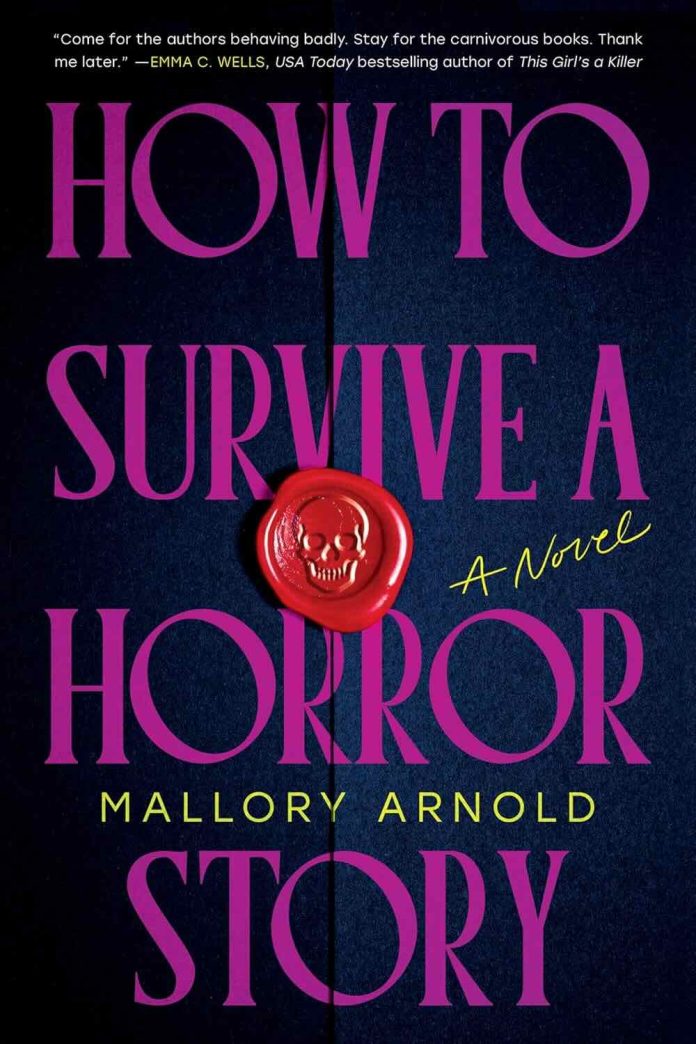
Mallory Arnold’s debut novel arrives like an uninvited guest at a dinner party—unexpected, unsettling, and impossible to ignore. How to Survive a Horror Story transforms the familiar trope of writers gathering in a mysterious manor into something far more sinister and psychologically complex than its premise initially suggests.
The novel follows seven aspiring and established authors who receive invitations to the will reading of legendary horror writer Mortimer Queen. Each harbors their own dark secrets and complicated relationships with the deceased literary icon. What begins as a seemingly straightforward inheritance gathering quickly descends into a deadly game of survival when the writers discover they’re trapped in Queen’s manor—a house that literally feeds on human flesh and won’t release them until they solve a series of increasingly perilous riddles.
A Manor Built on Bones and Betrayal
Arnold demonstrates remarkable skill in establishing atmosphere from the opening pages. The Queen manor emerges as more than mere setting; it becomes a character unto itself, complete with hundreds of grandfather clocks that chime in eerie unison, portraits of long-dead inhabitants whose eyes seem to follow visitors, and rooms that shift and change according to their occupants’ darkest fears. The author’s description of the house feels genuinely alive—breathing, watching, and most disturbingly, hungry.
The manor’s supernatural elements never feel arbitrary or over-the-top. Instead, Arnold grounds the horror in psychological realism, making readers question whether the house’s malevolence stems from supernatural forces or the collective guilt and paranoia of its trapped occupants. This ambiguity serves the story well, creating an atmosphere where both explanations feel equally plausible and terrifying.
Seven Sinners, Seven Stories
The ensemble cast represents Arnold’s greatest strength and most significant challenge. Each character arrives with carefully constructed backstories that slowly unfold through flashbacks and revelations:
Melanie Brown, the struggling writer who serves as our primary protagonist, undergoes the most dramatic transformation. Initially portrayed as meek and forgettable, she evolves into something far more complex and morally ambiguous. Arnold’s decision to have Melanie narrate large portions of the story proves inspired, as readers witness her gradual awakening to her own capacity for manipulation and violence.
Scott Clay, the bestselling thriller writer with anger management issues, embodies toxic masculinity wrapped in literary success. His volatile relationship with the other characters creates constant tension, though Arnold occasionally relies too heavily on his explosive temper as a plot device.
Chester Plumage, the horror writer who thrives on fear, represents perhaps the most successfully realized character. His genuine enthusiasm for the terror surrounding him creates darkly comic moments while highlighting the thin line between enjoying horror fiction and embracing real-world violence.
The supporting characters—Buck (the folksy Western writer), Winnie (the literary fiction author), Crystal (the romance novelist), and Petey (the plagiarizing wannabe)—each receive enough development to feel distinct, though some suffer from occasional stereotyping.
Riddles, Revelations, and Retribution
The novel’s structure revolves around seven rooms, each containing a riddle that must be solved to progress. This game-like progression creates natural pacing and builds tension effectively. Arnold excels at crafting puzzles that feel both solvable and genuinely challenging, avoiding the trap of making solutions either too obvious or impossibly obscure.
However, the riddle mechanics occasionally feel mechanical rather than organic to the story. Some solutions rely heavily on wordplay that may not land for all readers, and certain revelations about characters’ past crimes feel more convenient than carefully foreshadowed.
The Price of Ambition
Where Arnold truly succeeds is in exploring the moral corruption that can accompany literary ambition. Each character has committed some form of betrayal—plagiarism, exploitation, violence—in pursuit of their writing dreams. The manor serves as both literal prison and metaphorical purgatory where these sins must be confronted.
The novel’s examination of how writers exploit real people and experiences for their craft feels particularly relevant in contemporary discussions about artistic ethics. Melanie’s ultimate transformation into someone willing to literally kill for her stories provides a chilling commentary on unchecked ambition.
Technical Craftsmanship and Style
Arnold’s prose strikes an effective balance between accessibility and sophistication. Her writing style adapts subtly to match each character’s perspective, with Melanie’s sections becoming progressively more confident and predatory as her character develops. The author demonstrates particular skill in action sequences and moments of psychological tension.
The pacing occasionally stumbles during exposition-heavy flashback sequences, and some character revelations feel rushed in the novel’s final act. Additionally, certain secondary characters could benefit from more development beyond their archetypal roles.
Comparative Context and Literary Merit
Arnold successfully blends elements from classic works like The Fall of the House of Usher with contemporary locked-room mysteries such as Everyone in My Family Has Killed Someone. The novel also draws clear inspiration from Agatha Christie’s ensemble mysteries while adding distinctly modern horror sensibilities.
How to Survive a Horror Story shares DNA with recent horror novels that examine toxic creativity, such as Mexican Gothic by Silvia Moreno-Garcia and The Seven Husbands of Evelyn Hugo by Taylor Jenkins Reid, though Arnold’s focus remains more squarely on the horror genre’s tropes and conventions.
Final Verdict: A Promising Debut with Sharp Teeth
How to Survive a Horror Story succeeds as both an entertaining horror novel and a thoughtful examination of literary ambition gone wrong. Arnold demonstrates impressive command of atmosphere, character development, and thematic complexity for a debut author. While the novel occasionally stumbles with pacing and some characters feel underdeveloped, its strengths far outweigh its weaknesses.
How to Survive a Horror Story works exceptionally well as a Halloween read, delivering genuine scares while maintaining enough psychological depth to satisfy readers seeking more than simple thrills. Arnold has created a story that will particularly resonate with anyone involved in writing communities, though its themes of ambition, betrayal, and moral compromise speak to broader human experiences.
Recommended for Readers Who Enjoyed:
- The Silent Companions by Laura Purcell
- Mexican Gothic by Silvia Moreno-Garcia
- Everyone in My Family Has Killed Someone by Benjamin Stevenson
- The Thursday Murder Club by Richard Osman
- The Midnight Feast by Lucy Foley
- The House in the Cerulean Sea by TJ Klune (for ensemble character dynamics)
- Rebecca by Daphne du Maurier
- And Then There Were None by Agatha Christie
Content Considerations
Readers should be aware that the novel contains violence, psychological manipulation, references to past trauma, and morally ambiguous characters. The horror elements are more psychological than gore-focused, though there are several genuinely disturbing scenes involving the manor’s supernatural hunger.
How to Survive a Horror Story announces Mallory Arnold as a writer to watch in the horror genre. While not perfect, it’s a confident and engaging debut that suggests even greater things to come from this promising new voice. For readers seeking intelligent horror that questions the nature of storytelling itself, Arnold’s manor awaits—just remember to bring your wits, and perhaps prepare to question your own moral boundaries along the way.







