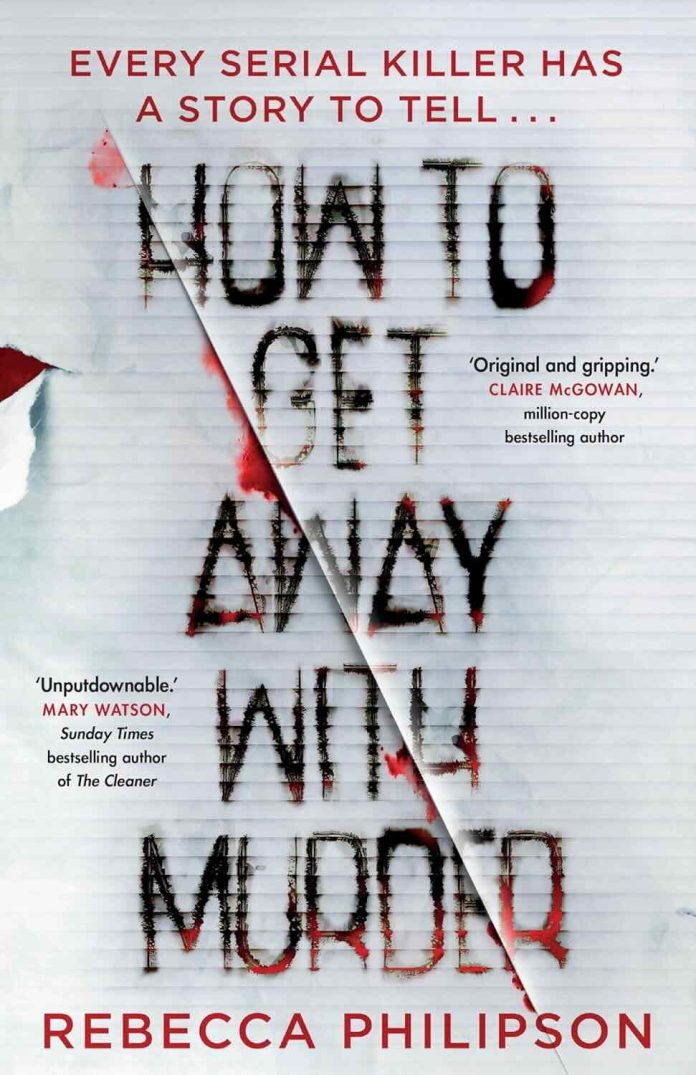
There is something deeply unsettling about a book that opens with a serial killer speaking directly to you, warmly, almost collegially, as though murder were merely a vocation you hadn’t yet considered. And there is something equally thrilling about a detective who walks toward that darkness when every sensible bone in her body is screaming at her to stay home with the chocolate Hobnobs and reruns of Only Fools and Horses.
How to Get Away with Murder by Rebecca Philipson is a debut thriller that arrives with the confidence of a novelist who has been sharpening her craft for years in quieter rooms. Published by Minotaur Books (St. Martin’s Publishing Group) and Bantam (Transworld), this is a book that does something genuinely unusual in the crowded crime-fiction market: it makes the reader complicit. Not merely a spectator, but a student enrolled in Denver Brady’s masterclass of murder. And that discomfort — the queasy thrill of being addressed as a “budding killer” — is precisely the engine that drives this story forward with relentless, uncomfortable momentum.
The Woman Behind the Warrant Card
At the heart of How to Get Away with Murder by Rebecca Philipson is Detective Inspector Samantha Hansen, and she is not the polished, quip-ready protagonist that crime fiction often defaults to. Sam is a woman held together by Prozac, oversized Nordic sweaters, and a fierce, stubborn refusal to let a fourteen-year-old girl become just another unsolved case file. She returns to New Scotland Yard after a six-month absence following a breakdown triggered by workplace sexual assault — an experience Philipson handles with restraint and unflinching honesty, never exploiting Sam’s trauma for cheap sympathy but allowing it to inform every tremor of her hands, every salty taste that floods her mouth when panic arrives uninvited.
Sam’s vulnerability is her strength, and Philipson seems to understand this paradox instinctively. The detective is overweight, under-showered, and arrives at work in unwashed leggings because none of her old suits fit anymore. She is also, without question, the most capable investigator on the fourth floor. This tension between fragility and formidable intelligence gives the novel a beating human heart that many thrillers in this genre desperately lack.
The Devil’s How-To Manual
The dual-narrative structure is where the novel truly distinguishes itself. Alternating between Sam’s investigation and Denver Brady’s self-help chapters — complete with numbered lists of serial-killer mistakes and darkly comic asides about writing to Dulux paint company to match the colour of drying blood — Philipson creates a reading experience that is both procedural and perversely instructional.
Denver’s voice is magnetic, cultured, and chilling in its casual arrogance. He quotes Dickens. He mourns his dead dog. And he carves initials into oak trees like a lovesick schoolboy. And he kills with methodical, emotionless precision. The book-within-a-book conceit could easily have become gimmicky, but Philipson wields it with intelligence, using Denver’s chapters not merely as shock-value interludes but as genuine clues that mirror and illuminate Sam’s investigation.
London as a Living, Breathing Character
Philipson writes London with the intimacy of someone who understands that the city is not one place but a thousand overlapping worlds:
- The shaded secrecy of Holland Walk, where vegetation spills over fences and few women would walk alone after dark
- The grand but sticky-carpeted mundanity of New Scotland Yard’s fourth floor, where fridge theft is commonplace among homicide detectives
- Holland Park itself, reimagined as both a pastoral haven and a crime scene, its great oak trees standing witness to innocence destroyed
These details never feel ornamental. They breathe. They create a London that smells of chlorine and old perfume and bus-stop rain, and they anchor the thriller’s more extreme plot turns in a world that feels stubbornly, recognizably real.
The Web of Deception
Without venturing into spoiler territory, the investigation that unfolds in How to Get Away with Murder by Rebecca Philipson is a layered puzzle involving a murdered schoolgirl named Charlotte Mathers, a viral self-help book penned by a self-proclaimed serial killer, and a supporting cast that includes Sam’s godfather and boss DCI Harry Blakelaw, her sharp young trainee Adam Taylor, and a constellation of suspects who are never quite what they seem.
What impresses most is Philipson’s refusal to take the obvious path. The novel asks readers to hold multiple possibilities in tension simultaneously — is Denver Brady real or fictional? Is the book at the crime scene a clue or a red herring? And crucially, who is truly capable of murder? The answers, when they arrive, are satisfying not because they are shocking (though some genuinely are) but because they feel earned, rooted in character rather than contrivance.
What Works Brilliantly
- Sam’s interiority — Philipson grants her protagonist a rich, sometimes contradictory inner life that never simplifies mental illness into a plot device or a personality quirk
- The pacing — Denver’s chapters function as pressure valves, releasing tension from Sam’s investigation only to replace it with a different, more insidious kind of dread
- The humour — Dark, dry, distinctly British, and never deployed at the expense of the novel’s emotional stakes
- The thematic ambition — Beneath the procedural surface, this is a novel about violence against women, institutional failure, the limitations of justice, and what happens when the system’s best detective decides that the system itself is insufficient
Where the Seams Show
No debut is flawless, and How to Get Away with Murder by Rebecca Philipson occasionally stretches credulity in its later chapters. Certain plot mechanics require characters to behave with a level of strategic brilliance that borders on omniscience, and one key subplot involving a domestic violence case, while emotionally powerful, introduces a tonal shift that doesn’t quite harmonize with the central investigation. The resolution of who killed Charlotte, while cleverly foreshadowed, arrives somewhat abruptly after the slower, more deliberate build of the first two acts.
Denver Brady’s chapters, too, occasionally teeter between genuinely menacing and slightly over-written. His literary references and philosophical asides, while characterful, sometimes slow the momentum of what should be relentless, creeping tension. A tighter editorial hand in these sections would have sharpened the blade further.
Additionally, a few of the secondary characters — particularly DI Tina Edris — feel underserved by the narrative, sketched rather than fully drawn. Given the novel’s ambition in every other department, these feel like missed opportunities rather than fatal flaws.
A Debut That Announces a Major Voice
How to Get Away with Murder by Rebecca Philipson is a remarkably assured first novel. Philipson, who grew up in County Durham, holds a First Class Honours degree from Northumbria University, completed the prestigious UEA Creative Writing master’s program, and has won scholarships and business awards alike. That breadth of experience — academic rigour married to real-world grit — is evident on every page. This is not a novel written by someone imitating crime fiction; it is written by someone who understands its bones and has decided to rearrange them.
For a debut, the confidence is striking. Philipson handles dual timelines, an unreliable narrator, procedural detail, and emotional complexity with the assurance of someone who has been telling stories for far longer than her bibliography suggests. Crime fiction readers looking for their next obsession would do well to remember her name.
If You Loved This, Try These
For readers who devoured How to Get Away with Murder by Rebecca Philipson and are hungry for more, consider the following recommendations that share its DNA in different, compelling ways:
- The Maid by Nita Prose — A murder mystery with an unconventional protagonist whose worldview reframes everything the reader assumes about guilt and innocence
- The Appeal by Janice Hallett — A British crime novel told entirely through documents, emails, and messages, playing brilliantly with form just as Philipson does
- In a Dark, Dark Wood by Ruth Ware — A taut psychological thriller with a protagonist haunted by past trauma who must confront danger head-on
- The Thursday Murder Club by Richard Osman — For readers who loved Philipson’s dark British humour woven into a genuine whodunit
- Notes on an Execution by Danya Kukafka — A crime novel told partly from a killer’s perspective, exploring violence against women with devastating intelligence (notably, Kukafka also served as the agent who brought Philipson’s book to North America)
Final Verdict
Rebecca Philipson has written a thriller that refuses to play it safe. It is occasionally imperfect, sometimes overambitious, and absolutely unputdownable. Sam Hansen is the kind of detective you want to follow into the dark — not because she guarantees safety, but because she refuses to pretend the dark isn’t there. This is crime fiction with teeth, a conscience, and a wickedly sharp sense of humour. The genre just got a little more dangerous.







